
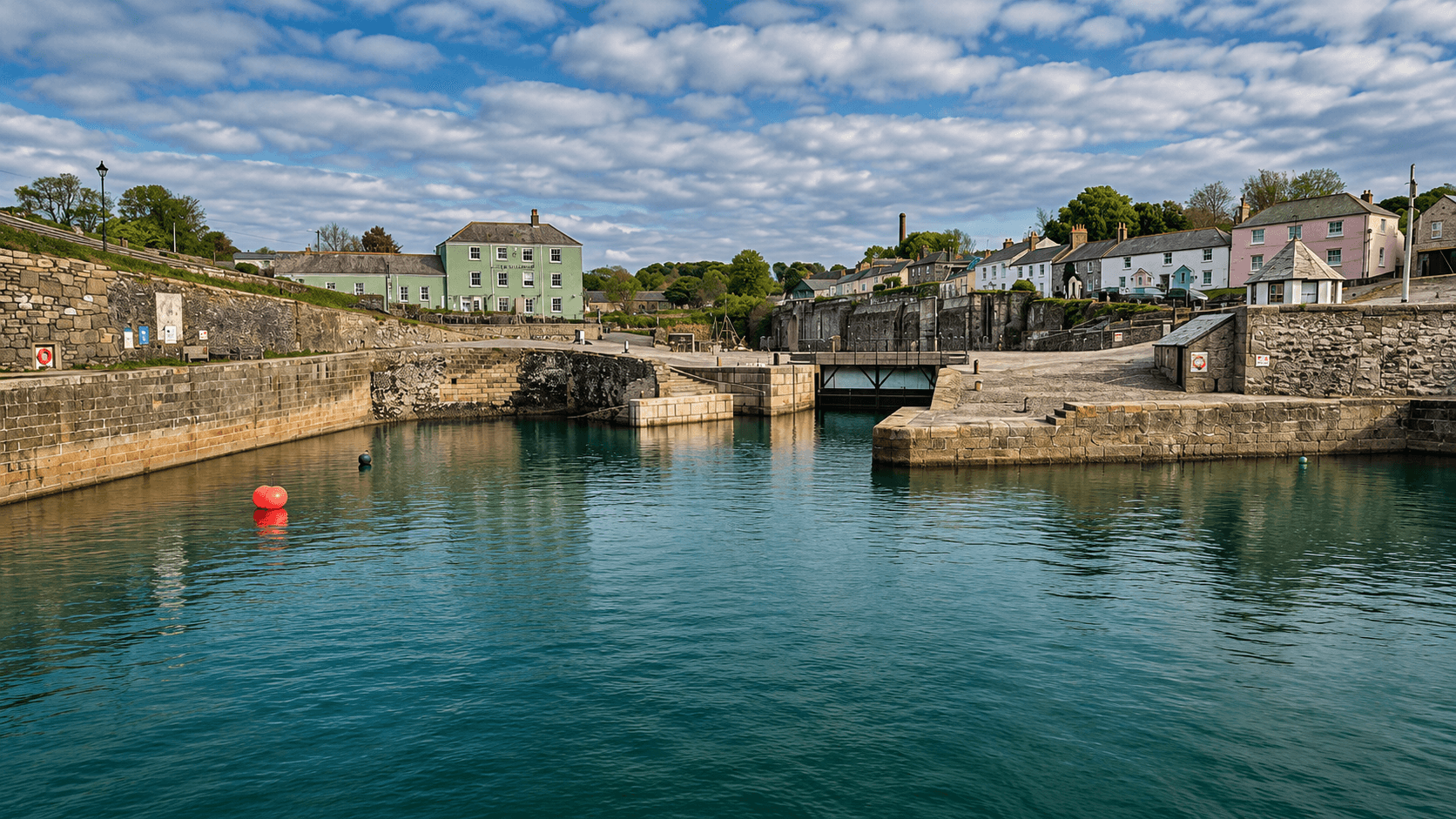
Walk down towards Charlestown Harbour today and it’s easy to see why film crews keep coming back. The granite quays, old harbour buildings and traditional sailing ships make it look as though somebody has managed to keep a little piece of Georgian Cornwall intact.
But Charlestown wasn’t built to look beautiful, attract tourists or provide a backdrop for television dramas. It was built to make money.
More than 200 years ago, this little stretch of coastline near St Austell was transformed into an industrial port. Copper ore and china clay left Cornwall aboard its ships, while coal and other supplies arrived to support the mines and industries developing inland. The harbour was a busy workplace, with ships, wagons, warehouses and workers handling heavy cargo.
Today, many people recognise it from Poldark and other film and television productions. Yet the reason Charlestown looks so convincing on screen has everything to do with the industrial harbour that came before.
And there’s a fascinating twist to its history. The features that eventually made Charlestown unsuitable for modern commercial shipping helped preserve the very character that makes it famous today.
Before Charlestown, there was a tiny fishing hamlet
Go back to the late eighteenth century and Charlestown as we know it didn’t exist. The settlement was known as West Polmear, sometimes called Lower Polmear, and consisted of a small fishing community with only a handful of cottages beside the shore.
There was no substantial harbour, no enclosed inner dock and none of the granite quays that now make Charlestown so recognisable. Fishing boats operated from the little cove, but the shoreline offered limited protection when the weather turned. Small vessels could be brought onto the beach at suitable tides, with goods loaded and unloaded using horse-drawn wagons.
That was manageable for a small coastal settlement, but it wasn’t an efficient way to handle the growing quantities of minerals being produced around St Austell. Copper mining was becoming increasingly important, while china clay and china stone offered further opportunities for local industry.
The problem was getting those materials to market. Road transport was slow and expensive, particularly when dealing with heavy cargo. Moving large quantities of ore or clay overland was difficult, and Cornwall’s industries needed reliable access to shipping routes. The sea offered an obvious solution, provided somebody could build a harbour capable of handling the trade. One local businessman recognised the opportunity.
Charles Rashleigh saw what Polmear could become
Charles Rashleigh was a lawyer, landowner and businessman from the prominent Rashleigh family of Menabilly, near Fowey. He had interests in mining and understood that extracting valuable minerals was only part of running a successful operation. Those minerals also needed to reach customers, and the cost of transporting them could make an enormous difference to profitability.
Rashleigh acquired property around Polmear during the late eighteenth century and began developing plans for a harbour serving the area’s growing industries. He sought advice from John Smeaton, one of Britain’s most respected civil engineers, whose achievements included the famous Eddystone Lighthouse.
Construction began around 1790, initially concentrating on the outer harbour works. And this wasn’t simply a matter of putting up a stone wall and providing somewhere for boats to tie up. Workers had to construct substantial protective piers, excavate rock and develop an enclosed dock capable of supporting commercial shipping.
It was an ambitious undertaking for a place that had previously been little more than a fishing hamlet. Smeaton died in 1792, before the harbour was completed. The remaining construction continued under the people responsible for carrying out Rashleigh’s plans, including Joseph Dingle, whom Rashleigh had appointed superintendent of works.
As the harbour developed, the settlement acquired a new name. Charles’ Town. By the end of the eighteenth century, the village was already taking shape around the new port. There wasn’t much mystery about who it had been named after, but Rashleigh had done considerably more than give the place his name. He had established the foundations of an industrial village whose future would be tied to the trade passing through its harbour.
Copper went out, coal came in, and china clay changed everything
Charlestown’s early development was closely connected with Cornwall’s copper industry. Copper ore extracted from mines around St Austell could be transported to the harbour and shipped to South Wales, where major smelting industries had developed. Ships returning to Cornwall brought coal, an important fuel for the mines and other local industries. It made commercial sense. Rather than vessels travelling in one direction and returning empty, the port supported trade moving both ways.
But copper wasn’t the only valuable product leaving the area. The china clay industry was expanding, and the deposits around St Austell would eventually become internationally important. China clay was increasingly used in ceramics, papermaking and other manufacturing industries. Demand created opportunities for Cornwall’s producers, who needed reliable ways to move their products to customers.
Charlestown became an important outlet for that trade. In 1824, records show that approximately 4,000 tonnes of china clay were shipped through the harbour. That’s a remarkable quantity for a port that had begun as a small fishing cove. For a period, Charlestown became one of the leading china clay export harbours in the country.
China stone was another important cargo, while pilchard fishing and processing continued to contribute to the local economy. And the harbour supported far more employment than the men directly loading and unloading ships. Shipbuilding, rope-making, storage, transport and other maritime trades developed around the port.
What had been a little coastal settlement was becoming a working industrial village. But handling all those ships and different cargoes presented some interesting engineering challenges.
The clever engineering that kept Charlestown working
One of Charlestown’s most interesting features is something visitors might not immediately notice. Its water-management system.
The harbour included an outer basin and an enclosed inner wet dock. The design had to accommodate tides, maintain sufficient water depth and deal with material accumulating around the harbour entrance. The solution involved bringing freshwater from miles inland.
A leat, approximately seven miles long, carried water from the Luxulyan Valley to the harbour. The water helped maintain levels in the inner dock and could be released to scour material from the outer harbour. Think about the work involved in creating that system. Before electric pumps and modern construction equipment, engineers developed a method of bringing water across miles of Cornish countryside to help operate a commercial port.
And it was only one part of the engineering. The original harbour was built in stages, with the inner dock initially serving shipbuilding and repair while much of the cargo handling took place around the outer basin. As trade increased, the facilities developed.
The inner dock was extended during the nineteenth century, with a major enlargement around 1871 creating much of the layout we recognise today. By then, the arrangement of the cargo-handling areas had become particularly interesting.
The western side of the inner dock was used for coal, while processed china clay was handled on the eastern side. Workers knew them as the black side and the white side. It’s difficult to imagine a more straightforward description. Coal arrived on one side, leaving its distinctive black dust, while pale china clay was loaded for export on the other. The separation helped organise the different trades and keep the cleaner clay cargo away from the dirtier coal-handling activity.
But Charlestown’s industrial equipment went well beyond the quays themselves. As the china clay trade developed, storage buildings, clay dries, tramways, tunnels and loading chutes became part of the operation. Some of those features survive around the harbour.
Look closely and the place begins to reveal what it was actually built to do. The quays weren’t originally places to sit beside with an ice cream. The tunnels weren’t decorative curiosities, and the loading chutes weren’t built to make the village look interesting. They all had practical purposes. What visitors now admire as historic scenery was designed to move heavy materials as efficiently as possible.
The village that grew around the harbour
A successful industrial port needed more than ships and warehouses. It needed workers to move cargo, maintain vessels, operate equipment, transport goods and support the businesses that depended on maritime trade.
Those workers needed somewhere to live. Their families needed shops, services, places of worship and somewhere to gather. Throughout the nineteenth century, Charlestown expanded along the roads leading towards the harbour.
Houses, workshops, stores, public houses and other buildings appeared as the settlement developed. Many of the historic buildings that give Charlestown its distinctive appearance today belong to that period of growth. But the village wasn’t built all at once. Different buildings appeared as businesses developed, ownership changed and industries expanded.
And while the old cottages, granite walls and harbour buildings look attractive today, it’s worth remembering what life around a working industrial port involved. Coal, copper ore and china clay were heavy cargoes. Moving them required hard physical labour, often in dusty and difficult conditions. Ships arrived and departed, wagons moved through the village, and the quays were places of constant activity.
The harbour that now attracts photographers and holidaymakers was once a demanding industrial workplace. But that’s an important part of what makes Charlestown special. The surviving buildings aren’t just attractive examples of old architecture. They’re evidence of the people and industries that created the village.
Without the workers who built the harbour, handled the cargo, repaired the ships and supported the local economy, Charlestown wouldn’t have developed into the place we know today.
Why the commercial ships eventually stopped coming
Charlestown was an impressive harbour for its time, but the shipping industry didn’t stand still. Throughout the nineteenth and twentieth centuries, commercial vessels became larger, transport networks improved and businesses increasingly relied on ports capable of handling greater quantities of cargo.
Charlestown had been designed around relatively small vessels. Its narrow entrance, enclosed dock and physical layout placed limits on the size of ships it could accommodate. Other Cornish ports, including Par and Fowey, became better suited to the changing requirements of the china clay industry.
Charlestown continued handling commercial cargo well into the twentieth century, but its importance gradually declined. And eventually, after roughly two centuries of industrial activity, the trade that had created the harbour came to an end.
The final china clay shipments left Charlestown in 1999, and commercial shipping ceased in 2000. It’s quite a moment in the village’s history. The harbour that Charles Rashleigh had created to support Cornwall’s developing industries was no longer needed for its original purpose.
But something remarkable had happened in the meantime. Unlike ports that had expanded or been extensively rebuilt to accommodate modern shipping, Charlestown had retained much of its historic layout.
Its narrow entrance and enclosed dock had become commercial limitations. Yet those same features helped preserve the harbour’s distinctive Georgian and Victorian character. And while its industrial role was disappearing, a completely different industry was beginning to recognise what Charlestown had to offer.
From china clay ships to Poldark
For millions of television viewers, Charlestown is probably most familiar from the BBC drama Poldark. Its granite quays, historic buildings and traditional sailing ships provided a convincing setting for the maritime world of eighteenth-century Cornwall. The harbour stood in for Truro in the series, while also appearing as Falmouth and other locations.
And that’s where Charlestown’s survival becomes particularly important. Film crews looking for convincing historical settings face a problem when using modern ports. Contemporary buildings, equipment, signage and infrastructure can make it difficult to recreate an earlier period without extensive alterations or digital effects.
Charlestown offers something unusual. Much of its original harbour layout and historic surroundings are still there. With traditional sailing ships, suitable costumes and carefully chosen camera angles, the harbour can represent places that have changed considerably over the centuries. And those buildings aren’t simply scenery constructed for the programme. They’re part of the real industrial harbour.
But Poldark was far from the first production to recognise Charlestown’s potential. The harbour has appeared in numerous film and television productions, including The Three Musketeers, Doctor Who, Taboo and the Cornish film Bait.
Its association with traditional sailing vessels also helped establish its modern reputation as a filming location. In 1994, Square Sail became involved with the harbour, helping strengthen its connection with tall ships and screen production. Those vessels added to Charlestown’s appeal, particularly for period dramas needing convincing historic ships alongside an authentic harbour setting.
There’s something rather fitting about that change. For generations, ships came to Charlestown carrying coal and leaving with Cornwall’s mineral products. Later, traditional sailing vessels became part of a different kind of business, helping filmmakers recreate the past. The harbour remained connected to ships and the sea, even though its working purpose had changed.
And the irony is difficult to miss. The harbour’s old-fashioned design eventually restricted its commercial future. But that same historic character made it valuable to an industry that needed convincing scenes from another age.
Why Charlestown’s industrial history matters more than its film appearances
It’s easy to think Charlestown is important because Poldark was filmed there. But its historical significance goes much deeper.
The harbour’s surviving structures, including the inner dock, quays, outer basin, piers and associated walls, have Grade II* listed protection. That designation recognises particularly important buildings and structures of more than special architectural or historic interest.
Charlestown also forms part of the Cornwall and West Devon Mining Landscape World Heritage Site, which was inscribed by UNESCO in 2006. And that recognition tells us something important about Cornwall’s industrial past. Mining wasn’t just about the mines.
We tend to picture engine houses standing above the cliffs, shafts descending underground and miners extracting valuable minerals. But getting those minerals out of the ground was only part of the operation.
Copper ore needed to reach smelters. China clay needed to reach manufacturers. Coal, timber, equipment and other supplies had to be brought into Cornwall. Without reliable transport, the industries that transformed the county couldn’t have operated on the scale they did.
That meant harbours, canals, tramways, railways, roads and industrial settlements were all connected to the wider mining economy. Charlestown preserves a particularly important part of that story.
Its dock, quays, loading facilities and surviving industrial buildings show how Cornwall’s mineral resources were connected to markets far beyond the county. And much of that evidence is still visible.
The black and white sides of the dock, the clay chutes, the granite quays and the old harbour entrance each reveal something about how the port operated. They help explain the movement of goods, the engineering involved and the working lives of the people who depended on the harbour.
That’s what makes Charlestown more than a pretty place with old buildings. It’s a surviving industrial landscape where you can still see the structures that made the trade possible. The film industry brought its appearance to a wider audience, but the historical importance was already there. And that deserves protecting regardless of whether another film crew ever arrives.
Charlestown has had more than one working life
Charles Rashleigh couldn’t possibly have imagined what Charlestown would become when he started developing his harbour more than two centuries ago. He wanted a port that would help move Cornwall’s minerals and support the industries developing around St Austell.
What he created became an important part of the local economy, supporting generations of workers, businesses and families. Copper ore, coal and china clay passed through its docks. Ships were built and repaired, cargo was loaded and unloaded, and a village grew around the trade.
Eventually, larger vessels and changing transport needs made Charlestown less useful as a commercial port. The final cargo ships departed, but the harbour didn’t disappear.
Its surviving structures gave it another purpose, attracting traditional sailing ships, film crews and visitors interested in its historic character. Today, people recognise Charlestown from television, admire the harbour and enjoy the buildings and quays that have survived from its industrial past.
But there’s a much bigger story behind the scenery. The mines created the demand. The harbour created the village. And the limitations that eventually ended its commercial importance helped preserve the place we know today.
That’s what makes Charlestown such a fascinating part of Cornwall’s history. The film industry didn’t create its character. It found a harbour whose history was still standing.