
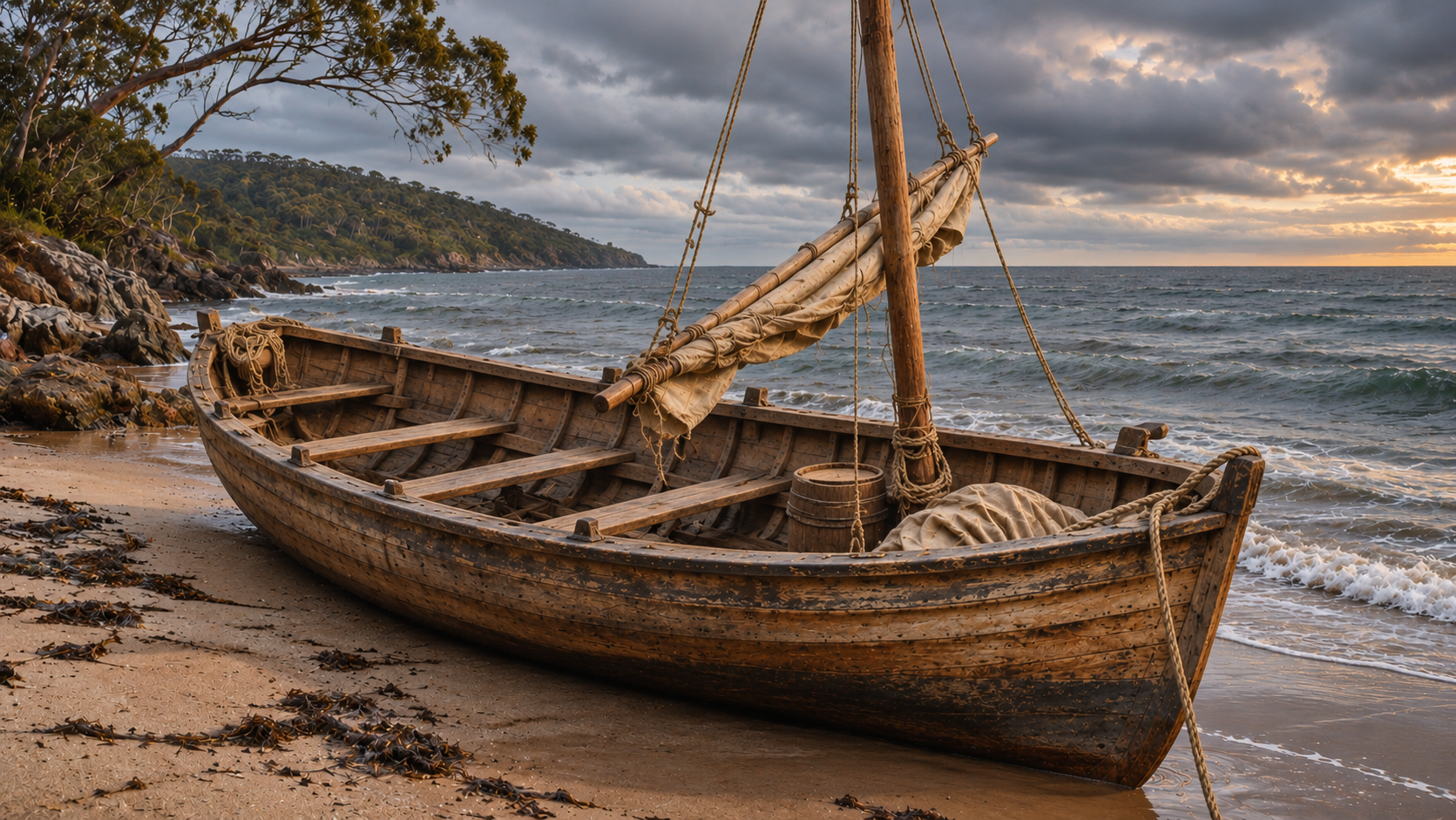
In March 1791, a Cornish woman climbed aboard a stolen wooden boat in Sydney Harbour with her husband, two small children and seven fellow convicts. Their plan was to escape the British penal colony and reach Timor, more than 5,000 kilometres away. They had no proper shelter, limited supplies and two children who were barely old enough to understand the danger. Their boat was a six-oared cutter, a small working vessel rather than something built for a journey across dangerous seas.
Sixty-nine days later, all eleven people were still alive.
It was an extraordinary achievement, but reaching Timor was not the end of Mary Bryant’s story. She would lose her husband and both children before eventually returning to Britain, where an unlikely friendship with a famous writer helped secure her freedom. And there is something particularly remarkable about what happened afterwards. We can trace Mary back to her family in Fowey, Cornwall. A surviving letter even confirms that she was staying with her brother-in-law there in February 1794. For a story that took her halfway around the world, it eventually brought her back to a small Cornish harbour town.
From Lanlivery to Fowey
Mary Bryant was born Mary Broad in Cornwall in 1765. The Oxford Dictionary of National Biography records her baptism at Lanlivery on 19 March that year, the daughter of William Broad, a farmer, and his wife Dorothy Gelef, whose surname also appears as Juleff. The Broad family had roots in the countryside around Lanlivery. Genealogical research also connects Mary’s father with woodland that he leased and managed alongside his brother Matthew. The family were not wealthy, but their background was more substantial than the image of a penniless convict’s family might suggest.
In the decade after Mary’s birth, her parents moved to Fowey. Her mother was buried there in June 1778, when Mary was about thirteen. This matters because older biographies give a different account of her origins. The Australian Dictionary of Biography, published in 1966, says she was baptised at Fowey in May 1765 and describes her father as a mariner. More recent research supports the Lanlivery baptism and the later move to Fowey.
Mary grew up with two sisters, Elizabeth and Dorothy. Elizabeth was living in Plymouth by the time Mary’s troubles with the law began, providing another family connection between Cornwall and Devon. We know relatively little about Mary’s childhood. She left no surviving diary or personal account, and most of what historians know about her comes from court records, officials’ correspondence and the people she encountered later.
By 1785, Mary was in Plymouth, where her life took a dramatic turn.
A silk bonnet and a death sentence
In July 1785, Mary and two other women, Catherine Fryer and Mary Hayden, also known as Shepherd, were accused of robbing a woman named Agnes Lakeman on a road in Plymouth. Among the stolen property was a silk bonnet valued at twelve pence. The other goods were valued at £1 and eleven shillings.
Under the criminal laws of eighteenth-century Britain, highway robbery was a capital offence. The relatively modest value of the property did not prevent the court from imposing the harshest possible punishment. On 20 March 1786, at Exeter Assizes, Mary and the other two women were sentenced to death. For a young Cornish woman of about twenty-one, it could have been the end of her story.
Instead, Mary’s sentence was commuted to seven years’ transportation. Rather than being executed, she would be sent to a new British penal colony on the other side of the world. There was little reason to believe she would ever see Cornwall again. Mary was held in prison before being transferred to the Dunkirk, a prison hulk at Plymouth. These hulks were old ships used to accommodate prisoners while they awaited transportation. It was during this period that Mary became pregnant.
She was eventually transferred to the Charlotte, one of the eleven vessels preparing to sail with the First Fleet to Australia.
A daughter born on the voyage to Australia
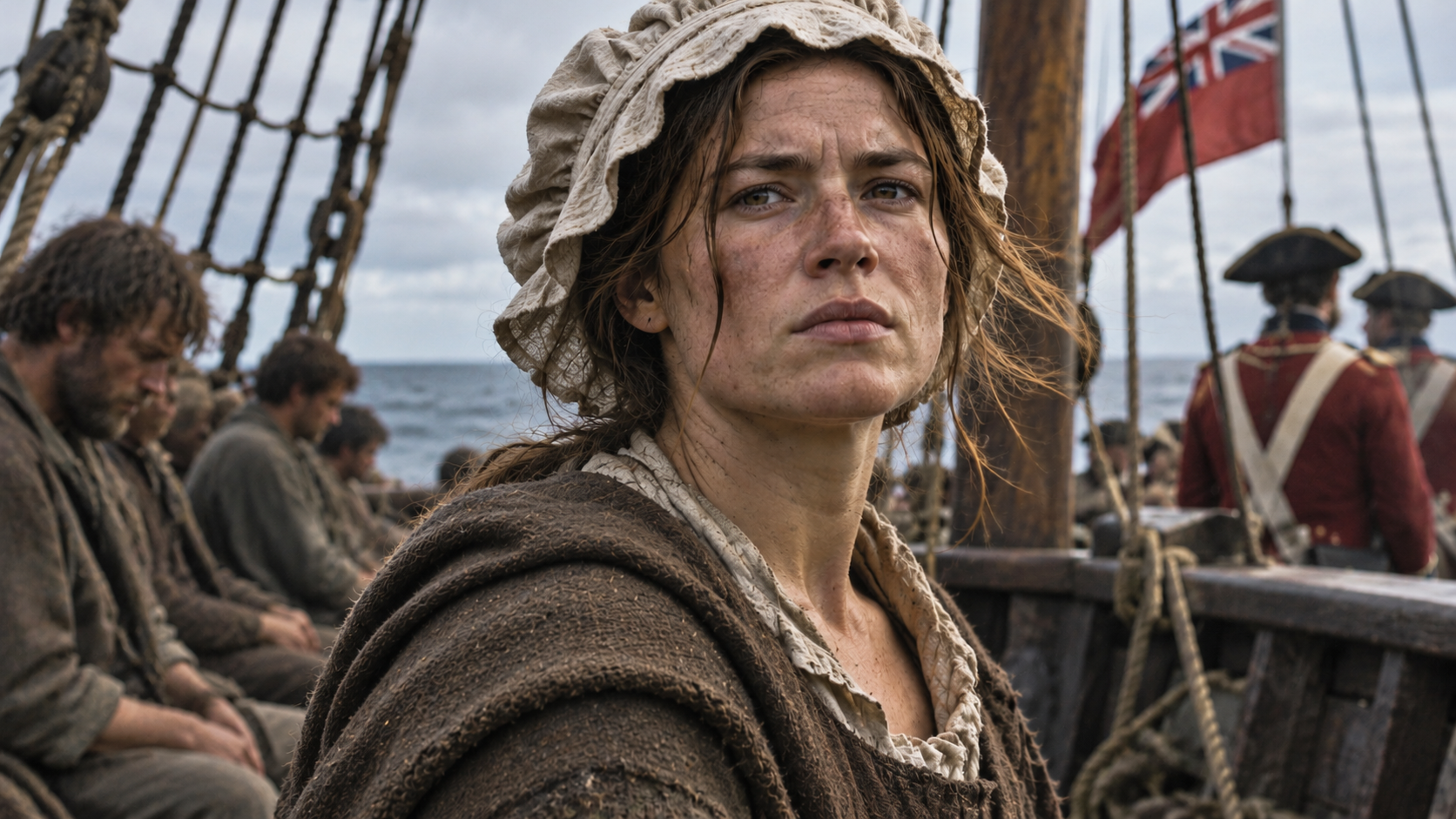
The First Fleet departed Portsmouth on 13 May 1787, carrying convicts, marines, officials and supplies towards New South Wales. Mary was pregnant when the voyage began. On 8 September 1787, while still at sea, she gave birth to a daughter named Charlotte, after the ship on which they were travelling. It is difficult to imagine the uncertainty surrounding a young woman giving birth aboard a crowded transport ship, knowing she was being taken thousands of miles from her family and home.
The fleet arrived in Australia in January 1788. The British established their settlement at Sydney Cove, on the traditional land of the Gadigal people. That settlement marked the beginning of profound and lasting changes for Aboriginal communities, including dispossession and conflict.
On 10 February 1788, Mary married William Bryant, another transported convict from Cornwall. William, a fisherman and seaman, had been convicted of impersonating another sailor to obtain wages. Like Mary, he had travelled to Australia aboard the Charlotte. The new colony was desperately short of experienced people who could help provide food. William’s fishing skills made him particularly valuable, and he was placed in charge of the settlement’s fishing boats.
The couple acquired a hut and a small garden. They also had contact with Aboriginal people, including Bennelong and his family, at a time when relationships between the newcomers and the people whose land they occupied were often tense and uncertain. For a while, the Bryants enjoyed certain advantages over other convicts, but life in the settlement remained difficult.
Why escape when your sentence had ended?
By 1790, the colony was struggling with severe food shortages. Supplies depended heavily on ships arriving from overseas, while attempts to produce sufficient food locally had met considerable difficulties. William’s position had also deteriorated. In February 1789, he was punished for privately trading fish caught while working for the government. He was sentenced to receive 100 lashes and removed from his position overseeing the fishing boats, although his skills remained useful.
In April 1790, Mary gave birth to their son, Emanuel. The couple now had two young children in a struggling penal settlement. But there was another problem, and it helps explain why they were willing to risk such a dangerous escape.
William Bryant’s seven-year transportation sentence had expired by March 1791, the very month they escaped. He had completed his sentence, but that did not mean he could simply board a ship and return to Cornwall. Former convicts were not automatically provided with passage back to Britain. They might technically be free, yet remain thousands of miles from home without the money or opportunity to leave.
Mary still had approximately two years of her sentence remaining. The Bryants faced the prospect of further hardship, with no obvious means of returning to their families. An escape by sea offered a different possibility, although it was an extraordinary gamble.
Eleven people and a small wooden boat
Mary and William were not acting alone. Seven other convicts joined their plan. They were William Allen, who had served in the navy; James Martin, whose surviving account would become the most important record of the escape; Samuel Bird, also known as John Simms; Samuel Broom, also known as John Butcher; James Cox, also known as Rolt; Nathaniel Lillie, whose surname also appears as Lilly; and William Morton, an experienced navigator whose skills would prove particularly valuable. Together with Mary, William and their two children, the group numbered eleven.
They gathered supplies, including flour, rice, pork and fresh water. They also obtained a compass, quadrant and nautical chart, reportedly supplied through a Dutch ship that had visited Sydney. Their intended destination was Timor, where the Dutch maintained a colonial settlement. If they could reach it, they hoped to pass themselves off as shipwreck survivors rather than escaped British convicts.
The vessel they chose was Governor Arthur Phillip’s six-oared cutter, a small open fishing boat equipped with masts, sails and oars. It was never intended to carry eleven people thousands of miles across dangerous seas. There was no enclosed cabin, no comfortable sleeping accommodation and very little protection from bad weather. Every passenger would have to share the limited space with food, water and equipment.
On the night of 28 March 1791, the group made its escape. Mary, William, Charlotte, Emanuel and their seven companions slipped out of Port Jackson and headed north along Australia’s eastern coast. The authorities did not have a suitable vessel immediately available to pursue them. By the time the escape was discovered, the little boat had already disappeared.
Sixty-nine days against the sea
The journey that followed was astonishing. The escapees travelled approximately 5,237 kilometres, or 3,254 miles, navigating coastal waters, reefs and stretches of open sea before reaching Timor. They encountered violent storms, heavy seas and periods when landing was impossible. Water flooded their boat, sometimes forcing them to bail throughout the night. Fresh drinking water was a constant concern. They depended on opportunities to land and replenish their supplies, while fishing and gathering food helped them survive. At one stage, conditions became so desperate that they threw clothing overboard to lighten the boat.
The journey would have been punishing for experienced sailors travelling without children. Mary was aboard with Charlotte, who was approximately three years old, and Emanuel, who was only eleven months old when they escaped. William Morton brought valuable navigational experience, while the other men contributed their own skills and labour. The remarkable achievement belonged to the whole group, not any single passenger.
One of the escapees, James Martin, later recorded their experiences in a manuscript known as Memorandoms. It is the only known surviving first-hand narrative written by a participant in the escape, and one of the earliest surviving accounts written by a transported convict in Australia. Martin described frightening conditions aboard the boat, the difficulties of finding food and water, and the constant risks posed by weather and unfamiliar coastlines.
During one particularly difficult period, the group reached an island in the Great Barrier Reef region, where turtles provided food and rain helped replenish their water supplies. The escapees also encountered Aboriginal and Torres Strait Islander communities along their route. Some meetings involved exchanges and assistance, while others were tense or hostile. These were inhabited coastlines with established communities and maritime traditions, not empty territory awaiting European arrivals.
Eventually, the party continued north and crossed towards Timor. On 5 June 1791, after sixty-nine days at sea, they reached Kupang.
All eleven had survived the journey.
The voyage was an extraordinary feat of endurance and seamanship. It has often been compared with William Bligh’s famous open-boat journey after the mutiny aboard HMS Bounty two years earlier, which had also ended at Timor. For a brief period, Mary and her family appeared to have achieved the impossible.
Their freedom begins to unravel
At Kupang, the fugitives claimed they had survived a shipwreck. The Dutch authorities initially accepted their story and provided assistance, but their freedom was fragile. The deception eventually came to light, and the escapees were detained by the Dutch authorities.
In September 1791, Captain Edward Edwards arrived at Timor with survivors of HMS Pandora, a British naval vessel sent to pursue men involved in the Bounty mutiny. The Pandora had itself been wrecked on the Great Barrier Reef. Edwards became involved in returning the escaped convicts to British custody.
The party was transported first to Batavia, now Jakarta, before the surviving prisoners were eventually taken towards Cape Town aboard Dutch ships. From there, their journey continued aboard HMS Gorgon, which was returning to Britain. The voyage that Mary had hoped would secure her freedom had instead brought her back under British authority.
And what followed was far worse.
The family she could not bring home
Mary’s baby son, Emanuel, died at Batavia on 1 December 1791. He was only about nineteen months old. Her husband William died three weeks later, on 22 December. After surviving sixty-nine days in a small boat and travelling thousands of miles, Mary had lost her husband and youngest child within a matter of weeks.
She continued the journey towards Britain with her daughter Charlotte, but the suffering was not over. On 6 May 1792, during the final voyage towards England, Charlotte died too. Mary had left Sydney with her husband and two children, hoping to find freedom and a better future. By the time she reached Britain, all three were dead.
Other members of the escape party had also died during the return journey. William Morton and Samuel Bird died, while James Cox was lost overboard. Of the eleven people who escaped from Sydney, only five survived to return to England. They were Mary Bryant, William Allen, Samuel Broom, Nathaniel Lillie and James Martin.
There is no surviving personal diary in which Mary describes the deaths of her family. We cannot know precisely what she thought or felt during those final months at sea. The surviving records tell us what happened, but leave the woman at the centre of the tragedy largely silent.
From Newgate Prison to a royal pardon
The five survivors arrived in England on 18 June 1792. They were imprisoned at Newgate in London while the authorities considered their cases. Mary had finally returned to the country from which she had been transported, but she remained a prisoner.
The extraordinary escape attracted public attention. Newspapers reported the journey, and influential people became interested in the fate of the surviving convicts. One of them was James Boswell, the Scottish writer best known for his biography of Samuel Johnson. Boswell took a particular interest in Mary’s case and worked to secure clemency for her and the other prisoners.
Mary eventually received a pardon on 2 May 1793, several weeks after her original seven-year sentence had expired. The four surviving men remained in custody until November that year, when they were released. After being sentenced to death, transported across the world, surviving the escape, losing her family and returning to Britain in chains, Mary was finally free.
There was now somewhere she could go. Back to Cornwall.
Mary’s return to Fowey: a letter that survives
This is where Mary’s story becomes especially interesting for Cornwall. Boswell helped arrange her passage back to her family in Fowey. On 13 October 1793, she left London aboard the Ann and Elizabeth, bound for the Cornish port. Her sister Elizabeth Broad had married Edward Puckey, who lived in Fowey, and unlike so much of Mary’s later life, there is surviving evidence confirming she reached her relatives.
On 16 February 1794, Edward wrote to James Boswell. Towards the end of the letter, he explained that Mary was staying with him:
Sir my sister in law is now with me
Beside Edward’s signature appeared Mary’s name, written as Mary Brion Broad, and she added her own mark, M B. It is a remarkable historical connection. A young woman who had left Cornwall under sentence of transportation, survived a dangerous escape across the seas around Australia, lost her entire family and returned to Britain as a prisoner was now staying with relatives in Fowey.
Boswell was pleased to learn that she had arrived safely and received a welcoming reception from her family. He continued helping her financially, arranging support through the Reverend John Baron of Lostwithiel. Boswell had promised Mary an allowance of £10 a year, provided she behaved well. He attempted to raise subscriptions to support the arrangement but ultimately paid much of the money himself. That was a meaningful sum for someone in Mary’s circumstances, and it provided assistance as she attempted to rebuild her life.
The payments continued until Boswell’s death in May 1795. The final surviving acknowledgement connected with Mary’s financial support dates from late 1794. After that, her story largely disappears from the historical record. We do not know precisely when or where she died.
Can you visit Mary Bryant’s home in Cornwall?
Fowey remains the most meaningful Cornish location associated with Mary’s childhood and later life. Her family moved to the town while she was young, her mother was buried there in 1778, and Mary returned to relatives there after her pardon. Visitors can still explore Fowey’s historic streets, waterfront and harbour, although the town has changed considerably since the eighteenth century.
What cannot currently be established is an exact address for Mary’s childhood home or Edward Puckey’s house, where she was staying in February 1794. There have been claims identifying a possible Mary Bryant house, but without sufficiently reliable property evidence it would be misleading to present a particular building as her confirmed home. The strongest way forward would be to trace the Puckey household through contemporary property records, land-tax assessments and other surviving archives. That is a question worth pursuing, because identifying a genuine location would give people interested in Mary’s story somewhere meaningful to visit.
For now, Fowey itself is the documented connection, while the precise house remains unknown. Lanlivery is also important to Mary’s story, as the place where she was baptised in 1765. Together, Lanlivery and Fowey provide the strongest geographical connections between her early life and Cornwall today.
Two leaves that survived the journey
There is another remarkable link to Mary Bryant. The State Library of New South Wales holds two dried leaves of sweet sarsaparilla, a native Australian plant used to make a tea-like drink. The leaves are associated with Mary and are said to have been carried during her escape before being given to James Boswell after her return to Britain. They eventually became part of the Boswell papers, and two were presented to the State Library in 1956.
Their exact journey cannot be verified at every stage, but the objects themselves survive. That is extraordinary when so little remains of Mary’s personal life. There is no authenticated portrait showing what she looked like. There is no surviving memoir written by Mary herself, and the exact date and place of her death remain unknown. Yet two fragile leaves, associated with her escape from Australia, have survived for more than two centuries. They provide a tangible connection to a woman whose life might otherwise seem almost impossible.
How Cornwall continues to tell Mary’s story
Mary Bryant’s extraordinary life has inspired novels, television dramas and theatrical productions. She was portrayed by Romola Garai in the 2005 television drama The Incredible Journey of Mary Bryant, which introduced her story to another generation of viewers. Her experiences have also inspired the stage, including Our Country’s Good by Timberlake Wertenbaker and other productions exploring the early years of Australia’s penal colony.
But there is a particularly fitting Cornish connection. The one-woman theatre production Oh Mary!, devised and performed by Bec Applebee and developed with director Simon Harvey, has brought Mary’s story back to audiences in Cornwall and beyond. The production incorporates specially commissioned music and a traditional Cornish soundtrack recorded by Dalla and Radjel.
Applebee, whose work includes connections with Kneehigh Theatre and Wild Works, presents Mary’s story through performance, movement, music and storytelling. In April 2026, Oh Mary! was performed at the Minack Theatre at Porthcurno, overlooking the Atlantic.
There is something fitting about that setting. More than two centuries after Mary crossed thousands of miles of ocean in a small wooden boat, audiences on the Cornish coast were still hearing about her extraordinary struggle to return home. Her story has travelled almost as far as she did.
The Cornish woman who made it home
Mary Bryant’s life would be extraordinary even if the escape from Australia were the only remarkable thing she ever did. But it is the complete story that makes her so compelling. She grew up in Cornwall, was sentenced to death for highway robbery, transported across the world, became a mother during the voyage and endured the hardships of Britain’s first Australian penal settlement.
She escaped with her husband, children and seven other convicts in a small wooden boat. Against extraordinary odds, every one of them survived the journey to Timor. Then came imprisonment, disease and the deaths of the people closest to her. She returned to England, gained her freedom and eventually made her way back to her family in Fowey.
And there, in February 1794, a surviving letter records a simple but extraordinary fact: after everything she had endured, Mary was home with her relatives. We still do not know where she spent her final years or exactly where she died. Perhaps further research into Fowey’s historic property records will one day uncover the house where she stayed.
Until then, her story remains a reminder that some of Cornwall’s most remarkable people are remembered for things they achieved thousands of miles from home.
Mary Bryant crossed the world as a prisoner and returned to Cornwall a free woman. But freedom had cost her almost everything.