
Details
Address & Contact
Falmouth
Cornwall
TR11 4NQ
United Kingdom
Sorry, no records were found. Please adjust your search criteria and try again.
Sorry, unable to load the Maps API.
Pendennis Castle Falmouth: Is It Worth Visiting? Honest Guide
Pendennis Castle is one of the clearest Falmouth attractions to understand once you are standing on the headland.
It looks across Carrick Roads towards St Mawes, with Falmouth below and the open water beyond. That position is the whole point. Pendennis was not built to look pretty in the background. It was built to defend one of Cornwall’s most important stretches of water.
My honest view: Pendennis Castle is worth visiting if you are already in or around Falmouth. I would not tell everyone to cross Cornwall for it, and I would not sell it as the most dramatic castle in the county. But as a Falmouth day out with history, views, space and proper facilities, it is a strong choice.
Pendennis is more fortress than fairy tale — and that is exactly why it works.
Quick answer: who Pendennis Castle suits best
Pendennis Castle works best for:
- families who want space as well as history
- visitors staying in Falmouth
- people interested in castles, forts or coastal defence
- dog owners looking for a practical attraction
- anyone who likes a view with meaning behind it
It is less suited to people looking for a romantic ruin, a free quick stop, or one of Cornwall’s wilder coastal experiences. Pendennis is a managed heritage site with a military story. That is the offer.
What is Pendennis Castle?
Pendennis Castle began as a coastal gun fort under Henry VIII. Along with St Mawes Castle across the water, it helped defend the entrance to Carrick Roads and the port towns below.
That setting gives the whole place its purpose. You can stand on the headland, look across the harbour and understand why it mattered. Falmouth was not just a pretty seaside town. It was a strategic port, and Pendennis was part of the defensive system around it.
The story also goes well beyond the Tudor period. Pendennis was adapted over centuries, with later batteries, barracks, guns and wartime features showing how its role changed as warfare changed.
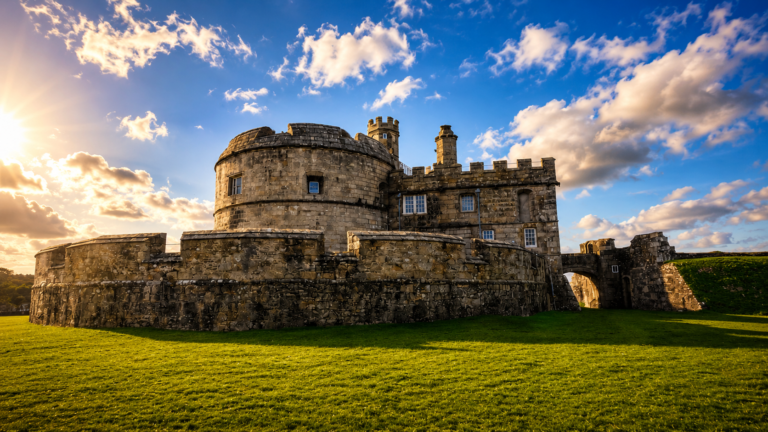
You get the Tudor keep, but you also get the wider fortress.
Things to see at Pendennis Castle
The Tudor keep is the natural centrepiece. Expect stone rooms, spiral stairs and roof views rather than luxury interiors or grand decoration. This was a defensive building, not a showpiece home.
The historic guns give Pendennis its harder edge. The site includes weaponry from different periods, including Tudor, Napoleonic, Victorian and 20th-century coastal defence. That range helps the visit feel layered rather than repetitive.
The Royal Artillery Barracks add another useful part of the story. The exhibitions cover the castle, the people who lived and worked there, and its relationship with Falmouth. The Fortress Falmouth material gives the site a stronger local connection, which matters. Without that, Pendennis could feel like another heritage attraction that happens to sit by the sea.
The Battery Observation Post and Half Moon Battery are also worth making time for, especially if you are interested in the later military history. Pendennis was still part of Cornwall’s defences long after the Tudor period, and those areas make that clearer.
The views are one of the best reasons to go
The views are a major part of the visit.
From different points around the site you can see across Falmouth, nearby beaches, Carrick Roads, St Mawes and the open water beyond. The roof of the Tudor keep gives you the big panoramic moment, but the wider grounds are just as important.
This is where Pendennis beats a lot of more static historic attractions. The landscape is not background scenery. It is part of the explanation. The guns, walls and observation points make more sense because the water is right there in front of you.
If you only want rooms full of objects, Pendennis may not be the strongest choice. If you like history that connects directly to place, it lands much better.
Is Pendennis Castle good for families?
Yes, and not because it has been turned into a theme park.
There is enough here for children without the castle losing its identity. The family trail, interactive displays, hands-on elements, open grounds and soft play for under-fives all help. The site has room to move, which makes a big difference if you are visiting with children who will not tolerate a slow shuffle through silent rooms.
The best family version of Pendennis is a mix:
- climb the keep if everyone can manage the stairs
- use the grounds rather than rushing straight indoors
- make time for the guns and batteries
- use the café or picnic space as a natural break
- treat the exhibitions as part of the visit, not the whole visit
That makes the day feel easier and less forced.
Food, drink and picnic space
Pendennis is practical enough to recommend without too many caveats.
There is a café/tearoom in the Royal Artillery Barracks serving refreshments, snacks and light meals, with gluten-free and dairy-free options listed. There is also a large lawned picnic area, which fits the site well. On a decent day, eating outside here makes more sense than treating the café as the main event.
The facilities are useful rather than flashy, which is exactly what this kind of place needs. You can break the visit up, keep children fed, bring a picnic, or stop for something simple without having to leave the site.
Is Pendennis Castle dog friendly?
Yes. Dogs on leads are welcome, including inside the buildings and around the grounds. Outdoor seating is available at the café, and dog bowls are listed too.
That makes Pendennis a better option than many historic attractions if you are travelling around Cornwall with a dog. It also means the site works well as part of a Falmouth day rather than forcing you to split the group or leave someone outside.
For dog owners, the main thing is to treat it like a historic visitor site rather than an open dog walk. Keep the lead on, use the outdoor space sensibly, and check any event-specific restrictions before making the day depend on it.
Pendennis Castle parking and getting there
Pendennis Castle sits on Pendennis Headland, about a mile south-east of Falmouth.
The main parking is on Castle Drive, using TR11 4NQ for sat nav. A height barrier is listed for the main car park. Accessible parking within the castle grounds is limited, and there is a drop-off point at the castle gates for visitors with mobility concerns.
Without a car, the nearest train station is Falmouth Docks, followed by an uphill walk. Buses stop along Castle Drive, also with a short uphill walk to the entrance.
That hill is worth taking seriously. It is not a reason to avoid Pendennis, but it can shape the day if you are with young children, older relatives, tired legs or anyone with access needs.
Accessibility at Pendennis Castle
Pendennis has some useful access provision, but it is still a historic fortress on a headland.
There is wheelchair access to the ground floor of the Royal Artillery Barrack Block. Lift access is listed for the first floor of the barrack block, where Fortress Falmouth and First World War material are housed. Accessible toilets and disabled parking are also listed.
The limitation is the castle itself. Some areas involve steps and spiral staircases, including the keep. There is no on-site transport, and not every part of the site will suit every visitor.
If access is central to your visit, confirm the current arrangements before travelling and plan around the areas that will actually work for you.
Pendennis Castle tickets, opening times and events
Pendennis uses paid entry, with English Heritage membership arrangements available. Advance booking can be cheaper than buying on the day, and tickets are generally valid for the day within the opening hours.
Opening times, prices and events change, so do not rely on old blog posts or screenshots. This is a place where the practical details are worth sorting before you travel, especially if you are planning the day around a specific event, school holiday activity or access requirement.
I would keep this simple: if Pendennis is the main point of your day, sort the tickets and timings first. If it is one part of a wider Falmouth visit, make sure the opening pattern fits before you build the day around it.
How I would fit Pendennis into a Falmouth day
Pendennis works best as part of a proper Falmouth day rather than a rushed detour.
I would pair it with time around the seafront, a harbour wander, or a food stop in town. The castle gives you the headland, the views and the history; Falmouth gives you the working town, the water and the places to eat and drink afterwards.
That is the stronger version of the day. Pendennis on its own is good. Pendennis as part of Falmouth makes more sense.
Final verdict
Pendennis Castle earns its place on a Falmouth itinerary.
The setting gives it strength, the history gives it substance, and the facilities make it easier to recommend than many older sites. It is not Cornwall’s most spectacular castle, and I would not pretend otherwise. But it is a very good visit if you want something historic, practical and properly connected to Falmouth.
Go for the fortress, the views and the sense of why this headland mattered. That is where Pendennis is at its best.
FAQs about Pendennis Castle Falmouth
Is Pendennis Castle dog friendly?
Yes. Dogs on leads are welcome in the buildings and grounds, with outdoor café seating available. Event rules can vary, so check any special event details before relying on it.
Is there parking at Pendennis Castle?
Yes. The main car park is on Castle Drive, using TR11 4NQ for sat nav. A height barrier is listed, and accessible parking within the castle grounds is limited.
Can you visit Pendennis Castle without a car?
Yes, but expect some walking. Falmouth Docks is the nearest train station, followed by an uphill walk. Buses stop along Castle Drive, also with a short uphill walk to the entrance.
Is Pendennis Castle accessible?
Partly. There is access provision including accessible toilets, disabled parking and access to parts of the Royal Artillery Barrack Block. Some areas, including the keep, involve steps and spiral staircases, so access is mixed.
What can you see at Pendennis Castle?
The main things to see are the Tudor keep, historic guns, Royal Artillery Barracks, Fortress Falmouth material, Battery Observation Post, Half Moon Battery, sea views and open grounds.
Pendennis Castle Falmouth: Is It Worth Visiting? Honest Guide
Pendennis Castle is one of the clearest Falmouth attractions to understand once you are standing on the headland.
It looks across Carrick Roads towards St Mawes, with Falmouth below and the open water beyond. That position is the whole point. Pendennis was not built to look pretty in the background. It was built to defend one of Cornwall’s most important stretches of water.
My honest view: Pendennis Castle is worth visiting if you are already in or around Falmouth. I would not tell everyone to cross Cornwall for it, and I would not sell it as the most dramatic castle in the county. But as a Falmouth day out with history, views, space and proper facilities, it is a strong choice.
Pendennis is more fortress than fairy tale — and that is exactly why it works.
Quick answer: who Pendennis Castle suits best
Pendennis Castle works best for:
- families who want space as well as history
- visitors staying in Falmouth
- people interested in castles, forts or coastal defence
- dog owners looking for a practical attraction
- anyone who likes a view with meaning behind it
It is less suited to people looking for a romantic ruin, a free quick stop, or one of Cornwall’s wilder coastal experiences. Pendennis is a managed heritage site with a military story. That is the offer.
What is Pendennis Castle?
Pendennis Castle began as a coastal gun fort under Henry VIII. Along with St Mawes Castle across the water, it helped defend the entrance to Carrick Roads and the port towns below.
That setting gives the whole place its purpose. You can stand on the headland, look across the harbour and understand why it mattered. Falmouth was not just a pretty seaside town. It was a strategic port, and Pendennis was part of the defensive system around it.
The story also goes well beyond the Tudor period. Pendennis was adapted over centuries, with later batteries, barracks, guns and wartime features showing how its role changed as warfare changed.
You get the Tudor keep, but you also get the wider fortress.
Things to see at Pendennis Castle
The Tudor keep is the natural centrepiece. Expect stone rooms, spiral stairs and roof views rather than luxury interiors or grand decoration. This was a defensive building, not a showpiece home.
The historic guns give Pendennis its harder edge. The site includes weaponry from different periods, including Tudor, Napoleonic, Victorian and 20th-century coastal defence. That range helps the visit feel layered rather than repetitive.
The Royal Artillery Barracks add another useful part of the story. The exhibitions cover the castle, the people who lived and worked there, and its relationship with Falmouth. The Fortress Falmouth material gives the site a stronger local connection, which matters. Without that, Pendennis could feel like another heritage attraction that happens to sit by the sea.
The Battery Observation Post and Half Moon Battery are also worth making time for, especially if you are interested in the later military history. Pendennis was still part of Cornwall’s defences long after the Tudor period, and those areas make that clearer.
The views are one of the best reasons to go
The views are a major part of the visit.
From different points around the site you can see across Falmouth, nearby beaches, Carrick Roads, St Mawes and the open water beyond. The roof of the Tudor keep gives you the big panoramic moment, but the wider grounds are just as important.
This is where Pendennis beats a lot of more static historic attractions. The landscape is not background scenery. It is part of the explanation. The guns, walls and observation points make more sense because the water is right there in front of you.
If you only want rooms full of objects, Pendennis may not be the strongest choice. If you like history that connects directly to place, it lands much better.
Is Pendennis Castle good for families?
Yes, and not because it has been turned into a theme park.
There is enough here for children without the castle losing its identity. The family trail, interactive displays, hands-on elements, open grounds and soft play for under-fives all help. The site has room to move, which makes a big difference if you are visiting with children who will not tolerate a slow shuffle through silent rooms.
The best family version of Pendennis is a mix:
- climb the keep if everyone can manage the stairs
- use the grounds rather than rushing straight indoors
- make time for the guns and batteries
- use the café or picnic space as a natural break
- treat the exhibitions as part of the visit, not the whole visit
That makes the day feel easier and less forced.
Food, drink and picnic space
Pendennis is practical enough to recommend without too many caveats.
There is a café/tearoom in the Royal Artillery Barracks serving refreshments, snacks and light meals, with gluten-free and dairy-free options listed. There is also a large lawned picnic area, which fits the site well. On a decent day, eating outside here makes more sense than treating the café as the main event.
The facilities are useful rather than flashy, which is exactly what this kind of place needs. You can break the visit up, keep children fed, bring a picnic, or stop for something simple without having to leave the site.
Is Pendennis Castle dog friendly?
Yes. Dogs on leads are welcome, including inside the buildings and around the grounds. Outdoor seating is available at the café, and dog bowls are listed too.
That makes Pendennis a better option than many historic attractions if you are travelling around Cornwall with a dog. It also means the site works well as part of a Falmouth day rather than forcing you to split the group or leave someone outside.
For dog owners, the main thing is to treat it like a historic visitor site rather than an open dog walk. Keep the lead on, use the outdoor space sensibly, and check any event-specific restrictions before making the day depend on it.
Pendennis Castle parking and getting there
Pendennis Castle sits on Pendennis Headland, about a mile south-east of Falmouth.
The main parking is on Castle Drive, using TR11 4NQ for sat nav. A height barrier is listed for the main car park. Accessible parking within the castle grounds is limited, and there is a drop-off point at the castle gates for visitors with mobility concerns.
Without a car, the nearest train station is Falmouth Docks, followed by an uphill walk. Buses stop along Castle Drive, also with a short uphill walk to the entrance.
That hill is worth taking seriously. It is not a reason to avoid Pendennis, but it can shape the day if you are with young children, older relatives, tired legs or anyone with access needs.
Accessibility at Pendennis Castle
Pendennis has some useful access provision, but it is still a historic fortress on a headland.
There is wheelchair access to the ground floor of the Royal Artillery Barrack Block. Lift access is listed for the first floor of the barrack block, where Fortress Falmouth and First World War material are housed. Accessible toilets and disabled parking are also listed.
The limitation is the castle itself. Some areas involve steps and spiral staircases, including the keep. There is no on-site transport, and not every part of the site will suit every visitor.
If access is central to your visit, confirm the current arrangements before travelling and plan around the areas that will actually work for you.
Pendennis Castle tickets, opening times and events
Pendennis uses paid entry, with English Heritage membership arrangements available. Advance booking can be cheaper than buying on the day, and tickets are generally valid for the day within the opening hours.
Opening times, prices and events change, so do not rely on old blog posts or screenshots. This is a place where the practical details are worth sorting before you travel, especially if you are planning the day around a specific event, school holiday activity or access requirement.
I would keep this simple: if Pendennis is the main point of your day, sort the tickets and timings first. If it is one part of a wider Falmouth visit, make sure the opening pattern fits before you build the day around it.
How I would fit Pendennis into a Falmouth day
Pendennis works best as part of a proper Falmouth day rather than a rushed detour.
I would pair it with time around the seafront, a harbour wander, or a food stop in town. The castle gives you the headland, the views and the history; Falmouth gives you the working town, the water and the places to eat and drink afterwards.
That is the stronger version of the day. Pendennis on its own is good. Pendennis as part of Falmouth makes more sense.
Final verdict
Pendennis Castle earns its place on a Falmouth itinerary.
The setting gives it strength, the history gives it substance, and the facilities make it easier to recommend than many older sites. It is not Cornwall’s most spectacular castle, and I would not pretend otherwise. But it is a very good visit if you want something historic, practical and properly connected to Falmouth.
Go for the fortress, the views and the sense of why this headland mattered. That is where Pendennis is at its best.
FAQs about Pendennis Castle Falmouth
Is Pendennis Castle dog friendly?
Yes. Dogs on leads are welcome in the buildings and grounds, with outdoor café seating available. Event rules can vary, so check any special event details before relying on it.
Is there parking at Pendennis Castle?
Yes. The main car park is on Castle Drive, using TR11 4NQ for sat nav. A height barrier is listed, and accessible parking within the castle grounds is limited.
Can you visit Pendennis Castle without a car?
Yes, but expect some walking. Falmouth Docks is the nearest train station, followed by an uphill walk. Buses stop along Castle Drive, also with a short uphill walk to the entrance.
Is Pendennis Castle accessible?
Partly. There is access provision including accessible toilets, disabled parking and access to parts of the Royal Artillery Barrack Block. Some areas, including the keep, involve steps and spiral staircases, so access is mixed.
What can you see at Pendennis Castle?
The main things to see are the Tudor keep, historic guns, Royal Artillery Barracks, Fortress Falmouth material, Battery Observation Post, Half Moon Battery, sea views and open grounds.
Contact & Details
Falmouth
Cornwall
TR11 4NQ
United Kingdom
Sorry, no records were found. Please adjust your search criteria and try again.
Sorry, unable to load the Maps API.