
In 1768, an English antiquarian arrived in Mousehole looking for someone who could still speak Cornish. He was directed to an elderly woman who sold fish for a living and decided on a rather unusual way of testing her language skills.
He told her he’d made a wager that nobody could speak Cornish any more.
The woman was Dorothy ‘Dolly’ Pentreath, and she apparently didn’t appreciate being told that the language she’d spoken since childhood no longer existed. According to the visitor’s own account, she launched into an angry response in Cornish that lasted two or three minutes.
Two women standing outside neighbouring cottages found the whole encounter highly entertaining. When the visitor asked whether Dolly had been insulting him, they confirmed that she had, and rather thoroughly.
That meeting helped turn an ordinary Cornish fish seller into one of the most famous women in Cornwall’s history. Yet behind the legend of the supposedly last speaker of Cornish is a more interesting story about poverty, family, personality and an elderly woman whose life was recorded largely by educated men who had come to study her.
A fisherman’s daughter from Mousehole
Dorothy Pentreath was born in Mousehole, in the parish of Paul, towards the end of the seventeenth century. She was baptised on 16 May 1692, the second of six known children of Nicholas Pentreath, a fisherman, and his second wife, Jone.
These details matter because Dolly’s early life has been muddled by conflicting accounts. Older biographies sometimes give her birth year as 1685, while stories repeated after her death claimed that she lived to the remarkable age of 102. The parish baptism identified in modern biographical research points instead to her being approximately 85 when she died in December 1777.
Her childhood belonged to a different Cornwall from the one we know today. Mousehole was a fishing community, and the Cornish language was still part of everyday life in parts of west Cornwall, although English was steadily taking its place.
Cornish was Dolly’s first language. She later claimed that she knew no English until she was twenty, although historians have questioned whether that was literally true.
There is a fascinating detail in an account obtained by the antiquarian Daines Barrington. Dolly reportedly remembered being sent to Penzance at the age of twelve to sell fish and conducting her business in Cornish, which she said people there could still understand.
Think about what that means. In the early eighteenth century, a young girl could apparently carry fish from Mousehole to Penzance and sell them in a language that would later be described as extinct.
The recollection was recorded many decades afterwards, so we cannot independently verify every detail. But it offers a remarkable glimpse of how Dolly understood her own childhood.
For her, Cornish wasn’t something to be preserved in a museum or learned from a book. It was the language she grew up with, and one she remembered using to earn a living.
The working life of a Cornish fishwife
Dolly spent her life in a world where work was physical, money could be scarce and families depended heavily on the fishing trade.
She was a fish seller, sometimes described as a jowster, an itinerant trader who carried fish to customers. Historical descriptions of the trade tell of women transporting their goods in baskets on their backs, travelling between fishing communities and local markets.
It was not a comfortable occupation. Fish needed to be sold while fresh, and a trader’s earnings depended on what was available, what customers would pay and whether a journey produced enough business to make it worthwhile.
Dolly’s circumstances appear to have been difficult. She was poor, and reports from her later years suggest that she depended partly on parish support.
The descriptions of her home are hardly grand. Barrington wrote of a small dwelling in a narrow lane at Mousehole, opposite two rather better cottages.
It’s a detail that says something about the difference between the people who became interested in Dolly and the woman herself. The educated gentlemen who came to investigate the Cornish language could travel, correspond with scholars and publish their observations. Dolly was an elderly fish seller living in modest circumstances.
Yet she possessed something they had travelled a considerable distance to find.
The son who complicates her story
Dolly’s family life challenges parts of her traditional biography.
In 1729, she gave birth to a son, John Pentreath, who lived until 1778. Modern biographical research indicates that she never married, although some older accounts claimed she had married a man named Jeffery.
The confusion is connected with the name under which her burial appears to have been recorded.
The Paul parish register includes a burial for Dolly Jeffery, and historian Matthew Spriggs has suggested that John may have used the surname of his presumed father when recording his mother’s death, perhaps to give the family relationship an appearance of legitimacy.
That explanation is plausible rather than certain. We don’t have Dolly’s own account of the relationship, and the surviving evidence does not establish the identity of John’s father beyond doubt.
The stronger documentary evidence nevertheless reveals a woman whose life was more complicated than the familiar image of a solitary elderly speaker. Dolly was a mother as well as a fish seller, and her son survived her by only a short time.
Her family circumstances also provide important context for the poverty recorded in later accounts. Raising a child outside marriage in eighteenth-century Cornwall could be difficult, particularly for a woman dependent on manual work and small earnings, although we cannot reconstruct every hardship Dolly personally experienced.
She lived for approximately 85 years. Only a small fraction of those years involved the antiquarians who eventually wrote about her.
The gentleman who came looking for Cornish
Daines Barrington was a lawyer, antiquarian and member of the Society of Antiquaries of London. He was interested in the survival of the Cornish language and travelled to west Cornwall in 1768 to investigate whether anyone could still speak it.
His original intention was to look towards Sennen, at the far western end of the county. He reasoned that if Cornish survived anywhere, it might be in a relatively isolated settlement.
But the landlord accompanying him from Penzance suggested that he would have better luck at Mousehole.
The landlord knew Dolly because he went there to buy fish. He had heard her speaking in a language he didn’t understand when she was dissatisfied with the price being offered.
That is quite an introduction. Dolly wasn’t recommended because she was a respected scholar, a teacher or a celebrated authority on Cornish. She was known to complain about fish prices in a language that outsiders no longer understood.
When Barrington arrived, he asked to be introduced as someone who had wagered that nobody could converse in Cornish.
Dolly’s response was immediate.
According to Barrington, she spoke angrily for two or three minutes in a language he thought sounded rather like Welsh. Two elderly women stood outside the cottages opposite, laughing at what she was saying.
Barrington asked whether Dolly had been insulting him. The women confirmed that she had, and explained that she was angry because he had suggested nobody could speak Cornish.
He then assumed the other women must also be speakers. They explained that they could understand Cornish but couldn’t speak it readily themselves.
It was a revealing encounter. Barrington had found not one isolated woman with an incomprehensible language, but several people with different levels of knowledge of Cornish.
It also tells us something about Dolly. She was not presented as a timid woman grateful for the attention of an educated visitor. She apparently gave him a piece of her mind.
Of course, we know this because Barrington chose to record it. We have his description of the scene, not Dolly’s own version, and he admitted that he couldn’t understand what she was saying.
The meeting tells us as much about the gentleman studying her as it does about the woman herself.
An elderly woman who could still surprise people
Barrington’s interest didn’t end with his visit.
In 1772, he made further enquiries about whether Dolly was still alive. Information sent back to him described an elderly woman who was short, bent with age and somewhat deaf, but whose memory and understanding were considered strong.
She was also reported to have walked approximately three miles to Castle Horneck and back, despite poor weather.
That is an interesting glimpse of the woman behind the descriptions of poverty and old age. Even as an elderly person, Dolly was evidently regarded as capable of making a substantial journey on foot.
The same correspondence repeated her claim that Cornish had been her childhood language and that she had once sold fish in it.
There were, however, doubts about the ages being reported. Dolly was described as being in her eighty-seventh year, even though the baptismal evidence suggests she was younger.
This helps explain how later accounts became so confused about her age. Inaccurate figures were circulating while she was still alive, and subsequent writers repeated them.
Barrington eventually published his account in the Society of Antiquaries’ journal Archaeologia in 1775, under the title On the Expiration of the Cornish Language.
By then, Dolly had become far more than a woman who happened to know Cornish. She was being presented as a surviving representative of an entire language tradition.
The growing interest brought her into contact with people beyond her ordinary working community. Scholars wanted to know about Cornish, while visitors were fascinated by the prospect of hearing a language they believed had almost disappeared.
It must have been an unusual position for a woman who had spent much of her life selling fish, although the surviving sources tell us frustratingly little about how she felt about the attention.
The woman with a fearsome reputation
Dolly’s reputation for colourful language became one of the most enduring parts of her legend.
Accounts describe her swearing in Cornish, particularly when angry. One expression associated with her, kronnekyn hager du, has been translated as an insult meaning an ugly black toad.
There were also tales of her practising fortune-telling, and later stories even portrayed her as a witch.
These claims need treating carefully.
The surviving accounts were written largely by educated men, and modern researchers have questioned how much the descriptions reflected the social prejudice of their time towards a poor working woman.
An elderly fish seller who spoke an unfamiliar language, argued with customers and lived in poverty was an easy subject for colourful storytelling. Once she had acquired a reputation, further stories could be attached to her whether or not they were true.
Barrington’s correspondence does include a contemporary report associating her with fortune-telling, but that is evidence of what someone reported about Dolly, not independent proof of the practices or supernatural reputation later attributed to her.
Nor does the fact that she reportedly swore in Cornish mean her knowledge was limited to insults.
Her recollections of childhood, Barrington’s assessment of her fluency and later testimony about conversations with other Cornish speakers suggest a more substantial command of the language.
Modern scholarship has challenged dismissive portrayals of Dolly and examined the influence of the educated men who recorded her life. The resulting picture is more complicated than the familiar stereotype of a foul-mouthed fishwife who knew a few obscure words.
There is something rather unfair about it. A woman who had spoken Cornish since childhood found herself being judged by gentlemen who had come to Cornwall precisely because they couldn’t speak it themselves.
What happened to Dolly’s own words?
For someone remembered because of her language, surprisingly little of Dolly’s actual speech was recorded.
We have descriptions of her speaking Cornish. We have accounts of occasions on which she used it, reports of what she remembered and observations about her fluency.
But there is no substantial surviving record of Dolly telling her own life story in Cornish.
That is a considerable loss.
Barrington had encountered someone who could apparently speak traditional Cornish learned naturally in childhood, yet the opportunity to preserve an extensive record of her vocabulary and conversation was largely missed.
Later scholars recognised how valuable such a record would have been. Instead, researchers were left to reconstruct her linguistic abilities from scattered descriptions and the recollections of other people.
It is one of the more frustrating parts of the story. The antiquarians recognised that they were dealing with a language in serious decline, but the records they left are far thinner than anyone studying Dolly today would wish.
We know that Barrington found her remarkable. We know that people remembered her personality. We know that artists produced portraits associated with her.
What we don’t have is Dolly sitting down and explaining her life in her own words.
The painter and the fishwife
Dolly’s fame also reached the world of art.
The Cornish painter John Opie, who would later become a celebrated portrait artist, is recorded as having painted Dolly around 1777. Opie was born near St Agnes in 1761 and was still at an early stage of his career when she was nearing the end of her life.
It is a striking connection between two people from very different circumstances in Cornwall.
Dolly had lived through most of the eighteenth century selling fish and speaking Cornish. Opie belonged to a younger generation and would eventually build a successful artistic career far beyond Cornwall.
Other depictions followed, including an engraving after Robert Scaddan published in 1781.
These images helped give Dolly a recognisable identity beyond the written descriptions. She was no longer simply an elderly woman whose name appeared in correspondence about an endangered language. She had become a historical figure whose likeness people wanted to preserve.
But there is a complication worth knowing before accepting every familiar picture of Dolly as a portrait from life.
One painting held by the National Trust at Lanhydrock, attributed to Richard Thomas Pentreath, was produced in the nineteenth century, long after Dolly’s death. It depicts her carrying a basket through the Cornish countryside, but the National Trust identifies it as an imaginary representation of what she might have looked like.
That doesn’t make it worthless. It tells us something about how later generations imagined Dolly and the life she represented.
It does, however, remind us that a painting can preserve a legend just as easily as a written account.
Her death and the mystery of her grave
Dolly died at Mousehole on 26 December 1777 and was buried at Paul.
At the time, there was no grand monument marking the resting place of the woman who would become one of Cornwall’s best-known historical figures.
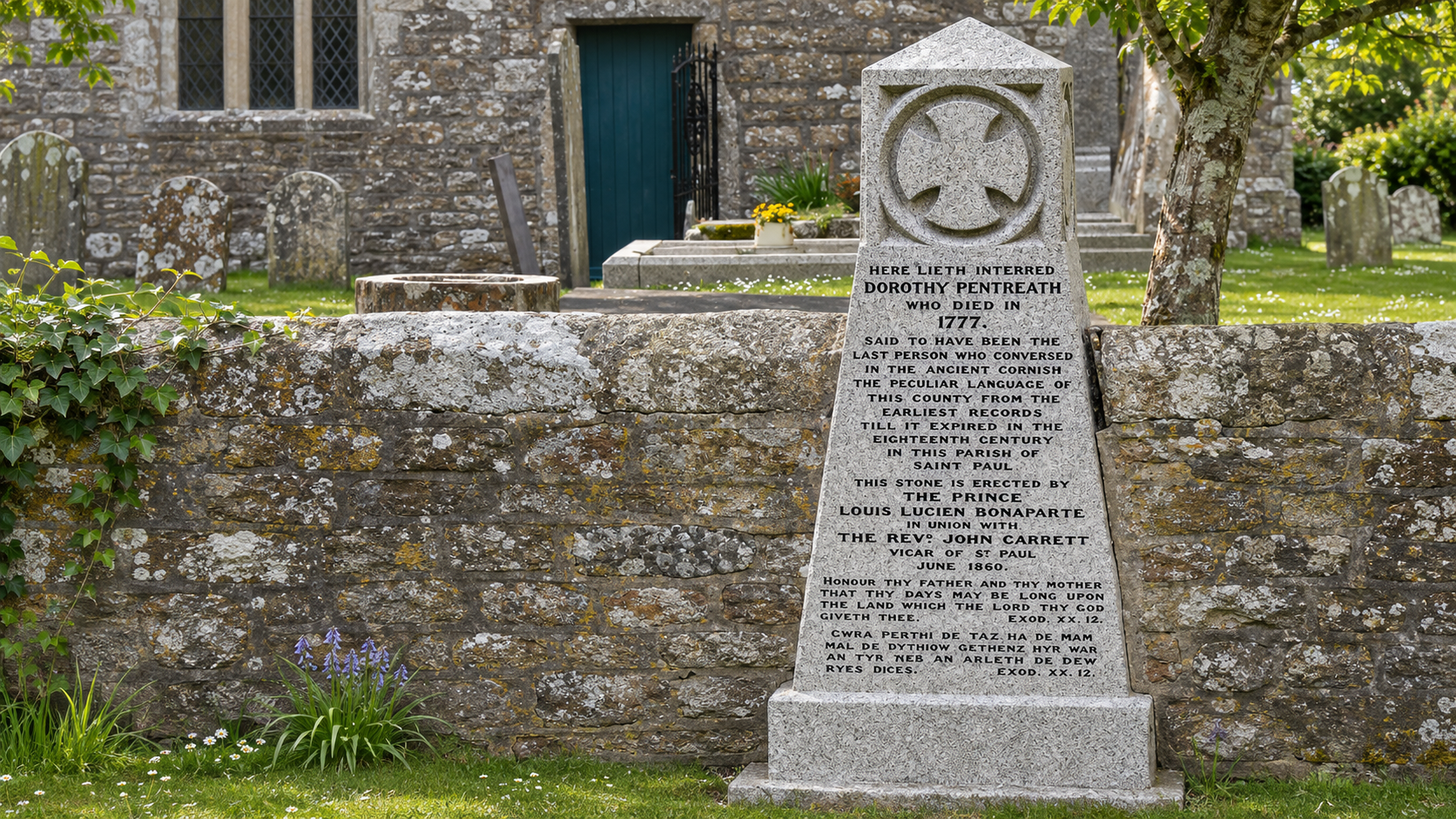
Decades later, in 1860, Prince Louis Lucien Bonaparte, a nephew of Napoleon Bonaparte, was involved in erecting a memorial to her at Paul churchyard, together with the Reverend John Garrett, the local vicar.
Bonaparte was a scholar with a particular interest in minority languages. His involvement shows how Dolly’s reputation had spread far beyond Mousehole.
But even the memorial became the subject of argument.
In 1882, Frederick William Pearce Jago published correspondence with Bernard Victor of Mousehole, who challenged the accuracy of the memorial’s original position.
Victor claimed that his grandfather, George Badcock, had been the undertaker at Dolly’s funeral. According to the family account he passed on, eight fishermen had carried her to her grave.
Victor argued that the burial place lay some distance from the memorial. He was sufficiently confident to supply measurements and a plan showing where he believed Dolly had been buried.
It is a wonderfully revealing historical disagreement. More than a century after Dolly’s death, people were still arguing over where she had been laid to rest.
Jago took the claim seriously enough to investigate Victor’s family chronology. He asked how Victor’s grandfather could have been old enough to conduct a funeral in 1777, more than a century before their correspondence.
Victor replied with dates and ages intended to show that his account was possible. Later historical accounts also describe the memorial being moved in 1887 to what was believed to be Dolly’s unmarked grave.
Nevertheless, Victor’s information was recorded many decades after the funeral and passed through family recollection. His insistence that Dolly had died aged 102 also conflicts with the baptismal evidence accepted by modern biographers.
The correspondence is valuable evidence of local memory, but it cannot establish the exact position of her remains beyond doubt.
The memorial itself survives as a reminder of her reputation. It also demonstrates how easily commemorations can turn a complicated life into a much simpler historical claim.
Was Dolly really the last speaker of Cornish?
Dolly became famous as the last person to speak Cornish, but the evidence doesn’t support that exact claim.
Other people who knew and used Cornish survived her. Among them was the Mousehole fisherman William Bodinar, also recorded as Bodener, who had learned the language in his youth.
The historian Richard Polwhele later recorded testimony that Bodinar and Dolly had spent considerable periods talking together in Cornish. That account provides another glimpse of her language being used between people, rather than simply demonstrated for visitors.
Dolly’s stronger claim to historical distinction is that she was one of the last recorded fluent native speakers brought up speaking Cornish from childhood.
That distinction is important, although it isn’t the whole story of her life.
She wasn’t an academic trying to reconstruct an ancient language. She was a woman who had grown up with Cornish as part of ordinary life and continued using it into old age, long after much of the world around her had changed.
Her fame came because other people realised that something she considered familiar had become extraordinarily rare.
The broader story of how Cornish declined, survived and was revived belongs in its own right to the companion Pasties & Pints feature, Cornish Never Quite Died: How Kernewek Survived the Story of Its Own Extinction.
Dolly’s personal story deserves attention for a different reason.
The real Dolly Pentreath
The difficulty with writing about Dolly is that the better known she became, the more her own life disappeared behind the legend.
She was remembered as the last speaker of Cornish, a foul-mouthed fishwife, a fortune-teller and occasionally even a witch. Her age was exaggerated, her marital circumstances were muddled and people argued over the location of her grave.
Some of these stories contain recognisable pieces of history. Others are doubtful, contradictory or impossible to establish.
What emerges from the stronger evidence is a more convincing woman.
Dorothy Pentreath was born into a fishing family at Mousehole and grew up speaking Cornish. She spent her working life selling fish, experienced poverty, raised a son and lived into her eighties. In her later years, her knowledge of Cornish attracted scholars and visitors who believed they were witnessing the disappearance of an ancient language.
She appears in their accounts as a woman with a sharp tongue, a strong memory and little inclination to remain quiet when someone annoyed her. But those descriptions came from outsiders, and the ordinary working life behind them deserves as much attention as the colourful stories.
There’s something particularly telling about the meeting that made her famous. Barrington came to Mousehole searching for the remains of a language. What he found was a living person who had spent decades using it.
And when he suggested that nobody could speak Cornish, Dolly apparently told him exactly what she thought of that idea.
More than two centuries later, the world still remembers her name.
Not bad for a Cornish fishwife who never set out to become a legend.