
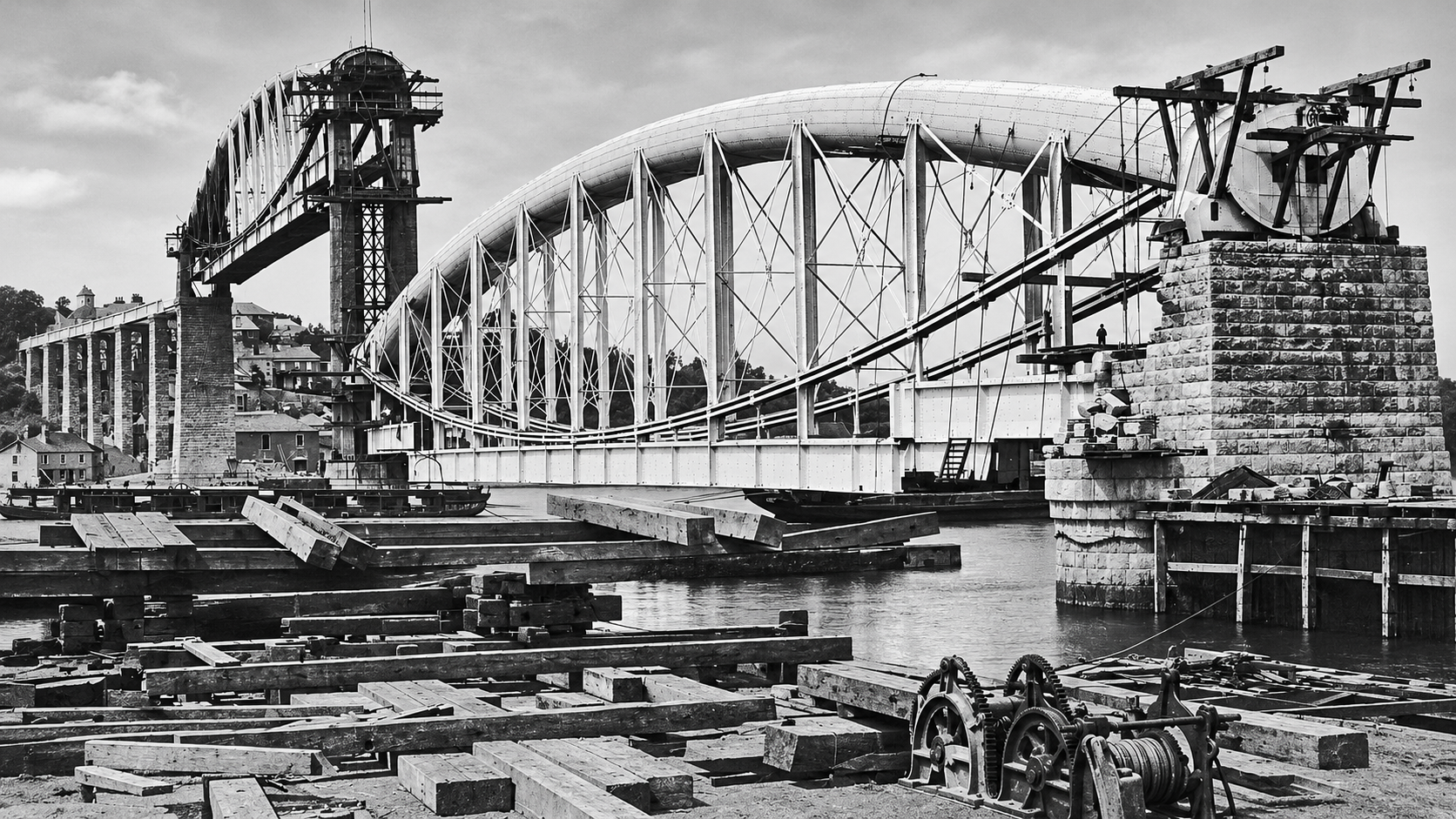
There are easier places to build a railway bridge than across the Tamar at Saltash. Deep water, strong tides, shipping underneath and a crossing wide enough to make Victorian engineers earn their dinner all stood between Cornwall and a direct rail connection eastwards.
Isambard Kingdom Brunel’s answer still carries trains into Cornwall today. The Royal Albert Bridge opened in 1859, and more than a century and a half later, its two enormous iron spans remain one of the most recognisable gateways into the county. What makes it remarkable is not simply that Brunel built a big bridge. It is how he managed to put such a structure across the Tamar using the engineering methods available in the 1850s. At one stage, thousands of people gathered to watch an enormous section of railway bridge being floated out into the river, and that was before anyone could run a train across it.
The Tamar was the problem
By the middle of the 19th century, railways were transforming Britain. Cornwall already had railway development of its own, but creating a useful connection towards Plymouth and the national railway network meant dealing with one unavoidable obstacle: the River Tamar.
A conventional low bridge was out of the question. The river was navigable, and ships needed to continue passing beneath the railway. The Admiralty required approximately 30 metres of clearance for their masts, which meant taking the railway high above the water. Brunel also needed to cross the main navigable channels without obstructing the river with numerous supports. His solution became a bridge unlike almost anything else on the railway.
Construction began in 1848, although work was interrupted before resuming in 1854. The completed structure would have two enormous main spans, each about 455 feet long, supported by a central pier and substantial masonry structures on either side.
Even now, seen from Saltash, the bridge looks peculiar. It is neither a conventional arch bridge nor a straightforward suspension bridge. Huge curved tubes rise above the railway while chains sweep beneath them, creating two distinctive iron shapes across the Tamar. Engineers know it as a bowstring tubular plate girder bridge, although I think most of us can safely stick with “that enormous Brunel bridge at Saltash”.
First, build a pier in the middle of the river
Designing the bridge on paper was one problem. Building it was another. The two main spans needed support in the Tamar, which meant establishing a substantial central pier in deep tidal water. It was a challenge that had to be overcome before the great iron structures could be lifted into their final positions.
Brunel’s solution involved a huge iron cylinder, constructed onshore before being floated into the river and sunk into position. The cylinder provided an enclosed working chamber. Water was removed, compressed air was introduced, and workers excavated through the material beneath the riverbed to reach suitable foundations. The central masonry pier could then be built upwards from the rock below.
It was difficult and potentially dangerous engineering, with the builders working beneath the river to establish the foundations that would eventually support the railway. Once those foundations were ready, Brunel still had to get two enormous iron spans into position high above the water. The obvious modern answer would involve enormous lifting equipment, but Brunel did not have that luxury. Instead, his team built the main spans on the shore, ready to be floated into the river.
The day an enormous bridge sailed into the Tamar
On 1 September 1857, the first of the great spans was moved from the Devon shore into the river. It was an extraordinary public event, with historical accounts estimating that around 20,000 people gathered to watch the operation.
The huge iron structure rested on floating barges. Five naval vessels and hundreds of workers helped manoeuvre it into position, with the movement carefully coordinated around the tide. Imagine standing on the banks of the Tamar and watching something that would normally form part of a railway bridge travelling across the water. This was not a small section of framework being delivered to a building site. It was one of the enormous spans that would eventually carry trains high above the river.
The operation succeeded, but floating the structure into place was only part of the job. It then had to be raised. Using hydraulic jacks, the builders gradually lifted the ironwork while the supporting structures beneath it were extended. The first main span reached its final height in 1858. The second span was floated out on 10 July 1858 and raised into place later that year.
The builders had assembled two enormous pieces of railway bridge beside the river, floated them into position and lifted them high enough for ships to pass underneath.
Victorian engineering is sometimes talked about as though Britain simply possessed an unlimited supply of men in tall hats who could point at a valley and have a viaduct appear by teatime. The Royal Albert Bridge is a useful reminder of the planning, experimentation and sheer physical difficulty hidden behind those finished structures.
Why does the bridge have that strange shape?
Brunel needed a structure strong enough to carry heavy railway traffic across long spans without requiring a line of piers through the river. His design combined the strengths of an arch bridge and a suspension bridge.
The curved iron tubes above the railway resist compression, while the chains below work in tension. The tubes push outwards towards the supports, while the chains pull inwards, helping the different parts of the structure balance one another. That is why the bridge has its distinctive appearance, with the tubes curving upwards and the chains sweeping downwards. It was an ingenious solution to a difficult problem.
The two principal spans were not the whole bridge, either. Seventeen smaller approach spans completed the crossing, bringing its overall length to approximately 2,200 feet. On the Cornish side, the railway approaches above the older riverside streets of Saltash before curving towards the station.
The Royal Albert Bridge is now Grade I listed. Its historic significance goes beyond Brunel’s reputation: it is an exceptionally important surviving example of this unusual form of railway bridge construction.
Prince Albert opens the railway to Cornwall
By the spring of 1859, the extraordinary construction project was nearly complete. A test train crossed the bridge on 11 April, demonstrating that the new structure was ready for railway traffic. The official opening followed on Monday 2 May 1859, when Prince Albert travelled to Saltash to inaugurate the bridge that would carry his name.
Thousands gathered for the occasion, although the day was not entirely without railway difficulties. Historical accounts record that a special train bringing guests from Cornwall broke down at Liskeard, causing some of the invited party to miss the ceremony. There is something reassuringly familiar about that. Even at the opening of one of Britain’s greatest railway engineering achievements, somebody was delayed by a train.
Regular passenger services between Plymouth and Truro began on 4 May. For Cornwall, this was far more significant than the opening of one spectacular bridge. The Tamar had stopped being an interruption in the railway.
The new line allowed broad-gauge trains to travel into Cornwall as far as Truro, connecting the county more effectively with Plymouth and the wider railway network. It did not instantly create the railway system we recognise today. Cornwall already had other railway lines, and different track gauges complicated journeys farther west. Those connections continued to develop and change over the following decades.
Nevertheless, crossing the Tamar removed one of the greatest physical barriers between Cornwall’s railway and the rest of the country. The bridge was both an engineering achievement and a major moment in the county’s transport history.
Brunel lived just long enough to see it finished
There was one particularly sad absence from the opening ceremony. Isambard Kingdom Brunel was seriously ill, and the engineer who had devoted years to overcoming the Tamar was unable to attend the public celebration of his achievement. He is believed to have crossed the completed bridge shortly afterwards, travelling on an open railway wagon rather than enjoying the journey as an ordinary passenger.
Brunel died on 15 September 1859, aged just 53, a little over four months after the official opening. His career had included remarkable railways, tunnels, bridges and ships, but the Royal Albert Bridge was among the last great engineering works completed during his lifetime.
Following his death, the Cornwall Railway Company added an enormous inscription to the bridge as a memorial:
I. K. BRUNEL
ENGINEER
1859
The lettering remains one of the bridge’s most recognisable features. Considering the scale of Brunel’s career, it feels appropriate that one of his last great works carries his name in letters large enough to be read across the river.
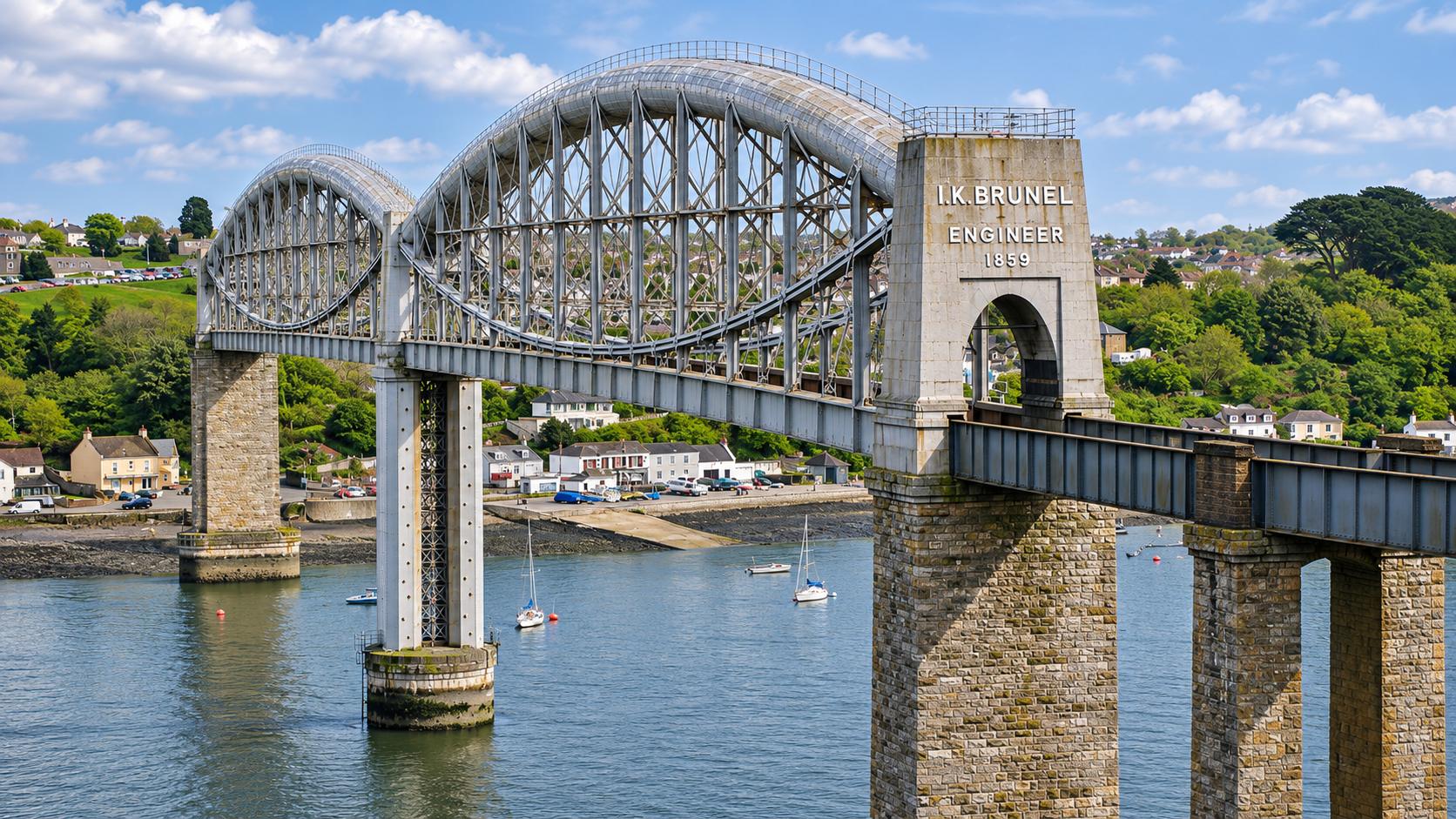
Photo: Geof Sheppard / Wikimedia Commons, CC BY-SA 4.0. AI-assisted adaptation.
More than 160 years later, trains still use it
Perhaps the most impressive thing about the Royal Albert Bridge is that it has not become a preserved Victorian engineering exhibit sitting behind a rope. It still works.
Trains travelling between Cornwall and Plymouth continue to use Brunel’s crossing as part of the modern railway. Naturally, keeping a structure of this age in service requires maintenance. Network Rail has undertaken substantial refurbishment work, including repairs and repainting of the main spans, while later engineering modifications have helped the bridge accommodate the changing demands of railway traffic.
One particularly interesting detail is that Brunel’s enormous memorial lettering was obscured for decades by maintenance walkways. The letters were made fully visible again in 2006, during the celebrations marking the 200th anniversary of his birth.
The railway itself has changed considerably since the bridge opened. The broad-gauge tracks it originally carried were converted to standard gauge in 1892, while further modifications were made over the following century to accommodate heavier locomotives and maintain the structure. But the great iron spans remained.
That creates a strange mixture of ordinary and extraordinary. If you regularly travel by train out of Cornwall, crossing the Tamar can become just another few moments of the journey. There is Saltash, there is the river, there is Plymouth, and somebody is already opening a packet of sandwiches before you reach Devon.
But underneath the train is an engineering solution worked out in the middle of the 19th century. The main spans were built beside the river, floated into position and gradually raised above the Tamar. And more than 160 years later, trains are still using them.
A proper gateway to Cornwall
Cornwall has plenty of places where you know immediately that you have arrived somewhere distinctive. The Royal Albert Bridge deserves to be counted among them.
From Saltash waterfront or from the road bridge beside it, Brunel’s structure has a presence that is difficult to appreciate when you are travelling across it. Its scale becomes clearer from a distance, when the great iron spans appear above the Tamar and the railway seems almost suspended between Cornwall and Devon.
There is something especially impressive about a structure that has become such a familiar part of the landscape while continuing to perform the job for which it was designed. It was built because a railway needed to cross a difficult river.
What Cornwall got was something much bigger: a working piece of Victorian engineering that became part of the county’s identity and remains one of its great entrances today.