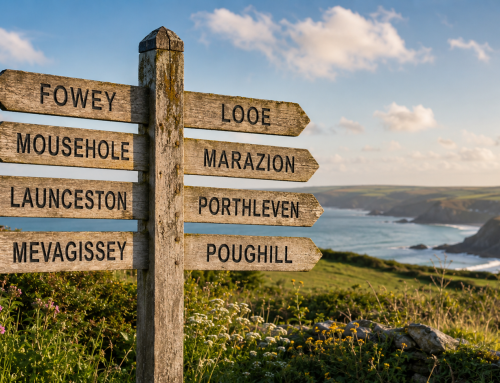

Living in Cornwall means beautiful places, but also winter weather, working harbours and real village life.
Living in Cornwall: What It’s Really Like Year-Round
Living in Cornwall sounds like the dream: sea air, harbour walks, pasties in paper bags, cosy pubs, quiet coves and a slower pace of life. And sometimes, honestly, it is every bit as good as that.
But living in Cornwall is not the same as coming here on holiday.
When you live here, you get the whole place. You get the beaches and the storms. The community and the isolation. The pasties and the parking problems. The sea views and the housing pressure. The summer buzz and the February damp.
That is what makes Cornwall so special, and also what makes it harder than people expect. It is not a lifestyle backdrop. It is a real place, with real pressures, strong communities, awkward roads, working towns, seasonal rhythms and a very deep sense of identity.
So if you are thinking about moving to Cornwall, or simply wondering what it is really like to live here, this is the honest version I would give a friend over a pint.
Cornwall is not a permanent holiday. It is a real place, with real pressures, and that is exactly why it deserves to be taken seriously.
Is Living in Cornwall Really as Good as People Imagine?
Yes, sometimes. But not in the way people imagine.
The best thing about living in Cornwall is not that every day feels like a holiday. It is that ordinary life has better edges.
You still work, clean, shop, pay bills, put bins out, chase appointments, sit in traffic and wonder whether the washing will dry before the rain comes in. The difference is that you might finish the day with a walk on the coast path, chips by the harbour, a swim before breakfast, or a pint beside a fire after a wet stomp across the cliffs.
That is the real luxury.
Cornwall suits people who value fresh air, nature, community and simple pleasures. It suits people who are happy with weather, distance and a slower pace. It suits walkers, swimmers, surfers, gardeners, dog owners, food lovers, pub people and anyone who feels better with the sea somewhere nearby.
But if your idea of a good life depends on constant nightlife, big-city job options, late shopping, fast transport and being anonymous, Cornwall may feel small. Falmouth, Truro, Penzance and Newquay all have energy in different ways, but Cornwall is not a city in disguise.
You have to want Cornwall for what it is, not for what you hope it will become.
Cornwall Changes Completely With the Seasons
Cornwall in August and Cornwall in February are two very different places.
In summer, the county fills up. Beaches are busy, restaurants book out, car parks become tactical operations, and small villages can feel as if they are carrying more weight than they were built for. If you live in one of the famous coastal spots, you quickly learn how to work around the season: shop early, avoid certain roads, eat out midweek, and save your favourite places for quieter months.
Tourism matters here. It supports pubs, cafés, campsites, galleries, surf schools, boat trips, makers, restaurants and independent shops. Cornwall needs visitors. But the pressure is real, and locals feel it.
Then autumn arrives, and the county exhales.
September and October can be some of the best months of the year. The sea still has warmth in it, the roads calm down, the light softens, and pubs start to feel like pubs again rather than overflow rooms for the beach. Winter is wilder, quieter and more local. Spring creeps in through primroses, cow parsley, birdsong and suddenly lighter evenings.
If you are thinking of moving to Cornwall, visit in winter before you commit. Not for a romantic weekend in a nice hotel. Come properly. Drive the lanes in rain. See the village after dark. Try the commute. Notice what is open. Work out whether you still love the place when the beach café is closed and your coat has not dried for three days.
If you do, you might be onto something.
The Beauty Is Real, But So Is the Weather
Cornwall is ridiculously beautiful. I am not going to pretend otherwise.
There are cliffs that stop you mid-sentence, coves that feel half-secret even when they are famous, wooded creeks, granite moors, big surf beaches, sheltered south-coast villages, working harbours, tin mine ruins, subtropical gardens and lanes so green they look almost staged.
But Cornwall is not soft.
The weather has teeth. Winters are not always bitterly cold, but they are damp, windy and persistent. A house can feel colder than the thermometer suggests, especially if it is old, stone-built or exposed. Laundry becomes a domestic strategy. Footwear matters. So does a good coat.
Storms are part of life here, especially along the more exposed stretches of coast. You learn to take forecasts seriously. You learn that “bright spells” can still mean a sideways soaking by lunchtime. You learn not to leave garden furniture unsecured unless you want it to visit next door.
The reward is that you live closer to nature than many people ever do. You notice tides. You notice light. You know when the sea is too rough to mess with. You learn which beaches work in which wind. You become someone who says things like, “It’s clearing from the west,” and means it.
That might sound small. It is not. It changes how you live.
The Pros and Cons of Living in Cornwall
People often search for the pros and cons of living in Cornwall, so here is the straight version.
The good bits are genuinely good:
- easy access to beaches, coast paths, moorland and countryside;
- a slower, more outdoorsy pace of life;
- strong local food, drink and pub culture;
- a good environment for children who love being outside;
- creative, independent and community-minded pockets;
- quieter months that feel like a reward for living here year-round.
The harder bits need taking seriously:
- housing can be expensive and competitive;
- local wages often do not match the cost of living comfortably;
- public transport is patchy outside better-connected towns;
- summer crowds change daily life;
- healthcare, dentists and services can involve travel and waiting;
- winter can feel damp, quiet and isolated;
- career options may be narrower than in a city.
That balance is important. Cornwall is not a place to romanticise blindly or dismiss unfairly. It is a place where the quality of life can be brilliant, but the practical trade-offs are real.
Housing Is the Hardest Part of Moving to Cornwall
If Cornwall has one unavoidable issue, it is housing.
This is where the romantic version of moving here crashes into reality. Cornwall is desirable, limited by geography, popular with second-home owners, attractive to remote workers, and heavily shaped by tourism. At the same time, many local wages do not stretch comfortably to buying or renting in the most sought-after areas.
That creates a squeeze.
For local families, young people, renters, key workers and anyone trying to build a stable life here, housing can be brutally difficult. Some villages have too many dark windows in winter. Some workers travel long distances because they cannot afford to live where they work. Some communities are trying to stay alive while their housing stock is pulled towards holidays, investment and retirement.
This does not mean nobody should move to Cornwall. That would be too simple, and not very useful. But it does mean you should move with your eyes open.
Ask yourself:
- Are you going to live here year-round, or mostly use the place as an escape?
- Can you afford Cornwall without relying on a fantasy version of local wages?
- Will your move support a community, or quietly remove another home from it?
- Are you choosing a place because it works, or because it looked good during one sunny week?
The prettiest harbour is not always the best place to live. In fact, it often is not. Coastal villages can be expensive, seasonal, awkward for parking, limited for services and strangely lonely in winter. Inland towns and less fashionable places can offer better value, stronger year-round community, easier schools, better shops and more practical transport.
Do not choose Cornwall by postcard. Choose it by Tuesday morning.
Work in Cornwall: Possible, But Plan Properly
People sometimes talk about Cornwall as if nobody works here, which is nonsense. People work hard here. Very hard.
There is work in healthcare, care, education, hospitality, retail, trades, construction, agriculture, fishing, marine industries, tourism, food and drink, local government, creative businesses and self-employment. There are serious, ambitious businesses here too. Cornwall is not just beach cafés and surfboards.
But the job market is different from a city.
There are fewer large employers. Career ladders can be shorter. Some roles are seasonal. Some sectors are underpaid for the cost of living. If you are used to lots of options, fast progression and being able to change jobs without changing your whole life, Cornwall can feel limiting.
Remote working has changed the picture. For some people, it makes Cornwall possible. If you can bring your work with you, earn steadily and live here properly, it can be a brilliant setup. But do not be casual about it. Broadband, mobile signal, workspace, travel requirements and winter isolation all matter.
Do not move first and “work it out later” unless you have a proper financial cushion. That is not romantic. It is risky.
Before moving, be honest about:
- how you will earn year-round;
- whether your income fits local housing costs;
- how often you need to travel for work;
- whether you can cope without city-level career choice;
- whether your business idea works in February as well as August;
- whether you are moving towards a life, not just away from burnout.
Cornwall rewards resourceful people. It is not always kind to vague plans.
Can You Live in Cornwall Without a Car?
In some places, yes. In many places, not easily.
Whether you can live in Cornwall without a car depends almost entirely on where you live. In towns such as Truro, Falmouth, Penzance, St Austell, Camborne, Redruth, Newquay and Liskeard, you have more options. There are rail links, local bus routes, branch lines and connections that make car-light living possible for some people.
The branch lines to places such as St Ives, Falmouth, Looe and Newquay are genuinely useful as well as scenic. Buses can work well for certain routes, especially if you are organised and live near a reliable connection.
But Cornwall is rural, spread out and shaped by awkward geography. Distances can look small on a map and feel much longer in real life. Roads twist. Lanes narrow. Getting from the north coast to the south coast can be oddly slow. Evening and Sunday transport can limit your choices, especially outside larger towns.
If you have children, shift work, caring responsibilities, a trade, pets, health appointments or a rural address, a car is often not a luxury. It is infrastructure.
Driving here also takes adjustment. You will reverse into hedges. You will meet tractors on lanes that appear to have been designed for goats. You will sit behind someone doing 28mph in a 60 because they are terrified of both stone walls and local drivers. You will learn patience, or at least develop a convincing imitation of it.
For getting out of Cornwall, the train is useful but not quick. The airport at Newquay adds options, especially for domestic and seasonal routes, but this is still the far south-west. You do feel the distance from the rest of the country.
For some people, that distance is the point. For others, it becomes the thing they did not think about enough.
What Is Daily Life in Cornwall Actually Like?
Most people do not go to the beach every day.
You can. That is one of the privileges of living here. But ordinary life still has a way of being ordinary. You work, clean, shop, cook, pay bills, put bins out, miss appointments, sit in roadworks, chase tradespeople and wonder whether the washing will dry before it starts raining again.
The difference is what sits around the ordinary.
You can finish work and walk the coast path. You can have chips by the harbour instead of scrolling through your phone on the sofa. You can swim before breakfast if you are hardy enough. You can turn a dull Sunday into a beach walk, a farm shop stop and a pint by the fire. You can know your fishmonger, your butcher, your favourite pasty shop, your local brewery, your good rainy-day pub and the lane where the wild garlic comes up first.
That is the real luxury. Not that life becomes permanently exciting, but that ordinary life has better edges.
Cornwall suits people who like simple pleasures:
- walking;
- swimming;
- surfing;
- gardening;
- fishing;
- cycling;
- sailing;
- birdwatching;
- pubs;
- food markets;
- community events;
- independent shops;
- fresh air that actually feels fresh.
If your idea of a good life depends on late-night shopping, big-city restaurants every week, constant gigs, endless career options and fast public transport, you may struggle. Falmouth, Truro, Penzance and Newquay all have energy in different ways, but Cornwall is not a city in disguise.
Community in Cornwall: Strong, But You Have to Show Up
Cornwall can be friendly, but it is not always instantly open. That is not rudeness. It is realism.
In small communities, people notice whether you are passing through, taking from the place, or genuinely putting down roots. If you arrive loudly, compare everything to where you came from, complain about the lack of services, and then disappear whenever the weather turns, you will not help yourself.
But if you live here properly, things change.
Use the local shop. Drink in the pub in winter. Join the gig club, the garden society, the sea swimming group, the school fair committee, the litter pick, the choir, the football club, the community fridge, the village hall event, whatever fits. Learn names. Listen before you lecture. Respect that Cornwall has its own identity, language, history and pride.
You do not have to be Cornish to love Cornwall well. But you do need humility.
Communities here often run on quiet effort: volunteers, neighbours, lifeboat crews, fundraisers, parents, pub regulars, farmers, shopkeepers, teachers, carers, people who turn up when something needs doing. If you want community, contribute to it.
That is not a slogan. It is how places survive.
Is Cornwall a Good Place to Raise a Family?
For younger children, Cornwall can be wonderful. Beaches become playgrounds. Woods become weekend plans. Rock pools, muddy boots, bodyboards, crabbing lines, garden dens and windswept picnics can make a childhood feel rich without needing much money.
There is space here for children to be outdoorsy, curious and weatherproof.
But families need to think beyond the primary-school years. Teenagers may want more independence, better buses, part-time jobs, nightlife, college options, sports clubs, music, friends nearby and a sense that the wider world is reachable. Some young people love growing up here. Some feel trapped by distance and poor transport. Both can be true.
Schools vary, as they do everywhere, and the practical details matter. A school may look close on a map but be awkward by bus. A club may be brilliant but impossible without a lift. A college course may suit your teenager perfectly but involve a long journey.
If you are moving with children, think hard about:
- school catchments and transport;
- access to clubs and friends;
- wet-weather life, not just beach life;
- teenage independence;
- part-time work and future opportunities;
- family support if you are moving away from relatives.
Cornwall can give children a brilliant upbringing. Just do not build the plan entirely around sandy toes and ice cream.
Healthcare, Dentists and Everyday Services
This is one of the less glamorous parts of moving to Cornwall, but it matters.
There are hospitals, GP practices, pharmacies, minor injury units and urgent care services across the county. But Cornwall is long, rural and busy in summer. Geography affects everything. A journey that looks manageable in theory can become tiring if you are doing it often, in bad weather, or with children or older relatives.
Dental access can be difficult. GP availability varies. Some specialist appointments may involve long travel. If you have a long-term condition, mobility needs, regular prescriptions or caring responsibilities, you need to choose location with your practical head on.
The same goes for everyday services: broadband, phone signal, childcare, vets, supermarkets, builders, plumbers, public transport and waste collections. None of this sounds dreamy when you are browsing cottages online, but it becomes your actual life very quickly.
The more rural the dream, the more carefully you need to test the basics.
A sea view is lovely. A working boiler, decent signal and a manageable drive to urgent care are lovelier when something goes wrong.
Food, Drink and Pubs Are One of the Great Joys
This is where Cornwall shines.
Living here gives you access to brilliant food and drink, from proper pasties and harbour fish to farm shops, bakeries, breweries, cider makers, vineyards, cafés, beach shacks, food markets and pubs that know exactly what they are.
There is pleasure in the everyday stuff. A pasty eaten hot in the car because you could not wait. Mackerel on the barbecue. Strawberries in season. New potatoes with butter. Crab sandwiches near the harbour. A pint after a wet walk. A cream tea done properly, with the cream first, because we are not in Devon.
Cornwall’s food scene can be polished, but it does not need to be. Some of the best meals are simple, local and eaten in slightly salty clothes.
The pubs are a big part of it for me. Not just the famous ones, and not only the food-led places with perfect lighting and a reservation system. I mean the proper locals too: warm, slightly battered, full of weather, dogs, regulars, low beams, old photographs and someone at the bar who has absolutely no interest in your lifestyle move.
A good Cornish pub in winter is one of life’s better things.
Best Places to Live in Cornwall
There is no single best place to live in Cornwall. Anyone who tells you otherwise is probably trying to sell you something.
The right place depends on the life you actually need.
Truro is practical, central and better connected, with more shops, schools, work options and services. Falmouth has energy, students, harbour life, food, arts and a strong creative feel. Penzance has character, rail links, sea air, independent spirit and access to west Cornwall. Newquay has surf, beaches, airport access and a changing year-round scene. St Austell is practical and often underrated. Camborne, Redruth, Bodmin, Liskeard, Helston, Wadebridge and Launceston all make sense for different budgets, commutes and stages of life.
The fashionable answer is not always the sensible one.
A famous fishing village may look perfect until you need parking, school transport, a dentist, winter neighbours and somewhere to buy milk after 6pm. A less glossy inland town may give you a better day-to-day life than the place everyone photographs.
Before choosing, work out your non-negotiables:
- Do you need a train station?
- Can you manage without regular buses?
- How far are you willing to drive for work, school or healthcare?
- Do you want community, privacy, coast, countryside or convenience?
- Can you afford the area in winter, not just imagine it in summer?
If you can, rent before buying. Spend a winter here. Try the commute. Learn the roads. See what the place feels like when the lights are off in holiday homes and the rain has been coming in sideways all week.
That will tell you more than any estate agent’s description.
Moving to Cornwall: A Practical Pre-Move Checklist
If I were advising someone seriously thinking about moving to Cornwall, I would tell them to check these before falling in love with a house:
- Visit in winter, not just during a sunny holiday.
- Test the commute at the times you would actually travel.
- Check broadband and mobile signal inside the property, not just in the village.
- Look at public transport honestly, especially evenings and Sundays.
- Understand the local housing market before assuming inland means cheap.
- Check GP, dentist, pharmacy and urgent care access.
- Research schools and colleges if children are part of the move.
- Think about teenage life, not only childhood beach days.
- Work out your year-round income, especially if self-employed.
- Spend time in the local pub, shop or café in winter and see if the place still feels alive.
- Be honest about isolation, especially if you are moving away from family and friends.
None of this is meant to put you off. It is meant to help you make a move that actually works.
FAQs About Living in Cornwall
Is Cornwall a good place to live?
Cornwall can be a brilliant place to live if you value coast, countryside, community, fresh air and a slower pace. It is less suitable if you need big-city job choice, strong public transport, late-night convenience or easy access to the rest of the UK. The quality of life can be excellent, but it comes with practical trade-offs.
Is living in Cornwall expensive?
Living in Cornwall can be expensive, especially when housing costs are compared with many local wages. Coastal areas and popular towns tend to be the most pressured. Inland areas can be more practical, but they are not automatically cheap. The real issue is the gap between income, housing, transport and year-round costs.
What are the downsides of moving to Cornwall?
The main downsides are housing pressure, lower local wages in some sectors, seasonal crowds, rural transport limits, distance from major cities, winter damp, and possible difficulty accessing dentists or specialist services. These do not make Cornwall a bad place to live, but they do need proper thought before moving.
Can I live in Cornwall without a car?
You can live without a car in some Cornish towns, especially if you are close to rail and bus links. It becomes much harder in rural villages, coastal hamlets and places with limited evening or Sunday services. For many households, especially families and shift workers, a car makes daily life much easier.
Where is the best place to live in Cornwall?
There is no single best place. Truro is practical and central. Falmouth is lively and creative. Penzance has character and strong access to west Cornwall. Newquay suits surfers and people who want airport access. St Austell, Camborne, Redruth, Bodmin, Liskeard, Helston and Wadebridge can all work well depending on budget, commute and lifestyle.
Is Cornwall a good place to retire?
Cornwall can be a lovely place to retire if you choose the location carefully. Think beyond the view. Access to healthcare, buses, shops, community, hills, parking and family support matters more as life changes. A beautiful isolated cottage may not be the best long-term choice if daily services are difficult to reach.
Is Cornwall good for families?
Cornwall can be a wonderful place for children, especially those who enjoy outdoor life. Beaches, woods, sports, community events and fresh air are big advantages. Families should think carefully about school catchments, transport, teenage independence, college access and part-time job opportunities before moving.
So, Is Living in Cornwall Worth It?
For the right person, yes. Completely.
But it is worth it in a grounded way, not a fantasy way.
Living in Cornwall is worth it if you value nature more than convenience, community more than anonymity, and fresh air more than fast everything. It is worth it if you can handle weather, distance, slow roads, seasonal crowds and practical compromise. It is worth it if you are prepared to contribute to the place, not just consume it.
It is not worth it if you are chasing a permanent holiday. Holidays are easy because you leave before the damp, bills, winter, work, traffic and awkward bits catch up with you. Living here means taking the whole place, not just the pretty edges.
Cornwall is pressured, proud, beautiful, awkward, generous, underpaid, over-loved and sometimes maddening. It has villages fighting to stay alive, towns finding new energy, businesses doing brilliant things, and communities trying to hold on to what makes them more than scenery.
For me, the magic is not just the beaches. It is knowing them in every mood. Empty, crowded, stormy, flat-calm, glittering, grey. It is the first sip of a pint after a wet walk, the smell of a pasty bag in the car, the lane home under a huge sky, and the feeling that life here still has edges.
That is what Cornwall is really like.
Not easy. Not cheap. Not always convenient.
But real, rich, and very hard to leave once it has got hold of you.