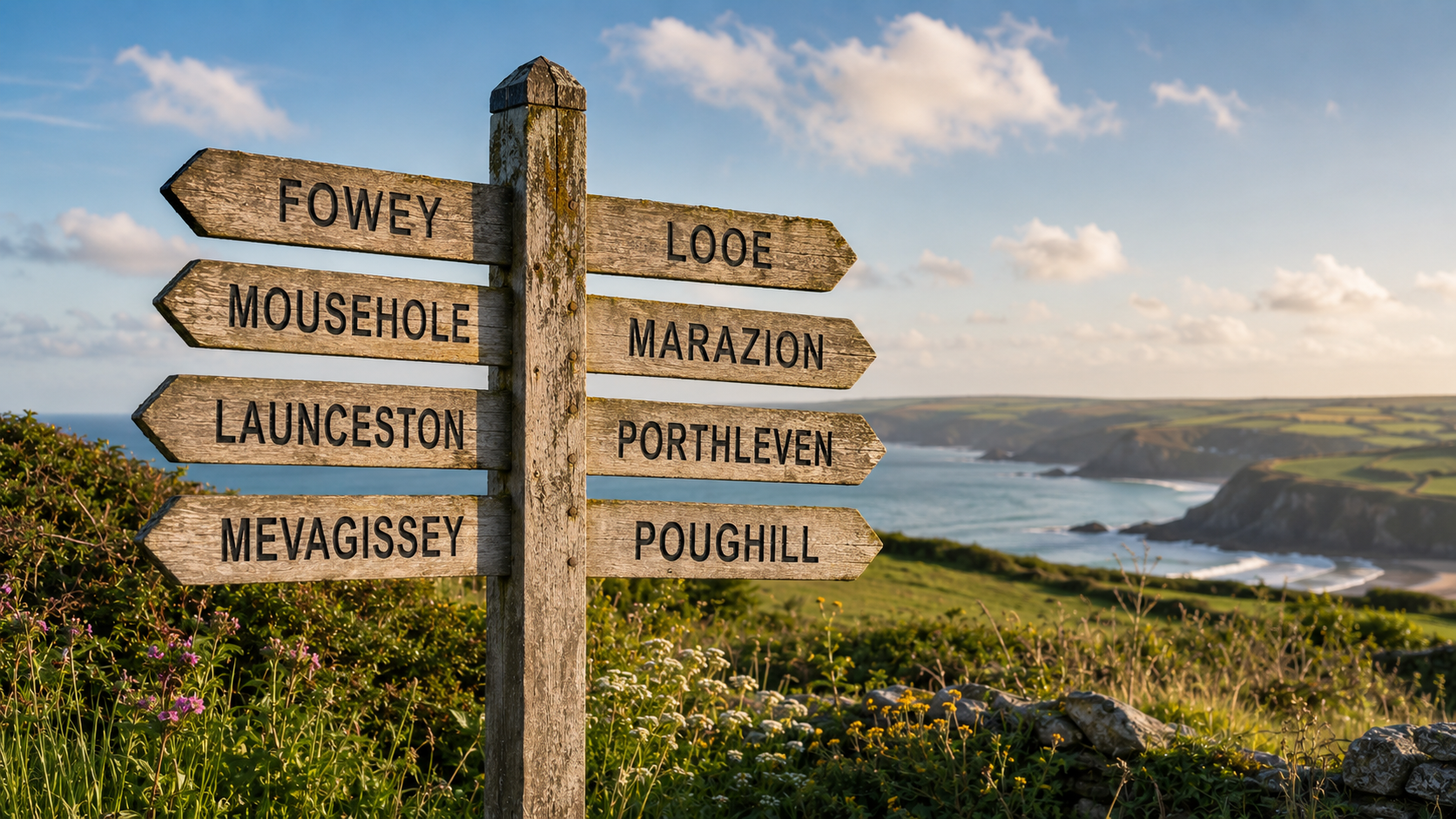
Cornish place names can catch visitors out, from Fowey and Mousehole to Launceston, Mevagissey and Poughill.
Cornish Place Names Visitors Say Wrong: A Practical Pronunciation Guide
I can usually tell when someone has only ever seen Cornwall on a map by the way they say “Mousehole”.
That is not meant cruelly. We have all mangled a place name somewhere unfamiliar. Cornwall just happens to be especially good at setting traps. Some Cornish place names look easy and then behave badly out loud. Some come from Cornish. Some have been softened by local speech over generations. Some seem to be playing a private joke on anyone who has trusted the spelling too much.
Nobody sensible is going to chase you out of a pub for getting one wrong. But learning how to pronounce Cornish place names does make travelling here easier. It helps when you are asking for directions, booking a table, finding a beach, catching a ferry, or trying not to sound as though you have just stepped out of the car after five hours on the A30.
This is my practical guide to the Cornish towns, villages and beach names visitors often say wrong — written in normal speak, not formal phonetics. It is the version you can actually use when you are standing in a car park, squinting at a road sign, wondering whether the sat-nav has betrayed you.
Cornish place names are not just labels on signs. They are little pieces of language, landscape and local memory.
Quick answer: how to pronounce Cornish place names visitors get wrong
Start here if you just want the useful bit.
- Mousehole is pronounced Mow-zul, not Mouse-hole.
- Fowey is pronounced Foy, rhyming with joy, not Fow-ee.
- Launceston is usually Lawn-sten, and locally often Lanson, not Lawn-cess-ton.
- Mevagissey is Mev-uh-GISS-ee, sometimes closer to Mev-a-gizzy, not Mev-a-geesy.
- Marazion is Muh-RAY-zee-un, sometimes softened to Muh-RAY-zhun, not Mara-zion.
- Polzeath is Pol-ZETH or Pul-ZETH, not Pol-zeeth.
- Porthtowan is Porth-TOE-an, not Porthtown.
- Portreath is Por-TREETH, with the ending like teeth, not Port-wreath.
- Zennor is ZEN-uh, not Zen-nor.
- Porthcurno is Porth-KUR-noh, not Porth-curn-oh.
- Redruth is RED-rooth, not Red-ruth.
Keep that list handy and you are already ahead of plenty of visitors.
A quick warning about Cornish pronunciation
This article is about the everyday English place names visitors are most likely to use when travelling around Cornwall. It is not a full Cornish-language lesson, and it is not pretending there is only one accent in Cornwall.
You will hear local variation. Some endings get softened. Some syllables almost disappear. Some families and villages have their own habits. That is part of the charm.
The aim here is simple: to help you say the names well enough that people know where you mean, and to save you from the most obvious visitor mistakes.
Why Cornish place names are so easy to mispronounce
Cornish place names carry far more than directions. They hold bits of language, old saints, farms, coves, rivers, headlands, mining country and working harbours.
Once you know a few common elements, the map starts to make more sense:
- Porth often points to a cove, harbour or landing place.
- Pen often means head, end, top or headland.
- Tre is common in settlement and farmstead names.
- Pol can be linked with water, pools or watercourses.
- Lan often appears around enclosures, church sites or older settlements.
That does not mean you can decode every Cornish town, village or beach perfectly from a road sign. Cornwall has had centuries of spoken usage, English spellings, Cornish roots, anglicised forms and local shortcuts. The spelling might tell part of the story, but the sound is often what has survived in people’s mouths.
In other words: do not be embarrassed if the letters lead you astray. They have led plenty of people astray before you.
How to pronounce the Cornish places visitors say wrong
Mousehole pronunciation: Mow-zul
Let’s begin with the one that catches almost everyone.
Mousehole is pronounced Mow-zul. Not Mouse-hole. Not Mousey-hole. Not anything involving a small rodent and a skirting board.
Mousehole sits on the western side of Mount’s Bay, just beyond Newlyn and a few miles from Penzance. It is one of Cornwall’s best-known fishing villages, with a small harbour, narrow lanes, sea views, galleries, gift shops and places to eat tucked into the streets around the water.
It is exactly the sort of place where pronunciation matters because so many visitors actively seek it out. In summer, the village can be busy with day-trippers. In winter, the Christmas lights bring a completely different mood, especially after dark when the harbour becomes the focus.
Practical note: parking can be tight in and around Mousehole, especially in peak season and during the lights. Treat it as a slow visit. Park sensibly, expect to walk, and do not try to force a quick stop into a village that was not built around modern traffic.
The easy way to remember it: Mow-zul sits somewhere close to “nozzle”. Once you have said it a couple of times, “Mouse-hole” starts to sound faintly ridiculous.
Fowey pronunciation: Foy
Fowey looks as though it wants to be “Fow-ee”. It does not.
Fowey is pronounced Foy, rhyming with joy or toy. This is one of those names that marks out the visitor because the wrong version often sounds so confident.
Fowey sits on the west side of the Fowey estuary, with Polruan across the water. It is a steep, handsome harbour town with narrow streets, independent shops, pubs, restaurants, river traffic and a strong literary connection with Daphne du Maurier. It feels coastal, but it is just as much a river town: boats, ferries, tides and estuary views shape the place.
Practical note: Fowey is not a town I would try to drive through casually. The streets are narrow and steep, and summer traffic can quickly turn a simple plan into a slow crawl. Use the main car parks above the town where possible and walk down. Your knees may notice the return journey, but your stress levels will thank you.
In short: keep it simple. Foy.
Launceston pronunciation: Lawn-sten, or Lanson if you are local
Launceston is where Cornwall tests your nerve.
The mistake is Lawn-cess-ton, with every syllable politely introduced. In Cornwall, you will usually hear Lawn-sten. Around the town and in local speech, you may also hear Lanson.
Launceston sits in north-east Cornwall, close to the Devon border and the Tamar. It is often thought of as a gateway into Cornwall, partly because of its position near the A30, but it deserves more than a passing glance. This is an old market town with a castle above it, historic streets, independent shops and a proper inland Cornish feel.
I like Launceston because it reminds you that Cornwall is not only beaches and harbour walls. It is also farms, markets, moorland edges, old roads, chapels, castles and working towns. If you are heading towards Bodmin Moor, the Tamar Valley, Crackington Haven, Boscastle or Bude, it sits in a useful position.
Practical note: Launceston is a good stop when you want a break from the obvious coastal route. The castle gives you the history and the views; the town gives you a more everyday Cornwall than the postcard resorts.
Visitor-safe version: Lawn-sten.
Local version you may hear: Lanson.
Mevagissey pronunciation: Mev-uh-GISS-ee
Mevagissey looks longer than it feels. The trick is not to overwork it.
Say Mev-uh-GISS-ee, with the stress on GISS. You may also hear it come out closer to Mev-a-gizzy in everyday speech. What you want to avoid is Mev-a-geesy, Mev-a-jissy, or any version where every letter has been given its own little moment.
Mevagissey is a fishing village on the south coast, not far from St Austell. Its lanes drop towards a busy harbour where working boats, visitor boats, pubs, cafés and seafood all crowd around the water. It is pretty, yes, but it is not just decorative. The harbour still gives the place its rhythm.
It also sits close to the Lost Gardens of Heligan, which makes it an easy pairing for a full day out: gardens first, harbour later, or the other way round if you prefer your day to end with something fried, grilled or poured into a pint glass.
Practical note: do not drive into the heart of Mevagissey unless you genuinely need to. The central streets are narrow and can be awkward when busy. Park on the way in and walk down. It is the better way to arrive anyway.
The weight belongs in the middle: Mev-uh-GISS-ee.
Marazion pronunciation: Muh-RAY-zee-un
Marazion catches people because of the “zion” ending. It is not usually said as though you are reading from a pulpit.
The everyday version is Muh-RAY-zee-un, with the stress in the middle. You may also hear it softened closer to Muh-RAY-zhun.
Marazion sits on Mount’s Bay facing St Michael’s Mount, which is one of Cornwall’s great views no matter how many times you have seen it. The town has beaches, galleries, cafés, pubs and long views across the water. It is one of those places where a simple walk can feel like the main event.
The key thing here is the tide. St Michael’s Mount is a tidal island, reached by the cobbled causeway at low tide and by boat when conditions and seasonal services allow.
Practical note: plan Marazion around the tide, weather and access rather than assuming you can cross whenever you fancy. The Mount is part of the magic, but the sea sets the terms.
And yes, this is a very good place for a pasty with a view.
Say it cleanly: Muh-RAY-zee-un.
Polzeath pronunciation: Pol-ZETH or Pul-ZETH
Polzeath is a north coast favourite: surfers, families, sandy feet, wetsuits, chips, gulls and a beach that changes character with the tide and weather.
The common visitor mistake is to say Pol-zeeth. Keep it shorter and flatter: Pol-ZETH or Pul-ZETH.
It sits near the Camel Estuary, with Rock, Daymer Bay and Padstow all within the wider orbit. In high summer, Polzeath is lively and busy. Out of season, it can be much quieter and better for a long beach walk or a proper stare at the Atlantic.
Practical note: Polzeath is a surf beach, so conditions matter. On a gentle day it can feel friendly and easy. When the swell is up, take the sea seriously. Use lifeguarded areas when they are operating, follow the flags, and do not treat a beautiful beach like a swimming pool.
The ending is short: Pol-ZETH, not Pol-zeeth.
Porthtowan pronunciation: Porth-TOE-an
Porthtowan often gets squashed into “Porthtown”. That is understandable, but wrong.
Say Porth-TOE-an. Keep the middle softer than it looks and do not turn the whole thing into one word that sounds like a housing estate.
This is a beach village between St Agnes and Portreath, backed by cliffs and mining country. It is a strong surf spot with a wide sandy beach at low tide, good sunsets and easy access to some properly dramatic north coast walking.
This part of Cornwall is brilliant because the landscape changes so quickly. One minute you are on sand, the next you are looking at cliffs, engine houses, heathland and old mining routes. It is a reminder that the coast here is not just pretty; it has been worked, lived in and fought with.
Practical note: at low tide the beach feels spacious; at high tide it is a different place. Check the tide before planning a full beach day, and keep an eye on the sea if you are walking below cliffs.
The mistake to avoid is Porthtown. Give it the extra breath: Porth-TOE-an.
Portreath pronunciation: Por-TREETH
Portreath looks simple, which is probably why people sometimes overthink it.
It is Por-TREETH, with the ending like “teeth”. Not Port-wreath.
Portreath is a compact north coast village with a beach, harbour, pubs, cafés and a strong mining-history backdrop. It once had a much more industrial role, tied into Cornwall’s copper and mining economy. Today, many visitors come for the beach, the coast path, the harbour and its handy position between Godrevy, Gwithian, Redruth and St Agnes.
It is also a good example of a place where Cornwall’s beauty and industry sit side by side. The harbour is not just there for the photos. The landscape around it carries the marks of work.
Practical note: the coast path around Portreath is excellent, but the cliffs are not forgiving. Keep back from edges, especially after bad weather, and keep dogs under proper control.
Keep the ending clear: Por-TREETH.
Zennor pronunciation: ZEN-uh
Zennor is short, atmospheric and often slightly over-pronounced.
Keep it simple: ZEN-uh.
This is West Penwith at its most brooding: granite, fields, old lanes, sea cliffs, weather, folklore and that feeling of being somewhere older than the road you arrived on. Zennor is linked with the famous mermaid legend at the church, and it sits on one of the most memorable stretches between St Ives and St Just.
It is not a big resort, and that is the point. Zennor is for walkers, folklore lovers, slow drivers, pub stops and people who like Cornwall with a bit of wind in it.
Practical note: the walking around Zennor can be rougher and more tiring than it looks on a map. Bring proper footwear, allow time, and do not underestimate the coast path just because the distance looks modest.
Short and soft wins here: ZEN-uh.
Porthcurno pronunciation: Porth-KUR-noh
Porthcurno is often said carefully and still comes out wrong. The easiest version is Porth-KUR-noh.
Do not make every letter work too hard. Let the middle do the job.
This is far west Cornwall at its most spectacular: pale sand, blue-green water on a good day, steep cliffs and the Minack Theatre above the bay. It is one of those places that looks almost unreal in photographs and still manages to surprise you in person.
It also gets busy because it is not a secret. The roads are narrow, the parking can fill, the paths are steep, and the beach is not the sort of place to treat casually if conditions are poor.
Practical note: if you are combining Porthcurno with the Minack, Porthgwarra, Land’s End or a coast path walk, give yourself more time than the mileage suggests. Far west Cornwall rewards patience and punishes rushing.
Do not over-polish it. Porth-KUR-noh is enough.
Redruth pronunciation: RED-rooth
Redruth is not usually the one visitors worry about first, but it still gets mangled.
It is RED-rooth, with the second half like “tooth”. Not Red-ruth, as though you are talking about someone called Ruth who has had a dramatic afternoon.
Redruth sits at the heart of Cornwall’s mining story. This is not the soft-focus Cornwall of white cottages and turquoise coves. It is engine houses, chapels, industry, invention, migration and hard graft. If you want to understand why Cornish mining matters, Redruth and nearby Camborne are essential.
It is also a practical inland base. You are close to Portreath, St Agnes, Carn Brea, Heartlands and the A30. Visitors who only chase the prettiest harbour towns miss a lot of Cornwall’s backbone.
Practical note: Redruth is best approached with curiosity rather than a beach-day mindset. Look for mining heritage, independent places, local events and the wider story of Cornwall’s industrial past.
Think tooth, not Ruth: RED-rooth.
More Cornish names worth listening for
Once you start noticing Cornish pronunciation, you will hear little traps everywhere. I would not cram every single one into a first visit, but these are worth keeping in your back pocket:
- Praa Sands — usually Pray Sands, not Prah Sands.
- Perranporth — PERR-an-porth, not Perran-worth.
- Gwithian — often GWITH-ee-an, with the opening sound kept fairly tight.
- Mawnan Smith — MAW-nan Smith, not Man-an.
- Porthleven — commonly Porth-LEV-en, though you may hear the first half softened locally.
- St Just — said as it looks, but often quickly; do not turn it into something grander than it is.
- Penzance — usually Pen-ZANS, not Pen-zarnce.
The bigger lesson is not to memorise the whole map. It is to listen. Cornwall will teach you quickly if you let it.
Tips for pronouncing Cornish place names
There is no perfect rulebook, but these habits will save you from the most obvious traps.
- Do not trust the spelling too much. Fowey and Mousehole are the warnings.
- Do not over-pronounce every syllable. Launceston is the classic example.
- Listen to local shortcuts. They are often the living version of the name.
- Treat “porth”, “pen”, “tre”, “pol” and “lan” as clues, not guarantees.
- Do not panic if you get it wrong. Correct it, smile, move on.
One of the best ways to learn Cornwall is simply to listen: to bus drivers, harbour staff, shopkeepers, bar staff, walking guides and the person in front of you ordering a coffee. Place names live in everyday speech more than they live on signs.
FAQ: Cornish place names and pronunciation
How do you pronounce Mousehole in Cornwall?
Mousehole is pronounced Mow-zul. It is one of the most common Cornish place names visitors say wrong because the spelling looks so obvious. The “mouse” and “hole” parts are not pronounced separately.
How do you pronounce Fowey?
Fowey is pronounced Foy, rhyming with joy. Do not say Fow-ee. It is a small word, and the pronunciation is smaller than the spelling makes it look.
How do locals pronounce Launceston?
Many people in Cornwall say Lawn-sten, while locals around the town often use Lanson. The version to avoid is Lawn-cess-ton, with all three syllables pushed too hard.
How do you pronounce Mevagissey?
Mevagissey is usually pronounced Mev-uh-GISS-ee, with the stress in the middle. In everyday speech you may hear it soften towards Mev-a-gizzy.
How do you pronounce Marazion?
Marazion is usually pronounced Muh-RAY-zee-un, with the stress on the middle syllable. Some speakers soften the ending, so it can sound closer to Muh-RAY-zhun.
Why are Cornish place names hard to say?
Many Cornish place names come from Cornish language roots, older local speech, saints’ names, landscape features and anglicised spellings. The written form does not always match the everyday pronunciation, which is why names such as Mousehole, Fowey and Launceston catch so many visitors.
What does “porth” mean in Cornish place names?
Porth often refers to a cove, harbour, port or landing place. You see it in names such as Porthtowan, Portreath, Porthcurno, Porthleven and Perranporth. It is a useful clue that the sea is probably nearby, but it does not tell you the whole pronunciation.
What are the most mispronounced places in Cornwall?
The big ones are usually Mousehole, Fowey, Launceston, Mevagissey, Marazion, Polzeath, Porthtowan, Portreath, Zennor and Porthcurno. They are popular with visitors, appear often on maps and signs, and do not always sound the way they look.
Is there one correct way to pronounce every Cornish place name?
Not always. There is often a widely recognised everyday pronunciation, but local accents and family habits can vary. The safest approach is to learn the common visitor-friendly version, then listen to how people nearby say it.
Final word
Cornish place names are part of the pleasure of being here. They slow you down. They remind you that Cornwall is not a theme park or a backdrop, but a place with its own language, history, humour and sound.
Get Mousehole and Fowey right and you are already ahead of plenty of visitors. Add Launceston, Mevagissey and Marazion, and you will feel far more confident moving around the map. Learn the beach names as you travel and Cornwall starts to become less of a puzzle and more of a conversation.
And if you still get one wrong? Do the sensible thing: laugh, try again, and buy the next round.