
Details
Address & Contact
Mevagissey
Cornwall
PL26 6EL
United Kingdom
Sorry, no records were found. Please adjust your search criteria and try again.
Sorry, unable to load the Maps API.
The Lost Gardens of Heligan: is it worth visiting? My practical Cornwall guide
The Lost Gardens of Heligan is one of Cornwall’s best-known days out, but that does not automatically mean it is right for everyone.
So here is my honest answer: yes, The Lost Gardens of Heligan is worth visiting if you give it enough time and treat it as a full estate, not a quick garden stroll. It is one of Cornwall’s strongest paid attractions because it gives you history, woodland, rare breed animals, family space, food, wildlife, working gardens and the famous Jungle in one place.
It is not the cheapest short stop in Cornwall. It is not completely flat. It is not somewhere I would rush around in an hour and a half. But if you want a proper Cornwall day out with depth, character and a real sense of place, Heligan earns its reputation.
For me, the appeal is simple. Heligan is beautiful, but beauty is not the main reason to go. The reason to go is that it still feels worked, remembered and alive.
Heligan feels like a garden with a memory, not a visitor attraction with a planting scheme.
Quick answer: should you visit The Lost Gardens of Heligan?
Visit Heligan if you want a full Cornwall day out with more to it than a pretty view. It works especially well for garden lovers, families, walkers, dog owners, wildlife watchers and anyone interested in Cornwall’s working land and local history.
Think twice if you only want a cheap quick stop, a fully flat attraction, or somewhere compact where everything is close together. Heligan is large, sloped in places and much better when you slow down.
My verdict: go, but do it properly. Give it at least three hours, wear decent shoes, build in time for food, and do not leave the Jungle or Productive Gardens until the end.
The Lost Gardens of Heligan at a glance
Best for: garden lovers, families, walkers, dog owners, local history, wildlife, food-minded visitors and slower Cornwall days out
Location: Pentewan, near Mevagissey and St Austell
Postcode: PL26 6EN
Allow: at least three hours, ideally longer
Dogs: welcome all year on short leads
Food: Heligan Kitchen and Bakery, the Steward’s House and seasonal outlets
Good to know: the estate is large, with slopes, uneven sections and different terrain across the site
Best nearby pairing: Mevagissey, Pentewan, Charlestown or St Austell Bay
Where is The Lost Gardens of Heligan?
The Lost Gardens of Heligan is near Pentewan, close to Mevagissey and St Austell. That makes it a strong choice if you are staying around Mevagissey, Charlestown, Pentewan, St Austell Bay or the wider south coast.
If you are driving, the sensible route is usually through St Austell and then along the B3273 towards Mevagissey, following the brown tourist signs. That is not filler advice. Sat nav can be too confident in Cornwall, and the shortest route is not always the route you want, especially if it starts pulling you through narrow lanes in a bigger car.
St Austell is the nearest railway station, around five miles from Heligan. There are bus and taxi options from there, and the bus stop is inside the Heligan car park. Heligan is also linked to National Cycle Network Route 3, with traffic-free connections from Mevagissey, Pentewan and St Austell.
If you are walking the South West Coast Path, Heligan sits about a mile and a half inland. That makes it possible as a proper inland detour from the coast rather than a completely separate day.
Why The Lost Gardens of Heligan is famous
Heligan’s story is a huge part of its pull.
The estate gardens reached their peak in the late nineteenth and early twentieth centuries. Then came the First World War. Gardeners and estate workers left, many did not return, and the gardens slipped into neglect. Bramble, ivy and time took over.
The modern restoration began after the gardens were rediscovered in 1990. One of the most moving details is the Thunderbox Room, where the names of gardeners were found on the wall beneath the date August 1914. That discovery helped turn Heligan into more than a garden restoration. It became a living memorial to the people who worked the land before the war changed everything.
That is why Heligan lands differently from many big attractions. You are not just looking at restored planting. You are walking through a story of work, loss, neglect, rediscovery and stewardship.
What is there to see at The Lost Gardens of Heligan?
Heligan covers more than 200 acres, so do not treat it like a quick stop. It is a half-day at minimum and can easily become a full day if you like to wander properly, eat on site, visit the farm, let children play, or take your time through the wider estate.
The main areas to know are:
- The Productive Gardens
- The Pleasure Grounds
- The Jungle
- The woodland and wider estate
- The farm and wildlife areas
- The family play spaces
- The food, shop and plant centre around the main visitor area
That range is what makes Heligan work. It is not one-note. You can visit for serious gardening, family adventure, food, woodland walking, local history or wildlife and still feel you have had a proper day.
What not to miss at The Lost Gardens of Heligan
If it is your first visit, these are the sections I would prioritise.
The Productive Gardens
The Productive Gardens are Heligan’s working heart. This is where you find the Kitchen Garden, walled Flower Garden and Melon Yard, along with traditional crops, heritage varieties, glasshouse fruit, Victorian growing methods and atmospheric working buildings.
This is the part of Heligan that connects the estate’s past with what is still happening now. You can see the growing spaces, then eat food shaped by the estate around you. That gives the visit more substance than a standard garden attraction.
Do not rush the Thunderbox Room either. It is one of the details that gives Heligan its emotional weight.
The Jungle
The Jungle is probably the section most first-time visitors remember.
It sits in a steep-sided valley with a warmer microclimate than the gardens above it, which allows the exotic planting to thrive. Expect raised boardwalks, ponds, giant rhubarb, bananas, palms, bamboo, tree ferns and that very Cornish trick of making you feel as though you have stepped much further from home.
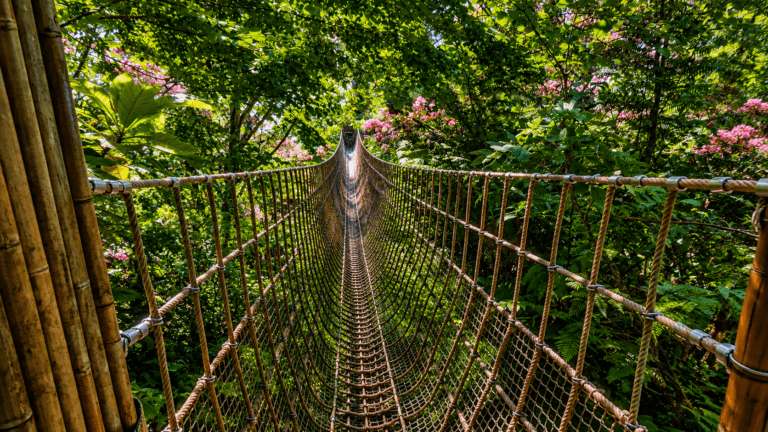
The Burmese Rope Bridge gives it theatre. It adds enough wobble and drama to make the Jungle memorable without turning the estate into a theme park.
The Jungle is not the easiest part of Heligan for everyone. There are slopes, boardwalks and steps, so visitors with mobility concerns should plan carefully rather than assuming every route will be straightforward.
The Pleasure Grounds
The Pleasure Grounds are the more romantic side of Heligan. These are the historic ornamental gardens, first laid out over 200 years ago, with old pathways, unusual structures, mature planting and a more designed estate-garden feel.
This is where Heligan’s mild Cornish climate really shows itself. The camellias and rhododendrons are a major feature, including historic plantings that give the gardens their spring colour and scale.
But the Pleasure Grounds are not just about floral display. They have atmosphere: older trees, hidden corners, the Italian Garden, the Sundial Garden and views that remind you how close you are to the south coast.
The woodland sculptures
Heligan’s woodland gives the estate a different rhythm.
This is where you find the Giant’s Head, the Mud Maid and the Grey Lady sculptures, tucked into the landscape rather than dropped in as obvious photo props. They work because they feel as though they belong there.
The woodland and wider estate are best taken slowly. Expect old paths, ponds, wildflowers, trees, quieter corners and a more earthy feel than the formal garden areas.
The farm and wildlife areas
Heligan is also strong because it is more than ornamental planting. The estate has wildlife habitats, farm animals and working land woven through the visit.
That is another reason I rate it. It has moved beyond “come and look at our garden” into something more rounded: land, food, wildlife, history and people all connected.
Best route around Heligan for a first visit
There is no single perfect route, but I would avoid drifting randomly if it is your first time. Heligan is big enough that a loose plan helps.
For a balanced visit, I would do this:
- Start with the Productive Gardens while your attention is fresh.
- Move through the Pleasure Grounds if you want the ornamental and historic side.
- Head for The Jungle before tired legs properly set in.
- Stop for food rather than pushing too long.
- Finish with the woodland sculptures, farm areas or Play Meadow, depending on who you are with.
With children, I would not save every exciting bit until the end. Use the Jungle and Play Meadow as part of the rhythm of the day, not as emergency bribery when everyone is already worn out.
Is The Lost Gardens of Heligan good for families?
Yes, and not in the half-hearted “children are allowed too” way.
Heligan is strong for families because children are not expected to quietly admire borders all day. There is proper space for them to move, climb, wander and explore.
The Jungle Rope Bridge is an obvious win, but there is more than that. Heligan has a large Play Meadow, climbing and scrambling areas, swings, slides, farm animals, a bug hotel and outdoor places where children can burn off energy without the day becoming a forced march between adult-only garden features.
For families, I would plan the visit like this:
- Start with the gardens while everyone still has energy.
- Work towards the Jungle before tired legs properly set in.
- Stop for food rather than pushing too long.
- Save the Play Meadow or farm animals for a second burst.
- Do not try to see every acre in one visit with younger children.
The estate is big. That is part of the appeal, but it also means you need to pace it properly.
Food and drink at The Lost Gardens of Heligan
Food is one of the reasons Heligan feels more substantial than a standard gardens day out.
There is the Heligan Kitchen and Bakery, the Steward’s House and seasonal food outlets, with the food offer built around garden produce, estate-reared meat and local ingredients where possible. Menus change with the season, but the broad shape is breakfast, lunch, cakes, hot and cold drinks and family-friendly options.
The important point is that the food does not feel separate from the gardens. The Productive Gardens feed into the kitchen, and that gives the visit more coherence. You are not just buying lunch because you happen to be hungry. You are eating within the same estate system you have just been walking through.
You do not need garden admission to use the Heligan Kitchen, Garden Bites Takeaway, Shop or Plant Centre. That makes Heligan useful even if you are nearby and not doing the full gardens that day.
If you are making a full visit, build food into the plan. Arrive early, walk first, eat properly, then use the afternoon for the Jungle, woodland or farm. Heligan is a better day out when you stop rather than trying to squeeze it into a rushed slot.
Can you take dogs to The Lost Gardens of Heligan?
Yes. Heligan is dog friendly all year round, which makes it much more useful for both locals and visitors travelling with dogs.
Dogs need to be kept on short leads, which is sensible given the livestock, poultry, wildlife and other visitors around the estate. Dogs on leads are also welcome in key food areas, so you are not left trying to work out where one of you can sit while the other disappears for food.
There are dog waste bins around the gardens, marked on the garden map.
Do not plan a visit that involves leaving your dog in the car. Cornwall can heat up quickly in the main visitor season, and Heligan does not provide shaded dog parking.
Accessibility at The Lost Gardens of Heligan
Accessibility at Heligan needs an honest answer, because the estate is large and the terrain matters.
Some parts are much easier than others. Around 13 acres can be accessed by even paths, including the Productive Gardens, Pleasure Grounds, Home Farm and the Steward’s House. The wider estate, the Jungle and some woodland routes are more challenging, with gradients, steps and boardwalks.
The general pattern is simple: the outward route is often downhill, and the return route is often uphill. That is worth knowing before you wander too far without thinking about the way back.
There are accessible parking bays near the entrance, accessible toilets, baby changing facilities and further facilities inside the gardens at the Steward’s House. Manual wheelchairs and Tramper hire are available, but availability and booking arrangements matter.
My practical advice: if mobility is a concern, plan the visit around the most suitable areas and ask for route advice when you arrive. Heligan has made meaningful provision, but the natural shape of the estate is still part of the day.
Tickets, parking and opening times
The Lost Gardens of Heligan is a paid attraction, and it is priced like one of Cornwall’s major days out rather than a casual quick stop. That does not make it poor value, but it does mean you should give it enough time to justify the ticket.
This is not somewhere I would rush around for 90 minutes. If you only want a short stroll, there are cheaper ways to spend a morning in Cornwall. Heligan becomes good value when you use the estate properly: gardens, Jungle, food, woodland, farm, play areas and a slower wander.
Opening is daily, with pre-booking advisable for day visitors. Last entry is earlier than closing, so do not turn up late in the afternoon expecting to do the place justice.
Parking is available, but busy periods can put pressure on the main car park. Free spaces in the main Heligan car park are limited and prioritised for Blue Badge holders, local pass holders and Heligan members. Nearby overflow parking may involve a charge.
The sensible approach is simple: go early, wear decent shoes, allow more time than you think, and do not leave the best parts until the end of the day.
How long do you need at The Lost Gardens of Heligan?
Give Heligan at least three hours. Four is better. A relaxed full day is completely reasonable if you want food, the Jungle, the Productive Gardens, woodland sculptures, farm animals and the family areas.
For a first visit, I would prioritise:
- The Productive Gardens
- The Jungle
- The woodland sculptures
- A proper food stop
- The Play Meadow and farm animals if visiting with children
- The Pleasure Grounds if you are there for plants and seasonal colour
The big mistake is treating Heligan like a list of things to tick off. It is better when you let it unfold.
Best time to visit The Lost Gardens of Heligan
Heligan has year-round value, but the feel changes with the seasons.
Spring is excellent for camellias, rhododendrons, fresh growth, blossom and that lift you get in Cornish gardens when everything starts moving again. Summer gives you the fullest family day out, outdoor eating, longer wandering time and the lushest Jungle atmosphere. Autumn can be brilliant for colour, harvest and a slightly quieter estate feel. Winter is more stripped back, but that can suit the history of the place: old walls, working gardens, woodland paths and the restoration story sitting closer to the surface.
If you are visiting in peak summer, I would go earlier in the day. You will usually have a calmer start, more time before last entry, and a better chance of enjoying the busiest areas before the estate fills up.
What to wear and take to Heligan
You do not need specialist gear, but you should dress for an outdoor estate rather than a paved town attraction.
I would take:
- Comfortable shoes with enough grip for slopes and woodland paths.
- A waterproof or extra layer, especially outside high summer.
- Water, particularly if you are walking the wider estate.
- A sturdy pushchair if visiting with small children.
- A lead, water bowl and sensible plan if taking a dog.
- Time, which sounds obvious but is the thing people most often under-allow.
Heligan is much more enjoyable when you are not clock-watching or trying to force it into the wrong kind of day.
What to do near The Lost Gardens of Heligan
Heligan sits in a useful part of south Cornwall, so it can pair well with a wider day out if you plan sensibly.
The closest obvious add-ons are:
- Mevagissey, for the harbour, food, pubs and a proper fishing village feel.
- Pentewan, for the beach and coast path access.
- Charlestown, for harbour views and a strong historic setting.
- St Austell Bay, if you want to keep the day coastal.
- The South West Coast Path, if you want to turn Heligan into part of a bigger walking day.
I would not cram too much in if you are paying for Heligan admission. The estate deserves time. But if you are staying nearby, Heligan and Mevagissey make a very natural pairing.
Who The Lost Gardens of Heligan is best for
The Lost Gardens of Heligan is best for people who like a day out with layers.
It is excellent for:
- Garden lovers who want more than a quick floral display.
- Families who need space, play and a bit of adventure.
- Dog owners looking for a proper dog-friendly Cornwall attraction.
- Visitors interested in local history and restoration stories.
- Food-minded people who care about produce, land and seasonality.
- Walkers who want woodland, slopes, paths and estate views.
- Visitors staying near Mevagissey, Pentewan, Charlestown or St Austell.
It is less ideal if you want a cheap quick stop, a fully flat route, or a compact attraction where everything is close together.
The hills matter. The ticket price matters. The weather matters. Your footwear matters. If you arrive expecting a small manicured garden, you may not get the best from it.
But if you treat Heligan as a working estate with gardens, woodland, food, history and family space, it makes far more sense.
FAQs about The Lost Gardens of Heligan
Is The Lost Gardens of Heligan worth visiting?
Yes, Heligan is worth visiting if you want a proper Cornwall day out rather than a quick stop. It is best for people who enjoy gardens, woodland, food, wildlife, history, family space and slow exploring. It becomes better value when you allow enough time to see the main areas properly.
How long do you need at The Lost Gardens of Heligan?
I would allow at least three hours. Four hours is better, especially if you want to see the Productive Gardens, Jungle, woodland sculptures, farm areas and stop for food. A relaxed full day is not too much if you are visiting with children or like to wander slowly.
Can dogs go to The Lost Gardens of Heligan?
Yes, dogs are welcome at Heligan all year round. They need to stay on short leads, and dog bins are marked on the garden map. Dogs are also welcome in key food areas, which makes the visit much easier if you are travelling with one.
Is The Lost Gardens of Heligan suitable for children?
Yes. Heligan is a strong family day out because it has the Jungle Rope Bridge, Play Meadow, farm animals, woodland areas and lots of outdoor space. The estate is large, so with younger children I would pace the visit carefully and avoid trying to see everything.
Is The Lost Gardens of Heligan pushchair friendly?
Some areas are easier with a pushchair than others. The Productive Gardens, Pleasure Grounds, Home Farm and Steward’s House areas are more manageable, but the Jungle and wider estate include slopes, boardwalks and steps. A sturdy pushchair is better than a lightweight one if you plan to explore more widely.
Is The Lost Gardens of Heligan wheelchair accessible?
Parts of Heligan are accessible, but not the whole estate. Around 13 acres can be reached by even paths, while the Jungle and some wider estate routes are more challenging. The outward route is often downhill and the return route uphill, so route planning matters.
Is there food at The Lost Gardens of Heligan?
Yes. Heligan has the Kitchen and Bakery, the Steward’s House and seasonal food outlets. The food offer is one of the stronger parts of the visit because it connects back to the estate’s Productive Gardens, produce and food story.
Do you need to book The Lost Gardens of Heligan?
Pre-booking is advisable, especially for day visitors and during busier periods. Opening is daily, but times, ticket details and last entry can vary by season, so it is better to plan the visit rather than leaving it to a late-afternoon gamble.
Is parking free at The Lost Gardens of Heligan?
There are limited free spaces in the main Heligan car park, prioritised for Blue Badge holders, local pass holders and Heligan members. Nearby overflow parking may involve a charge. In busy periods, I would arrive early rather than assuming parking will be simple.
What is near The Lost Gardens of Heligan?
Heligan is close to Mevagissey, Pentewan and St Austell. It also works well with Charlestown, St Austell Bay and parts of the South West Coast Path if you are planning a broader south Cornwall day out.
Is The Lost Gardens of Heligan better than the Eden Project?
They are very different. Eden is stronger if you want a big, modern, global plant-and-environment attraction. Heligan is stronger if you want a historic Cornish estate, working gardens, woodland, local food connection and a more layered sense of place. I would not treat one as a direct replacement for the other.
My verdict: should you visit The Lost Gardens of Heligan?
I’d happily recommend The Lost Gardens of Heligan.
It is absolutely worth visiting, and not just because it is famous.
Heligan is one of Cornwall’s strongest days out because it has range. Garden lovers get serious horticulture. Families get adventure and space. Food-minded visitors get a real link between growing and eating. Dog owners get a proper walk. People who care about history get a restoration story with emotional weight. Wildlife lovers get an estate that is clearly thinking beyond ornamental display.
The mistake would be treating Heligan as only a garden. It is more like a working Cornish estate that has been opened up carefully enough for visitors to understand it.
That is what makes it stand out.
Go with enough time, decent footwear, a plan for food and a willingness to wander. Heligan rewards curiosity. It is beautiful, yes, but the real reason to go is that it still feels alive.
Video Guide
The Lost Gardens of Heligan: is it worth visiting? My practical Cornwall guide
The Lost Gardens of Heligan is one of Cornwall’s best-known days out, but that does not automatically mean it is right for everyone.
So here is my honest answer: yes, The Lost Gardens of Heligan is worth visiting if you give it enough time and treat it as a full estate, not a quick garden stroll. It is one of Cornwall’s strongest paid attractions because it gives you history, woodland, rare breed animals, family space, food, wildlife, working gardens and the famous Jungle in one place.
It is not the cheapest short stop in Cornwall. It is not completely flat. It is not somewhere I would rush around in an hour and a half. But if you want a proper Cornwall day out with depth, character and a real sense of place, Heligan earns its reputation.
For me, the appeal is simple. Heligan is beautiful, but beauty is not the main reason to go. The reason to go is that it still feels worked, remembered and alive.
Heligan feels like a garden with a memory, not a visitor attraction with a planting scheme.
Quick answer: should you visit The Lost Gardens of Heligan?
Visit Heligan if you want a full Cornwall day out with more to it than a pretty view. It works especially well for garden lovers, families, walkers, dog owners, wildlife watchers and anyone interested in Cornwall’s working land and local history.
Think twice if you only want a cheap quick stop, a fully flat attraction, or somewhere compact where everything is close together. Heligan is large, sloped in places and much better when you slow down.
My verdict: go, but do it properly. Give it at least three hours, wear decent shoes, build in time for food, and do not leave the Jungle or Productive Gardens until the end.
The Lost Gardens of Heligan at a glance
Best for: garden lovers, families, walkers, dog owners, local history, wildlife, food-minded visitors and slower Cornwall days out
Location: Pentewan, near Mevagissey and St Austell
Postcode: PL26 6EN
Allow: at least three hours, ideally longer
Dogs: welcome all year on short leads
Food: Heligan Kitchen and Bakery, the Steward’s House and seasonal outlets
Good to know: the estate is large, with slopes, uneven sections and different terrain across the site
Best nearby pairing: Mevagissey, Pentewan, Charlestown or St Austell Bay
Where is The Lost Gardens of Heligan?
The Lost Gardens of Heligan is near Pentewan, close to Mevagissey and St Austell. That makes it a strong choice if you are staying around Mevagissey, Charlestown, Pentewan, St Austell Bay or the wider south coast.
If you are driving, the sensible route is usually through St Austell and then along the B3273 towards Mevagissey, following the brown tourist signs. That is not filler advice. Sat nav can be too confident in Cornwall, and the shortest route is not always the route you want, especially if it starts pulling you through narrow lanes in a bigger car.
St Austell is the nearest railway station, around five miles from Heligan. There are bus and taxi options from there, and the bus stop is inside the Heligan car park. Heligan is also linked to National Cycle Network Route 3, with traffic-free connections from Mevagissey, Pentewan and St Austell.
If you are walking the South West Coast Path, Heligan sits about a mile and a half inland. That makes it possible as a proper inland detour from the coast rather than a completely separate day.
Why The Lost Gardens of Heligan is famous
Heligan’s story is a huge part of its pull.
The estate gardens reached their peak in the late nineteenth and early twentieth centuries. Then came the First World War. Gardeners and estate workers left, many did not return, and the gardens slipped into neglect. Bramble, ivy and time took over.
The modern restoration began after the gardens were rediscovered in 1990. One of the most moving details is the Thunderbox Room, where the names of gardeners were found on the wall beneath the date August 1914. That discovery helped turn Heligan into more than a garden restoration. It became a living memorial to the people who worked the land before the war changed everything.
That is why Heligan lands differently from many big attractions. You are not just looking at restored planting. You are walking through a story of work, loss, neglect, rediscovery and stewardship.
What is there to see at The Lost Gardens of Heligan?
Heligan covers more than 200 acres, so do not treat it like a quick stop. It is a half-day at minimum and can easily become a full day if you like to wander properly, eat on site, visit the farm, let children play, or take your time through the wider estate.
The main areas to know are:
- The Productive Gardens
- The Pleasure Grounds
- The Jungle
- The woodland and wider estate
- The farm and wildlife areas
- The family play spaces
- The food, shop and plant centre around the main visitor area
That range is what makes Heligan work. It is not one-note. You can visit for serious gardening, family adventure, food, woodland walking, local history or wildlife and still feel you have had a proper day.
What not to miss at The Lost Gardens of Heligan
If it is your first visit, these are the sections I would prioritise.
The Productive Gardens
The Productive Gardens are Heligan’s working heart. This is where you find the Kitchen Garden, walled Flower Garden and Melon Yard, along with traditional crops, heritage varieties, glasshouse fruit, Victorian growing methods and atmospheric working buildings.
This is the part of Heligan that connects the estate’s past with what is still happening now. You can see the growing spaces, then eat food shaped by the estate around you. That gives the visit more substance than a standard garden attraction.
Do not rush the Thunderbox Room either. It is one of the details that gives Heligan its emotional weight.
The Jungle
The Jungle is probably the section most first-time visitors remember.
It sits in a steep-sided valley with a warmer microclimate than the gardens above it, which allows the exotic planting to thrive. Expect raised boardwalks, ponds, giant rhubarb, bananas, palms, bamboo, tree ferns and that very Cornish trick of making you feel as though you have stepped much further from home.
The Burmese Rope Bridge gives it theatre. It adds enough wobble and drama to make the Jungle memorable without turning the estate into a theme park.
The Jungle is not the easiest part of Heligan for everyone. There are slopes, boardwalks and steps, so visitors with mobility concerns should plan carefully rather than assuming every route will be straightforward.
The Pleasure Grounds
The Pleasure Grounds are the more romantic side of Heligan. These are the historic ornamental gardens, first laid out over 200 years ago, with old pathways, unusual structures, mature planting and a more designed estate-garden feel.
This is where Heligan’s mild Cornish climate really shows itself. The camellias and rhododendrons are a major feature, including historic plantings that give the gardens their spring colour and scale.
But the Pleasure Grounds are not just about floral display. They have atmosphere: older trees, hidden corners, the Italian Garden, the Sundial Garden and views that remind you how close you are to the south coast.
The woodland sculptures
Heligan’s woodland gives the estate a different rhythm.
This is where you find the Giant’s Head, the Mud Maid and the Grey Lady sculptures, tucked into the landscape rather than dropped in as obvious photo props. They work because they feel as though they belong there.
The woodland and wider estate are best taken slowly. Expect old paths, ponds, wildflowers, trees, quieter corners and a more earthy feel than the formal garden areas.
The farm and wildlife areas
Heligan is also strong because it is more than ornamental planting. The estate has wildlife habitats, farm animals and working land woven through the visit.
That is another reason I rate it. It has moved beyond “come and look at our garden” into something more rounded: land, food, wildlife, history and people all connected.
Best route around Heligan for a first visit
There is no single perfect route, but I would avoid drifting randomly if it is your first time. Heligan is big enough that a loose plan helps.
For a balanced visit, I would do this:
- Start with the Productive Gardens while your attention is fresh.
- Move through the Pleasure Grounds if you want the ornamental and historic side.
- Head for The Jungle before tired legs properly set in.
- Stop for food rather than pushing too long.
- Finish with the woodland sculptures, farm areas or Play Meadow, depending on who you are with.
With children, I would not save every exciting bit until the end. Use the Jungle and Play Meadow as part of the rhythm of the day, not as emergency bribery when everyone is already worn out.
Is The Lost Gardens of Heligan good for families?
Yes, and not in the half-hearted “children are allowed too” way.
Heligan is strong for families because children are not expected to quietly admire borders all day. There is proper space for them to move, climb, wander and explore.
The Jungle Rope Bridge is an obvious win, but there is more than that. Heligan has a large Play Meadow, climbing and scrambling areas, swings, slides, farm animals, a bug hotel and outdoor places where children can burn off energy without the day becoming a forced march between adult-only garden features.
For families, I would plan the visit like this:
- Start with the gardens while everyone still has energy.
- Work towards the Jungle before tired legs properly set in.
- Stop for food rather than pushing too long.
- Save the Play Meadow or farm animals for a second burst.
- Do not try to see every acre in one visit with younger children.
The estate is big. That is part of the appeal, but it also means you need to pace it properly.
Food and drink at The Lost Gardens of Heligan
Food is one of the reasons Heligan feels more substantial than a standard gardens day out.
There is the Heligan Kitchen and Bakery, the Steward’s House and seasonal food outlets, with the food offer built around garden produce, estate-reared meat and local ingredients where possible. Menus change with the season, but the broad shape is breakfast, lunch, cakes, hot and cold drinks and family-friendly options.
The important point is that the food does not feel separate from the gardens. The Productive Gardens feed into the kitchen, and that gives the visit more coherence. You are not just buying lunch because you happen to be hungry. You are eating within the same estate system you have just been walking through.
You do not need garden admission to use the Heligan Kitchen, Garden Bites Takeaway, Shop or Plant Centre. That makes Heligan useful even if you are nearby and not doing the full gardens that day.
If you are making a full visit, build food into the plan. Arrive early, walk first, eat properly, then use the afternoon for the Jungle, woodland or farm. Heligan is a better day out when you stop rather than trying to squeeze it into a rushed slot.
Can you take dogs to The Lost Gardens of Heligan?
Yes. Heligan is dog friendly all year round, which makes it much more useful for both locals and visitors travelling with dogs.
Dogs need to be kept on short leads, which is sensible given the livestock, poultry, wildlife and other visitors around the estate. Dogs on leads are also welcome in key food areas, so you are not left trying to work out where one of you can sit while the other disappears for food.
There are dog waste bins around the gardens, marked on the garden map.
Do not plan a visit that involves leaving your dog in the car. Cornwall can heat up quickly in the main visitor season, and Heligan does not provide shaded dog parking.
Accessibility at The Lost Gardens of Heligan
Accessibility at Heligan needs an honest answer, because the estate is large and the terrain matters.
Some parts are much easier than others. Around 13 acres can be accessed by even paths, including the Productive Gardens, Pleasure Grounds, Home Farm and the Steward’s House. The wider estate, the Jungle and some woodland routes are more challenging, with gradients, steps and boardwalks.
The general pattern is simple: the outward route is often downhill, and the return route is often uphill. That is worth knowing before you wander too far without thinking about the way back.
There are accessible parking bays near the entrance, accessible toilets, baby changing facilities and further facilities inside the gardens at the Steward’s House. Manual wheelchairs and Tramper hire are available, but availability and booking arrangements matter.
My practical advice: if mobility is a concern, plan the visit around the most suitable areas and ask for route advice when you arrive. Heligan has made meaningful provision, but the natural shape of the estate is still part of the day.
Tickets, parking and opening times
The Lost Gardens of Heligan is a paid attraction, and it is priced like one of Cornwall’s major days out rather than a casual quick stop. That does not make it poor value, but it does mean you should give it enough time to justify the ticket.
This is not somewhere I would rush around for 90 minutes. If you only want a short stroll, there are cheaper ways to spend a morning in Cornwall. Heligan becomes good value when you use the estate properly: gardens, Jungle, food, woodland, farm, play areas and a slower wander.
Opening is daily, with pre-booking advisable for day visitors. Last entry is earlier than closing, so do not turn up late in the afternoon expecting to do the place justice.
Parking is available, but busy periods can put pressure on the main car park. Free spaces in the main Heligan car park are limited and prioritised for Blue Badge holders, local pass holders and Heligan members. Nearby overflow parking may involve a charge.
The sensible approach is simple: go early, wear decent shoes, allow more time than you think, and do not leave the best parts until the end of the day.
How long do you need at The Lost Gardens of Heligan?
Give Heligan at least three hours. Four is better. A relaxed full day is completely reasonable if you want food, the Jungle, the Productive Gardens, woodland sculptures, farm animals and the family areas.
For a first visit, I would prioritise:
- The Productive Gardens
- The Jungle
- The woodland sculptures
- A proper food stop
- The Play Meadow and farm animals if visiting with children
- The Pleasure Grounds if you are there for plants and seasonal colour
The big mistake is treating Heligan like a list of things to tick off. It is better when you let it unfold.
Best time to visit The Lost Gardens of Heligan
Heligan has year-round value, but the feel changes with the seasons.
Spring is excellent for camellias, rhododendrons, fresh growth, blossom and that lift you get in Cornish gardens when everything starts moving again. Summer gives you the fullest family day out, outdoor eating, longer wandering time and the lushest Jungle atmosphere. Autumn can be brilliant for colour, harvest and a slightly quieter estate feel. Winter is more stripped back, but that can suit the history of the place: old walls, working gardens, woodland paths and the restoration story sitting closer to the surface.
If you are visiting in peak summer, I would go earlier in the day. You will usually have a calmer start, more time before last entry, and a better chance of enjoying the busiest areas before the estate fills up.
What to wear and take to Heligan
You do not need specialist gear, but you should dress for an outdoor estate rather than a paved town attraction.
I would take:
- Comfortable shoes with enough grip for slopes and woodland paths.
- A waterproof or extra layer, especially outside high summer.
- Water, particularly if you are walking the wider estate.
- A sturdy pushchair if visiting with small children.
- A lead, water bowl and sensible plan if taking a dog.
- Time, which sounds obvious but is the thing people most often under-allow.
Heligan is much more enjoyable when you are not clock-watching or trying to force it into the wrong kind of day.
What to do near The Lost Gardens of Heligan
Heligan sits in a useful part of south Cornwall, so it can pair well with a wider day out if you plan sensibly.
The closest obvious add-ons are:
- Mevagissey, for the harbour, food, pubs and a proper fishing village feel.
- Pentewan, for the beach and coast path access.
- Charlestown, for harbour views and a strong historic setting.
- St Austell Bay, if you want to keep the day coastal.
- The South West Coast Path, if you want to turn Heligan into part of a bigger walking day.
I would not cram too much in if you are paying for Heligan admission. The estate deserves time. But if you are staying nearby, Heligan and Mevagissey make a very natural pairing.
Who The Lost Gardens of Heligan is best for
The Lost Gardens of Heligan is best for people who like a day out with layers.
It is excellent for:
- Garden lovers who want more than a quick floral display.
- Families who need space, play and a bit of adventure.
- Dog owners looking for a proper dog-friendly Cornwall attraction.
- Visitors interested in local history and restoration stories.
- Food-minded people who care about produce, land and seasonality.
- Walkers who want woodland, slopes, paths and estate views.
- Visitors staying near Mevagissey, Pentewan, Charlestown or St Austell.
It is less ideal if you want a cheap quick stop, a fully flat route, or a compact attraction where everything is close together.
The hills matter. The ticket price matters. The weather matters. Your footwear matters. If you arrive expecting a small manicured garden, you may not get the best from it.
But if you treat Heligan as a working estate with gardens, woodland, food, history and family space, it makes far more sense.
FAQs about The Lost Gardens of Heligan
Is The Lost Gardens of Heligan worth visiting?
Yes, Heligan is worth visiting if you want a proper Cornwall day out rather than a quick stop. It is best for people who enjoy gardens, woodland, food, wildlife, history, family space and slow exploring. It becomes better value when you allow enough time to see the main areas properly.
How long do you need at The Lost Gardens of Heligan?
I would allow at least three hours. Four hours is better, especially if you want to see the Productive Gardens, Jungle, woodland sculptures, farm areas and stop for food. A relaxed full day is not too much if you are visiting with children or like to wander slowly.
Can dogs go to The Lost Gardens of Heligan?
Yes, dogs are welcome at Heligan all year round. They need to stay on short leads, and dog bins are marked on the garden map. Dogs are also welcome in key food areas, which makes the visit much easier if you are travelling with one.
Is The Lost Gardens of Heligan suitable for children?
Yes. Heligan is a strong family day out because it has the Jungle Rope Bridge, Play Meadow, farm animals, woodland areas and lots of outdoor space. The estate is large, so with younger children I would pace the visit carefully and avoid trying to see everything.
Is The Lost Gardens of Heligan pushchair friendly?
Some areas are easier with a pushchair than others. The Productive Gardens, Pleasure Grounds, Home Farm and Steward’s House areas are more manageable, but the Jungle and wider estate include slopes, boardwalks and steps. A sturdy pushchair is better than a lightweight one if you plan to explore more widely.
Is The Lost Gardens of Heligan wheelchair accessible?
Parts of Heligan are accessible, but not the whole estate. Around 13 acres can be reached by even paths, while the Jungle and some wider estate routes are more challenging. The outward route is often downhill and the return route uphill, so route planning matters.
Is there food at The Lost Gardens of Heligan?
Yes. Heligan has the Kitchen and Bakery, the Steward’s House and seasonal food outlets. The food offer is one of the stronger parts of the visit because it connects back to the estate’s Productive Gardens, produce and food story.
Do you need to book The Lost Gardens of Heligan?
Pre-booking is advisable, especially for day visitors and during busier periods. Opening is daily, but times, ticket details and last entry can vary by season, so it is better to plan the visit rather than leaving it to a late-afternoon gamble.
Is parking free at The Lost Gardens of Heligan?
There are limited free spaces in the main Heligan car park, prioritised for Blue Badge holders, local pass holders and Heligan members. Nearby overflow parking may involve a charge. In busy periods, I would arrive early rather than assuming parking will be simple.
What is near The Lost Gardens of Heligan?
Heligan is close to Mevagissey, Pentewan and St Austell. It also works well with Charlestown, St Austell Bay and parts of the South West Coast Path if you are planning a broader south Cornwall day out.
Is The Lost Gardens of Heligan better than the Eden Project?
They are very different. Eden is stronger if you want a big, modern, global plant-and-environment attraction. Heligan is stronger if you want a historic Cornish estate, working gardens, woodland, local food connection and a more layered sense of place. I would not treat one as a direct replacement for the other.
My verdict: should you visit The Lost Gardens of Heligan?
I’d happily recommend The Lost Gardens of Heligan.
It is absolutely worth visiting, and not just because it is famous.
Heligan is one of Cornwall’s strongest days out because it has range. Garden lovers get serious horticulture. Families get adventure and space. Food-minded visitors get a real link between growing and eating. Dog owners get a proper walk. People who care about history get a restoration story with emotional weight. Wildlife lovers get an estate that is clearly thinking beyond ornamental display.
The mistake would be treating Heligan as only a garden. It is more like a working Cornish estate that has been opened up carefully enough for visitors to understand it.
That is what makes it stand out.
Go with enough time, decent footwear, a plan for food and a willingness to wander. Heligan rewards curiosity. It is beautiful, yes, but the real reason to go is that it still feels alive.
Contact & Details
Mevagissey
Cornwall
PL26 6EL
United Kingdom
Sorry, no records were found. Please adjust your search criteria and try again.
Sorry, unable to load the Maps API.