
Details
Address & Contact
Padstow
Cornwall
PL28 8AF
United Kingdom
Sorry, no records were found. Please adjust your search criteria and try again.
Sorry, unable to load the Maps API.
Things to Do in Padstow, Cornwall: My Practical Guide to the Harbour, Beaches, Food and Camel Trail
If you are looking for the best things to do in Padstow, my honest advice is this: do not treat it as a quick harbour stop. Padstow is at its best when you give it a proper day. Come for the fishing boats, seafood, pasties and pubs, but leave room for the Camel Trail, the ferry to Rock, the estuary beaches, a boat trip, and a slow wander through the old streets above the harbour.
Padstow is one of the best-known places to visit in North Cornwall, and it has the crowds to prove it. In summer, it can feel busy, polished and very aware of its own appeal. But underneath the food reputation and harbour photographs, there is still a proper Cornish town here: a working quay, serious history, old lanes, a church above the water, fishing boats, local traditions, and the Camel Estuary quietly setting the rhythm of the day.
I think Padstow works best when you arrive with one clear plan and enough space around it. Make lunch the anchor, or the ferry, or the Camel Trail, or the walk to the beaches. Try to cram everything in and you will probably remember the parking more than the place. Use it well and Padstow becomes one of the most satisfying days out in Cornwall.
Padstow is not just a pretty harbour with good restaurants. It is a town where the tide, the ferry, the food and the footpaths all pull the day in different directions — and that is the pleasure of it.
Padstow in brief: what to know before you go
For a first visit, this is the useful shape of Padstow:
- Best for: harbour wandering, seafood, pubs, boat trips, estuary walks, the Camel Trail and nearby beaches.
- Best simple day plan: park early, explore the harbour, walk to St George’s Cove, have lunch in town, then choose either the ferry to Rock or a Camel Trail ride.
- Good with children: yes, especially for crabbing, beaches, bike hire, boat trips and the National Lobster Hatchery.
- Good without a car: possible, but easiest if Padstow is your main destination rather than one stop in a packed North Cornwall itinerary.
- Main practical warning: sort your parking before you reach the tightest central streets.
- Main coastal warning: build any beach walk around the tide.
Padstow is compact, but it is not a place to do on autopilot. The best days here usually have one clear anchor — food, ferry, trail, beach or boat trip — with time left for wandering.
Best things to do in Padstow
If you want the short version before we get into the detail, these are the main things I would put on a Padstow itinerary:
- Wander around Padstow Harbour.
- Eat seafood, fish and chips, a pasty, or a proper pub lunch.
- Walk to St George’s Cove, Harbour Cove and Hawkers Cove.
- Cycle or walk the Camel Trail from Padstow to Wadebridge.
- Take the Padstow to Rock ferry.
- Explore the nearby Seven Bays beaches.
- Book a boat trip or wildlife safari.
- Visit the National Lobster Hatchery.
- Step into Padstow’s older history at St Petroc’s Church, Prideaux Place or Padstow Museum.
- Slow down with a pint by the harbour.
That list is tempting, but do not try to do it all in one day. Padstow rewards choosing well.
Start with Padstow Harbour
The harbour is the obvious place to begin, and for once the obvious thing is the right thing.
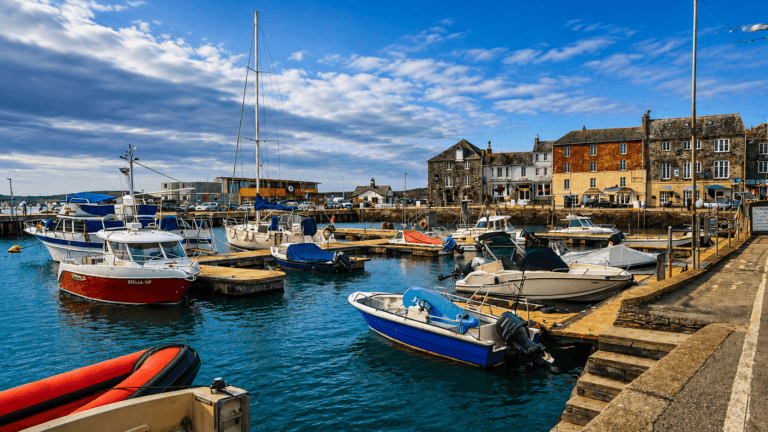
Padstow gathers itself around the water. The streets run down towards the quay, the shops and pubs cluster close, and nearly everyone ends up doing the same slow loop: looking at boats, reading menus, watching children crab from the wall, and wondering whether it is too early for chips.
It is rarely quiet, but it has a good rhythm. Fishing boats and pleasure craft sit side by side. The tide rises and drops. People drift between bakeries, galleries, pubs and restaurants. Dogs pull towards dropped crumbs with professional determination.
The best thing to do first is simple: walk around the harbour, get your bearings, and notice where the lanes climb away from the water. Padstow is small enough to explore on foot, but it rewards nosing about. The best corners are not always on the first turn around the quay.
Understand the town behind the food reputation
Padstow’s food reputation is now so strong that it can overshadow the age of the place. This has been a useful harbour for a very long time, with early links by sea and across Cornwall. The story of St Petroc is central to the town, with tradition placing his arrival from Ireland in the early medieval period and the foundation of a monastery above the harbour.
In the Middle Ages, Padstow developed as a trading port. Tin, copper, lead ores, slate, pilchards and agricultural produce moved out through the harbour, while timber, coal and fish salt came in by sea. Later, fishing and shipbuilding became major parts of the town’s life. By the nineteenth century, Padstow had several shipyards, and it was also a departure point for Cornish people leaving for new lives across the Atlantic.
The railway arrived at the end of the nineteenth century and helped push Padstow further towards tourism, but the town never became a blank resort. You can still feel the older shape of it in St Petroc’s Church, Prideaux Place, the harbour walls, the back lanes and the local traditions that matter here.
That history is important because it stops Padstow feeling like a stage set. This is not only a place with a view. It is a place with a pulse.
Eat well: seafood, pasties, pubs and harbour food
Padstow is famous for food, and there is no point pretending otherwise. This is one of Cornwall’s best-known eating towns, with seafood restaurants, smart dining rooms, pubs, cafés, bakeries, takeaways, ice cream, pasties, fish and chips, cream teas and harbour snacks all jostling for attention.
What I like is that you can make it as polished or as unfussy as you want. You can book a proper sit-down meal and build the day around it. You can eat fish and chips near the harbour and guard them from the gulls like they are family jewellery. You can sit in a pub with a pint and something comforting when the weather turns. Or you can buy a pasty, find a bench and let the estuary do the rest.
For a Pasties & Pints sort of Padstow day, I would keep it practical:
- Book ahead if there is a particular restaurant you care about, especially in school holidays and summer.
- Eat earlier or later if you want to avoid the thickest lunch rush.
- Do not judge Padstow only by the famous places. The casual food is part of the charm.
- Always assume the gulls are watching. Because they are.
Padstow’s strength is that it gives you both versions of Cornwall: smart seafood and simple harbour food. The trick is choosing the one that suits your day, not the one you feel you ought to be doing.
Walk to St George’s Cove, Harbour Cove and Hawkers Cove
One of Padstow’s best qualities is how quickly you can leave the busy harbour behind. Head north from town and you can walk towards St George’s Cove, Harbour Cove and Hawkers Cove, with views across the Camel Estuary towards Rock and Daymer Bay.
St George’s Cove is the easiest little escape. It is close enough for a gentle wander but far enough to change the mood. Carry on and the beaches become wider and quieter, especially outside peak summer hours. Harbour Cove and Hawkers Cove have that broad estuary beauty: pale sand, big sky, and water that seems to rearrange the whole landscape every time you look at it.
This is where you need to be sensible. The tide is not a background detail here. It decides where the beach is, how much sand you have, and how easy your route feels. Low tide can make the estuary feel huge and open. High tide can make the same area feel much tighter.
If you are visiting with a dog, plan properly. Some beaches around Padstow have seasonal restrictions, while others are easier year-round. Even where dogs are welcome, keep them under close control on coast paths, around families and near wildlife. Padstow is dog-friendly in many ways, but that only works if dog owners are thoughtful.
Explore the Seven Bays near Padstow
Padstow is also a strong base for the beaches around St Merryn and the wider North Cornwall coast. The “Seven Bays” idea is a useful way to think about the area: a string of beaches within reach, each with its own mood.
Trevone is close and popular, with sand, rocks, a natural pool at nearby Newtrain Bay and the well-known blowhole above the beach. It is a good family option, but take care near cliff edges and natural features.
Harlyn Bay is one of the easiest beaches to recommend near Padstow. It is wide, sandy, practical and good for families, surf lessons and a classic beach day. It has that straightforward North Cornwall appeal that makes people return.
Constantine and Booby’s Bay feel wilder and more surf-led. They can be glorious, especially at low tide, but they deserve respect. Parts of Booby’s Bay are not available around high water, and the surf is better suited to people who know what they are doing.
Treyarnon and Porthcothan are excellent for a bigger coastal day: rock pools, cliffs, sand, open skies and proper sunset potential.
My advice is simple: do not choose the beach just because you saw the name on a list. Choose it by the day you are actually having.
- For families: go practical.
- For surfers: follow the conditions.
- For walkers: let the coast path choose for you.
- For a slower day: pick the beach with the easiest parking and the least faff.
That is how you get the best from the beaches around Padstow, rather than spending half the day moving the car.
Cycle or walk the Camel Trail from Padstow
The Camel Trail is one of the best things to do in Padstow because it does not demand much from you. It follows the old railway line between Padstow, Wadebridge and Bodmin, with the early stretch running beside the Camel Estuary.
It is largely traffic-free, smooth-surfaced and mostly level, which makes it ideal for families, casual cyclists and people who do not want their “bike ride” to become a personal development exercise.
The classic Padstow option is to hire bikes and ride to Wadebridge and back. You get estuary views, birdlife, open water, salt marsh and enough movement to justify whatever you eat afterwards. If you have more time and energy, you can continue towards Bodmin and the wooded Camel Valley.
For most visitors, Padstow to Wadebridge and back is the sweet spot. It feels like a proper outing without swallowing the whole day.
Go early if you prefer a quieter ride. In peak season, expect families, dogs, children on unpredictable lines, and adults who have not been on a bike since 2009. None of this ruins it. It just means patience is part of the route.
Take the Padstow to Rock ferry
The Padstow to Rock ferry is one of the simplest pleasures in town. It makes the estuary part of the day rather than just something nice to look at.
The passenger ferry runs between Padstow and Rock, with times and landing points affected by season, tide and weather. That is part of the charm, but it also means you should not leave your timings until the last minute if you have plans on the other side. In the main visitor season, an evening water taxi usually adds more flexibility, which is useful if you are eating or walking across the water.
Rock has a different feel from Padstow: roomier, sandier, smarter in places, and excellent for watersports. From the ferry side, you can walk towards Daymer Bay and St Enodoc Church, where Sir John Betjeman is buried. The views back across the estuary are beautiful, and the walk gives you a fresh angle on Padstow itself.
A good half-day plan is:
- Ferry from Padstow to Rock.
- Walk towards Daymer Bay.
- Loop back for a drink or snack.
- Return to Padstow for the evening harbour atmosphere.
It is not complicated, and that is why it works.
Book a boat trip or visit the National Lobster Hatchery
Padstow’s harbour is not only for looking at. Boat trips run from here in the main visitor season, with options ranging from coastal cruises to wildlife safaris and fishing trips. Depending on conditions and the time of year, trips may look for seals, dolphins, porpoises, seabirds and puffins, but the sea does not take requests. Even if wildlife is shy, the coastline itself is worth seeing from the water.
For something land-based, the National Lobster Hatchery is a useful stop, especially with children or on a damp day. It connects neatly with Padstow’s relationship with the sea and gives you something more substantial than another browse around the shops.
Padstow Museum is small, local and quietly valuable, with displays linked to the town’s maritime life, railway past and traditions. Prideaux Place, above the town, adds a grander historic layer and is worth keeping in mind if you want a break from the harbour.
On a wet day, I would not force a beach itinerary. Do Padstow the cosy way: harbour wander, museum or Lobster Hatchery, lunch, shops, coffee, then a short walk if the weather lifts. A rainy Padstow pub with steamed-up windows and something good on the table is not a failed day. It is a very Cornish one.
Parking in Padstow: do not wing it
Padstow is much easier if you make your parking decision before you are crawling through the narrowest streets behind someone having a mild holiday crisis.
The harbour car park is closest, but closest does not always mean calmest. There are several public car parks serving the town, including options near the harbour, by the old railway area and slightly further out. In busy periods, I would rather park a little away from the centre and walk in than spend twenty minutes trying to win a space beside the water.
Do not rely on street parking. The streets are narrow, access matters, and many central spaces are restricted or unsuitable. It is not worth starting your day irritated.
If you are staying all day, walking the coast path or bringing a motorhome, plan more carefully. Padstow is not the place to improvise with a large vehicle.
Getting to Padstow without a car
You can reach Padstow by public transport, but it needs a more relaxed mindset than driving. Bodmin Parkway is the most practical rail connection, with buses linking through Wadebridge towards Padstow. There are also bus links towards Newquay and the airport side of Cornwall.
For places north of the River Camel, such as Rock, Polzeath and Port Isaac, you will usually need to think in terms of Wadebridge connections or use the ferry to Rock and continue from there.
My honest view: public transport works best if Padstow is your main event. It becomes harder work if you are trying to cram three villages and two beaches into one tight day.
Accessibility and slower travel in Padstow
Padstow is an old Cornish harbour town, which means charm and inconvenience often arrive together. There are slopes, narrow pavements, cobbles, busy crossing points and tight streets. The harbour area is the easiest place to enjoy at a slower pace, while some lanes and coastal routes are more demanding.
The Camel Trail is one of the more manageable outdoor options because of its flatter, smoother nature. The ferry can be possible for wheelchair users, but tide and boarding conditions matter, especially when low-tide access involves the beach. If mobility is a concern, treat the harbour and Camel Trail as the most reliable parts of the day and be more cautious with estuary beaches and cliff paths.
Padstow can still be very rewarding at a gentler pace. You do not need to climb every hill or walk every mile to enjoy it.
Best time to visit Padstow
Summer gives you the classic Padstow experience: busy harbour, beach days, boat trips, outdoor eating and long evenings. It also gives you queues, full car parks and the need to book anything important.
Spring is excellent for brighter walks, lighter crowds and the first proper feeling of the season. Autumn may be my favourite time here: the food feels better, the light softens, the coast has more drama, and the town relaxes after the main rush. Winter is quieter, but it can be atmospheric, especially around Christmas.
May Day is different altogether. Padstow’s Obby Oss celebrations are a major local tradition, with music, crowds and deep community feeling. It is not a gentle “pop in and have a look” sort of day. Go for it if you want the full event. Avoid it if you were hoping for a peaceful harbour stroll.
My ideal one-day Padstow itinerary
If I had one day in Padstow, I would not try to do everything. I would do this:
Morning: harbour and old streets
Arrive early and park without trying to be clever. Walk the harbour before it gets too busy, take coffee and something baked, then wander the lanes above the quay.
Late morning: estuary walk
Head towards St George’s Cove and carry on towards Harbour Cove or Hawkers Cove if the tide and weather suit. If the tide is wrong, keep the walk shorter and spend more time in town.
Lunch: make food the anchor
Back in Padstow, make lunch the anchor of the day. Go seafood-led and booked if that is your plan, or keep it casual with fish and chips, a pasty, a pub lunch or something from a bakery.
Afternoon: choose one main thing
Do not try to squeeze everything in. Choose one:
- For fresh air: cycle the Camel Trail to Wadebridge.
- For a change of view: take the ferry to Rock and walk towards Daymer Bay.
- For the sea: book a boat trip.
- For a wet day: do the Lobster Hatchery, museum, shops and a long pub stop.
Evening: slow down by the harbour
Evening belongs back near the harbour. Have a pint, eat well, and give yourself a final slow wander as the day quietens. Padstow is much better when you leave room for lingering.
FAQs about visiting Padstow
What is Padstow best known for?
Padstow is best known for its harbour, seafood, restaurants, Camel Trail access, ferry to Rock, nearby beaches and strong local traditions. It is one of the best-known towns in North Cornwall, but it still has a working harbour and a proper sense of place behind the visitor polish.
Is Padstow worth visiting?
Yes, Padstow is worth visiting, especially if you enjoy harbour towns, food, coastal walks and estuary scenery. It can be busy in peak season, so the best way to enjoy it is to arrive early, park sensibly and choose one or two main things to do rather than rushing around.
What are the best things to do in Padstow?
The best things to do in Padstow are walking around the harbour, eating seafood or fish and chips, cycling the Camel Trail, taking the ferry to Rock, walking to St George’s Cove and Hawkers Cove, booking a boat trip, visiting the National Lobster Hatchery and exploring the old streets above the quay.
Can you walk to a beach from Padstow?
Yes, you can walk from Padstow to St George’s Cove, Harbour Cove and Hawkers Cove. The walk is one of the best easy escapes from the harbour, but the tide matters. At low tide the estuary beaches feel much wider; at high tide, some routes and sandy areas are more limited.
Is Padstow good for families?
Padstow is good for families because there is plenty to do without needing a complicated itinerary. Children usually enjoy crabbing at the harbour, cycling the Camel Trail, boat trips, beaches, ice cream, fish and chips, and the National Lobster Hatchery.
Is Padstow dog-friendly?
Padstow is generally dog-friendly, with plenty of walks, pubs and outdoor areas, but beach rules vary by season. Some beaches have summer restrictions, while others are easier with dogs year-round. Keep dogs under control around the harbour, coast paths, families and wildlife.
Where is the best place to park in Padstow?
The best place to park depends on when you arrive and how long you are staying. The harbour car park is closest, but it can be the busiest. In peak season, using a car park slightly further out and walking into town is often less stressful than trying to park right beside the water.
Can you do the Camel Trail from Padstow?
Yes, Padstow is one of the main starting points for the Camel Trail. The most popular ride is Padstow to Wadebridge and back, which gives you estuary views without taking the whole day. The trail is mostly level and largely traffic-free, so it suits casual cyclists and families.
How long does the Padstow to Rock ferry take?
The Padstow to Rock ferry is a short crossing across the Camel Estuary. It is one of the easiest ways to add variety to a Padstow day, especially if you want to walk towards Daymer Bay or see the town from the other side of the water. Times and landing points can vary with tide, season and weather.
When is the best time to visit Padstow?
Spring and autumn are the best times to visit Padstow if you want a good balance of atmosphere and manageable crowds. Summer is lively and gives you the full holiday feel, but it is also the busiest time for parking, restaurants and the harbour. Winter is quieter and can be atmospheric, especially around Christmas.
Can you visit Padstow without a car?
Yes, you can visit Padstow without a car, but it works best if you keep the day focused. The simplest approach is to use public transport to reach Padstow, stay mainly around the harbour, town, Camel Trail and ferry, and avoid trying to hop between too many beaches or villages in one day.
What should I do in Padstow when it rains?
On a rainy day in Padstow, keep the plan compact: wander the harbour, visit the National Lobster Hatchery or Padstow Museum, browse the shops, have a long lunch, and settle into a pub or café. If the weather lifts, add a short walk towards St George’s Cove.
Final thoughts: how to get the best from Padstow
I’d happily recommend Padstow.
It is popular because it deserves to be. That does not mean it is perfect. It can be crowded, parking can be tiresome, and parts of the town know exactly how desirable they are. But I would not let that put you off.
Underneath the fame and the food reputation, Padstow still has the things that make a Cornish place last: a working harbour, old streets, serious history, estuary light, boat trips, beaches, footpaths, pubs, pasties, seafood and a tide that keeps rearranging the day.
Use it properly and Padstow is not just a pretty stop on the North Cornwall map. It is a full day out, a strong weekend base, and one of the best places in Cornwall to let food, coast and harbour life meet in one place.
Arrive early, respect the tide, park sensibly, book the meal that matters, and leave space to wander. That is how Padstow gives you its best.
Video Guide
Things to Do in Padstow, Cornwall: My Practical Guide to the Harbour, Beaches, Food and Camel Trail
If you are looking for the best things to do in Padstow, my honest advice is this: do not treat it as a quick harbour stop. Padstow is at its best when you give it a proper day. Come for the fishing boats, seafood, pasties and pubs, but leave room for the Camel Trail, the ferry to Rock, the estuary beaches, a boat trip, and a slow wander through the old streets above the harbour.
Padstow is one of the best-known places to visit in North Cornwall, and it has the crowds to prove it. In summer, it can feel busy, polished and very aware of its own appeal. But underneath the food reputation and harbour photographs, there is still a proper Cornish town here: a working quay, serious history, old lanes, a church above the water, fishing boats, local traditions, and the Camel Estuary quietly setting the rhythm of the day.
I think Padstow works best when you arrive with one clear plan and enough space around it. Make lunch the anchor, or the ferry, or the Camel Trail, or the walk to the beaches. Try to cram everything in and you will probably remember the parking more than the place. Use it well and Padstow becomes one of the most satisfying days out in Cornwall.
Padstow is not just a pretty harbour with good restaurants. It is a town where the tide, the ferry, the food and the footpaths all pull the day in different directions — and that is the pleasure of it.
Padstow in brief: what to know before you go
For a first visit, this is the useful shape of Padstow:
- Best for: harbour wandering, seafood, pubs, boat trips, estuary walks, the Camel Trail and nearby beaches.
- Best simple day plan: park early, explore the harbour, walk to St George’s Cove, have lunch in town, then choose either the ferry to Rock or a Camel Trail ride.
- Good with children: yes, especially for crabbing, beaches, bike hire, boat trips and the National Lobster Hatchery.
- Good without a car: possible, but easiest if Padstow is your main destination rather than one stop in a packed North Cornwall itinerary.
- Main practical warning: sort your parking before you reach the tightest central streets.
- Main coastal warning: build any beach walk around the tide.
Padstow is compact, but it is not a place to do on autopilot. The best days here usually have one clear anchor — food, ferry, trail, beach or boat trip — with time left for wandering.
Best things to do in Padstow
If you want the short version before we get into the detail, these are the main things I would put on a Padstow itinerary:
- Wander around Padstow Harbour.
- Eat seafood, fish and chips, a pasty, or a proper pub lunch.
- Walk to St George’s Cove, Harbour Cove and Hawkers Cove.
- Cycle or walk the Camel Trail from Padstow to Wadebridge.
- Take the Padstow to Rock ferry.
- Explore the nearby Seven Bays beaches.
- Book a boat trip or wildlife safari.
- Visit the National Lobster Hatchery.
- Step into Padstow’s older history at St Petroc’s Church, Prideaux Place or Padstow Museum.
- Slow down with a pint by the harbour.
That list is tempting, but do not try to do it all in one day. Padstow rewards choosing well.
Start with Padstow Harbour
The harbour is the obvious place to begin, and for once the obvious thing is the right thing.
Padstow gathers itself around the water. The streets run down towards the quay, the shops and pubs cluster close, and nearly everyone ends up doing the same slow loop: looking at boats, reading menus, watching children crab from the wall, and wondering whether it is too early for chips.
It is rarely quiet, but it has a good rhythm. Fishing boats and pleasure craft sit side by side. The tide rises and drops. People drift between bakeries, galleries, pubs and restaurants. Dogs pull towards dropped crumbs with professional determination.
The best thing to do first is simple: walk around the harbour, get your bearings, and notice where the lanes climb away from the water. Padstow is small enough to explore on foot, but it rewards nosing about. The best corners are not always on the first turn around the quay.
Understand the town behind the food reputation
Padstow’s food reputation is now so strong that it can overshadow the age of the place. This has been a useful harbour for a very long time, with early links by sea and across Cornwall. The story of St Petroc is central to the town, with tradition placing his arrival from Ireland in the early medieval period and the foundation of a monastery above the harbour.
In the Middle Ages, Padstow developed as a trading port. Tin, copper, lead ores, slate, pilchards and agricultural produce moved out through the harbour, while timber, coal and fish salt came in by sea. Later, fishing and shipbuilding became major parts of the town’s life. By the nineteenth century, Padstow had several shipyards, and it was also a departure point for Cornish people leaving for new lives across the Atlantic.
The railway arrived at the end of the nineteenth century and helped push Padstow further towards tourism, but the town never became a blank resort. You can still feel the older shape of it in St Petroc’s Church, Prideaux Place, the harbour walls, the back lanes and the local traditions that matter here.
That history is important because it stops Padstow feeling like a stage set. This is not only a place with a view. It is a place with a pulse.
Eat well: seafood, pasties, pubs and harbour food
Padstow is famous for food, and there is no point pretending otherwise. This is one of Cornwall’s best-known eating towns, with seafood restaurants, smart dining rooms, pubs, cafés, bakeries, takeaways, ice cream, pasties, fish and chips, cream teas and harbour snacks all jostling for attention.
What I like is that you can make it as polished or as unfussy as you want. You can book a proper sit-down meal and build the day around it. You can eat fish and chips near the harbour and guard them from the gulls like they are family jewellery. You can sit in a pub with a pint and something comforting when the weather turns. Or you can buy a pasty, find a bench and let the estuary do the rest.
For a Pasties & Pints sort of Padstow day, I would keep it practical:
- Book ahead if there is a particular restaurant you care about, especially in school holidays and summer.
- Eat earlier or later if you want to avoid the thickest lunch rush.
- Do not judge Padstow only by the famous places. The casual food is part of the charm.
- Always assume the gulls are watching. Because they are.
Padstow’s strength is that it gives you both versions of Cornwall: smart seafood and simple harbour food. The trick is choosing the one that suits your day, not the one you feel you ought to be doing.
Walk to St George’s Cove, Harbour Cove and Hawkers Cove
One of Padstow’s best qualities is how quickly you can leave the busy harbour behind. Head north from town and you can walk towards St George’s Cove, Harbour Cove and Hawkers Cove, with views across the Camel Estuary towards Rock and Daymer Bay.
St George’s Cove is the easiest little escape. It is close enough for a gentle wander but far enough to change the mood. Carry on and the beaches become wider and quieter, especially outside peak summer hours. Harbour Cove and Hawkers Cove have that broad estuary beauty: pale sand, big sky, and water that seems to rearrange the whole landscape every time you look at it.
This is where you need to be sensible. The tide is not a background detail here. It decides where the beach is, how much sand you have, and how easy your route feels. Low tide can make the estuary feel huge and open. High tide can make the same area feel much tighter.
If you are visiting with a dog, plan properly. Some beaches around Padstow have seasonal restrictions, while others are easier year-round. Even where dogs are welcome, keep them under close control on coast paths, around families and near wildlife. Padstow is dog-friendly in many ways, but that only works if dog owners are thoughtful.
Explore the Seven Bays near Padstow
Padstow is also a strong base for the beaches around St Merryn and the wider North Cornwall coast. The “Seven Bays” idea is a useful way to think about the area: a string of beaches within reach, each with its own mood.
Trevone is close and popular, with sand, rocks, a natural pool at nearby Newtrain Bay and the well-known blowhole above the beach. It is a good family option, but take care near cliff edges and natural features.
Harlyn Bay is one of the easiest beaches to recommend near Padstow. It is wide, sandy, practical and good for families, surf lessons and a classic beach day. It has that straightforward North Cornwall appeal that makes people return.
Constantine and Booby’s Bay feel wilder and more surf-led. They can be glorious, especially at low tide, but they deserve respect. Parts of Booby’s Bay are not available around high water, and the surf is better suited to people who know what they are doing.
Treyarnon and Porthcothan are excellent for a bigger coastal day: rock pools, cliffs, sand, open skies and proper sunset potential.
My advice is simple: do not choose the beach just because you saw the name on a list. Choose it by the day you are actually having.
- For families: go practical.
- For surfers: follow the conditions.
- For walkers: let the coast path choose for you.
- For a slower day: pick the beach with the easiest parking and the least faff.
That is how you get the best from the beaches around Padstow, rather than spending half the day moving the car.
Cycle or walk the Camel Trail from Padstow
The Camel Trail is one of the best things to do in Padstow because it does not demand much from you. It follows the old railway line between Padstow, Wadebridge and Bodmin, with the early stretch running beside the Camel Estuary.
It is largely traffic-free, smooth-surfaced and mostly level, which makes it ideal for families, casual cyclists and people who do not want their “bike ride” to become a personal development exercise.
The classic Padstow option is to hire bikes and ride to Wadebridge and back. You get estuary views, birdlife, open water, salt marsh and enough movement to justify whatever you eat afterwards. If you have more time and energy, you can continue towards Bodmin and the wooded Camel Valley.
For most visitors, Padstow to Wadebridge and back is the sweet spot. It feels like a proper outing without swallowing the whole day.
Go early if you prefer a quieter ride. In peak season, expect families, dogs, children on unpredictable lines, and adults who have not been on a bike since 2009. None of this ruins it. It just means patience is part of the route.
Take the Padstow to Rock ferry
The Padstow to Rock ferry is one of the simplest pleasures in town. It makes the estuary part of the day rather than just something nice to look at.
The passenger ferry runs between Padstow and Rock, with times and landing points affected by season, tide and weather. That is part of the charm, but it also means you should not leave your timings until the last minute if you have plans on the other side. In the main visitor season, an evening water taxi usually adds more flexibility, which is useful if you are eating or walking across the water.
Rock has a different feel from Padstow: roomier, sandier, smarter in places, and excellent for watersports. From the ferry side, you can walk towards Daymer Bay and St Enodoc Church, where Sir John Betjeman is buried. The views back across the estuary are beautiful, and the walk gives you a fresh angle on Padstow itself.
A good half-day plan is:
- Ferry from Padstow to Rock.
- Walk towards Daymer Bay.
- Loop back for a drink or snack.
- Return to Padstow for the evening harbour atmosphere.
It is not complicated, and that is why it works.
Book a boat trip or visit the National Lobster Hatchery
Padstow’s harbour is not only for looking at. Boat trips run from here in the main visitor season, with options ranging from coastal cruises to wildlife safaris and fishing trips. Depending on conditions and the time of year, trips may look for seals, dolphins, porpoises, seabirds and puffins, but the sea does not take requests. Even if wildlife is shy, the coastline itself is worth seeing from the water.
For something land-based, the National Lobster Hatchery is a useful stop, especially with children or on a damp day. It connects neatly with Padstow’s relationship with the sea and gives you something more substantial than another browse around the shops.
Padstow Museum is small, local and quietly valuable, with displays linked to the town’s maritime life, railway past and traditions. Prideaux Place, above the town, adds a grander historic layer and is worth keeping in mind if you want a break from the harbour.
On a wet day, I would not force a beach itinerary. Do Padstow the cosy way: harbour wander, museum or Lobster Hatchery, lunch, shops, coffee, then a short walk if the weather lifts. A rainy Padstow pub with steamed-up windows and something good on the table is not a failed day. It is a very Cornish one.
Parking in Padstow: do not wing it
Padstow is much easier if you make your parking decision before you are crawling through the narrowest streets behind someone having a mild holiday crisis.
The harbour car park is closest, but closest does not always mean calmest. There are several public car parks serving the town, including options near the harbour, by the old railway area and slightly further out. In busy periods, I would rather park a little away from the centre and walk in than spend twenty minutes trying to win a space beside the water.
Do not rely on street parking. The streets are narrow, access matters, and many central spaces are restricted or unsuitable. It is not worth starting your day irritated.
If you are staying all day, walking the coast path or bringing a motorhome, plan more carefully. Padstow is not the place to improvise with a large vehicle.
Getting to Padstow without a car
You can reach Padstow by public transport, but it needs a more relaxed mindset than driving. Bodmin Parkway is the most practical rail connection, with buses linking through Wadebridge towards Padstow. There are also bus links towards Newquay and the airport side of Cornwall.
For places north of the River Camel, such as Rock, Polzeath and Port Isaac, you will usually need to think in terms of Wadebridge connections or use the ferry to Rock and continue from there.
My honest view: public transport works best if Padstow is your main event. It becomes harder work if you are trying to cram three villages and two beaches into one tight day.
Accessibility and slower travel in Padstow
Padstow is an old Cornish harbour town, which means charm and inconvenience often arrive together. There are slopes, narrow pavements, cobbles, busy crossing points and tight streets. The harbour area is the easiest place to enjoy at a slower pace, while some lanes and coastal routes are more demanding.
The Camel Trail is one of the more manageable outdoor options because of its flatter, smoother nature. The ferry can be possible for wheelchair users, but tide and boarding conditions matter, especially when low-tide access involves the beach. If mobility is a concern, treat the harbour and Camel Trail as the most reliable parts of the day and be more cautious with estuary beaches and cliff paths.
Padstow can still be very rewarding at a gentler pace. You do not need to climb every hill or walk every mile to enjoy it.
Best time to visit Padstow
Summer gives you the classic Padstow experience: busy harbour, beach days, boat trips, outdoor eating and long evenings. It also gives you queues, full car parks and the need to book anything important.
Spring is excellent for brighter walks, lighter crowds and the first proper feeling of the season. Autumn may be my favourite time here: the food feels better, the light softens, the coast has more drama, and the town relaxes after the main rush. Winter is quieter, but it can be atmospheric, especially around Christmas.
May Day is different altogether. Padstow’s Obby Oss celebrations are a major local tradition, with music, crowds and deep community feeling. It is not a gentle “pop in and have a look” sort of day. Go for it if you want the full event. Avoid it if you were hoping for a peaceful harbour stroll.
My ideal one-day Padstow itinerary
If I had one day in Padstow, I would not try to do everything. I would do this:
Morning: harbour and old streets
Arrive early and park without trying to be clever. Walk the harbour before it gets too busy, take coffee and something baked, then wander the lanes above the quay.
Late morning: estuary walk
Head towards St George’s Cove and carry on towards Harbour Cove or Hawkers Cove if the tide and weather suit. If the tide is wrong, keep the walk shorter and spend more time in town.
Lunch: make food the anchor
Back in Padstow, make lunch the anchor of the day. Go seafood-led and booked if that is your plan, or keep it casual with fish and chips, a pasty, a pub lunch or something from a bakery.
Afternoon: choose one main thing
Do not try to squeeze everything in. Choose one:
- For fresh air: cycle the Camel Trail to Wadebridge.
- For a change of view: take the ferry to Rock and walk towards Daymer Bay.
- For the sea: book a boat trip.
- For a wet day: do the Lobster Hatchery, museum, shops and a long pub stop.
Evening: slow down by the harbour
Evening belongs back near the harbour. Have a pint, eat well, and give yourself a final slow wander as the day quietens. Padstow is much better when you leave room for lingering.
FAQs about visiting Padstow
What is Padstow best known for?
Padstow is best known for its harbour, seafood, restaurants, Camel Trail access, ferry to Rock, nearby beaches and strong local traditions. It is one of the best-known towns in North Cornwall, but it still has a working harbour and a proper sense of place behind the visitor polish.
Is Padstow worth visiting?
Yes, Padstow is worth visiting, especially if you enjoy harbour towns, food, coastal walks and estuary scenery. It can be busy in peak season, so the best way to enjoy it is to arrive early, park sensibly and choose one or two main things to do rather than rushing around.
What are the best things to do in Padstow?
The best things to do in Padstow are walking around the harbour, eating seafood or fish and chips, cycling the Camel Trail, taking the ferry to Rock, walking to St George’s Cove and Hawkers Cove, booking a boat trip, visiting the National Lobster Hatchery and exploring the old streets above the quay.
Can you walk to a beach from Padstow?
Yes, you can walk from Padstow to St George’s Cove, Harbour Cove and Hawkers Cove. The walk is one of the best easy escapes from the harbour, but the tide matters. At low tide the estuary beaches feel much wider; at high tide, some routes and sandy areas are more limited.
Is Padstow good for families?
Padstow is good for families because there is plenty to do without needing a complicated itinerary. Children usually enjoy crabbing at the harbour, cycling the Camel Trail, boat trips, beaches, ice cream, fish and chips, and the National Lobster Hatchery.
Is Padstow dog-friendly?
Padstow is generally dog-friendly, with plenty of walks, pubs and outdoor areas, but beach rules vary by season. Some beaches have summer restrictions, while others are easier with dogs year-round. Keep dogs under control around the harbour, coast paths, families and wildlife.
Where is the best place to park in Padstow?
The best place to park depends on when you arrive and how long you are staying. The harbour car park is closest, but it can be the busiest. In peak season, using a car park slightly further out and walking into town is often less stressful than trying to park right beside the water.
Can you do the Camel Trail from Padstow?
Yes, Padstow is one of the main starting points for the Camel Trail. The most popular ride is Padstow to Wadebridge and back, which gives you estuary views without taking the whole day. The trail is mostly level and largely traffic-free, so it suits casual cyclists and families.
How long does the Padstow to Rock ferry take?
The Padstow to Rock ferry is a short crossing across the Camel Estuary. It is one of the easiest ways to add variety to a Padstow day, especially if you want to walk towards Daymer Bay or see the town from the other side of the water. Times and landing points can vary with tide, season and weather.
When is the best time to visit Padstow?
Spring and autumn are the best times to visit Padstow if you want a good balance of atmosphere and manageable crowds. Summer is lively and gives you the full holiday feel, but it is also the busiest time for parking, restaurants and the harbour. Winter is quieter and can be atmospheric, especially around Christmas.
Can you visit Padstow without a car?
Yes, you can visit Padstow without a car, but it works best if you keep the day focused. The simplest approach is to use public transport to reach Padstow, stay mainly around the harbour, town, Camel Trail and ferry, and avoid trying to hop between too many beaches or villages in one day.
What should I do in Padstow when it rains?
On a rainy day in Padstow, keep the plan compact: wander the harbour, visit the National Lobster Hatchery or Padstow Museum, browse the shops, have a long lunch, and settle into a pub or café. If the weather lifts, add a short walk towards St George’s Cove.
Final thoughts: how to get the best from Padstow
I’d happily recommend Padstow.
It is popular because it deserves to be. That does not mean it is perfect. It can be crowded, parking can be tiresome, and parts of the town know exactly how desirable they are. But I would not let that put you off.
Underneath the fame and the food reputation, Padstow still has the things that make a Cornish place last: a working harbour, old streets, serious history, estuary light, boat trips, beaches, footpaths, pubs, pasties, seafood and a tide that keeps rearranging the day.
Use it properly and Padstow is not just a pretty stop on the North Cornwall map. It is a full day out, a strong weekend base, and one of the best places in Cornwall to let food, coast and harbour life meet in one place.
Arrive early, respect the tide, park sensibly, book the meal that matters, and leave space to wander. That is how Padstow gives you its best.
Contact & Details
Padstow
Cornwall
PL28 8AF
United Kingdom
Sorry, no records were found. Please adjust your search criteria and try again.
Sorry, unable to load the Maps API.