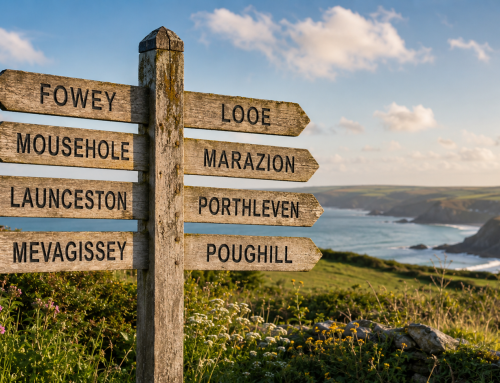
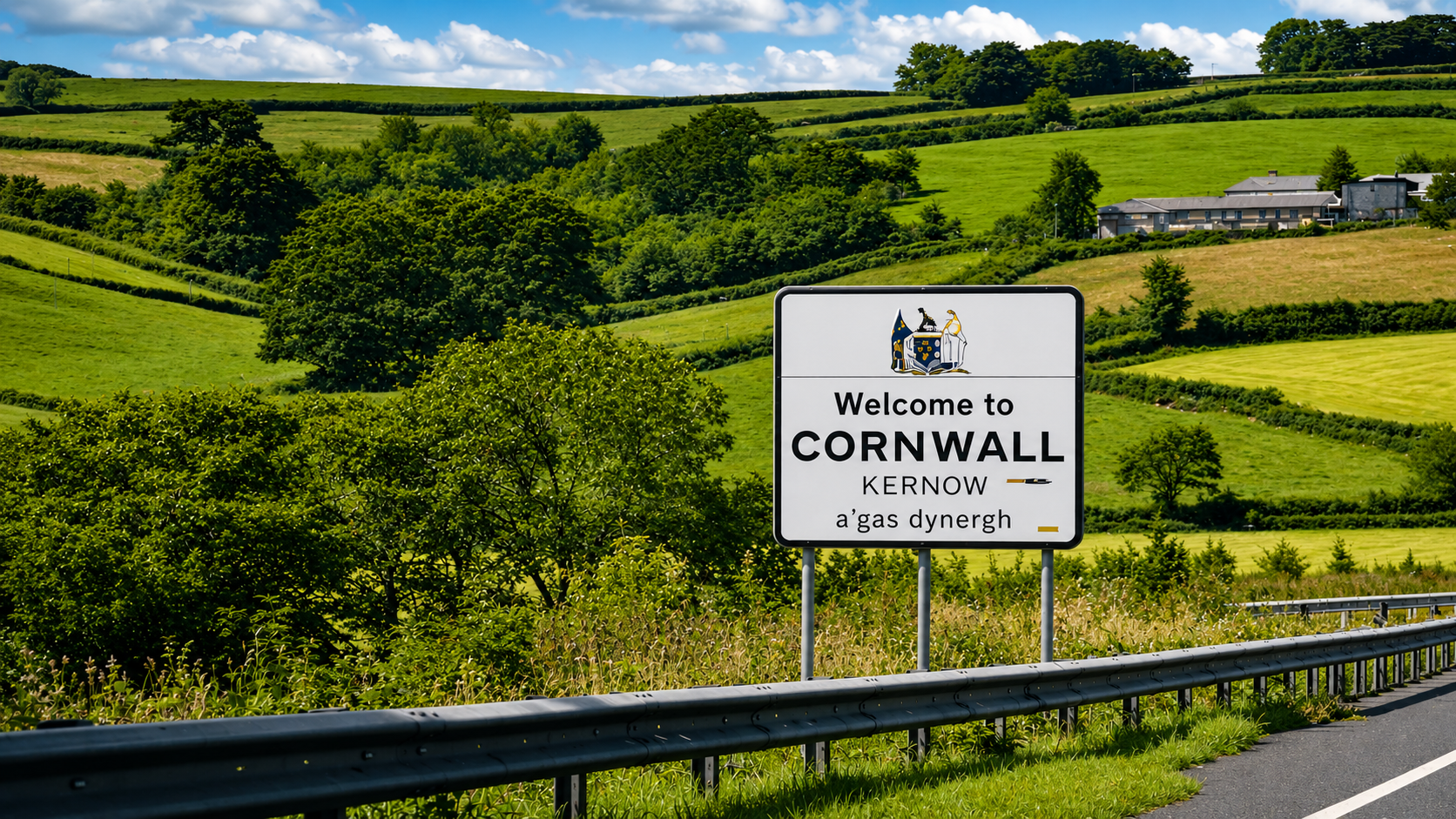
Before you cross the Tamar, it helps to know how Cornwall actually works.
Cornish Words and Place Names Visitors Should Know
Cornwall gets easier to understand when you stop treating its names as decoration.
A lot of visitors arrive with a list of beaches, pubs, harbour towns and coves, then spend the week following the sat nav through names they have never really looked at. Porth this. Pen that. Tre something. Pol somewhere. Towan, Nans, Wheal, Zawn.
Once you know a few Cornish words and place-name clues, Cornwall stops looking like a string of pretty names and starts becoming a map you can actually read.
This is not a formal Cornish lesson. You do not need to master Kernewek before you order a pint, find a beach or enjoy a pasty. But learning a handful of common Cornish words, beach names and place-name meanings does make Cornwall more useful, more interesting and easier to navigate.
It helps you spot coves, headlands, old settlements, dunes, valleys, mining land and stone country before you have even parked the car.
It also helps you visit with a bit more respect. Cornwall is not just a scenic edge of England with good beaches. It has its own language, history, working communities and identity. The names are part of that.
Once you know a few Cornish words, the map stops being a route and starts becoming a conversation with the place.
Quick answer: common Cornish place-name meanings
If you want the simple version first, these are the Cornish place-name clues visitors will see again and again.
Kernow means Cornwall.
Kernewek means the Cornish language.
Porth is commonly linked with a cove, harbour, gate or entrance. Around the coast, it often tells you that land and sea meet there.
Tre usually points towards a farmstead, settlement or homestead.
Pol or poll is usually connected with a pool, pond or body of water.
Pen or penn often means head, end or top. Around the coast, it can hint at a headland or high ground.
Towan or tewyn is linked with sand or dunes.
Treth means beach.
Nans means valley.
Men, maen or meyn usually points towards stone.
Carn or karn often points towards rocks, crags, tors or cairns.
Lan or lann usually points towards an enclosure, often with a religious connection in place names.
Wheal is connected with works or mine workings.
Zawn usually means a narrow, steep-sided sea inlet or cove.
These meanings are best treated as clues rather than perfect one-word translations. Cornish place names have been shaped over time through language, speech, spelling, landscape, work, faith and local use. A name can carry more than one layer.
What is Cornwall called in Cornish?
Cornwall in Cornish is Kernow.
The Cornish language is Kernewek.
You will see Kernow everywhere once you start looking: on road signs, flags, stickers, clothing, business names, pub walls, local campaigns and festival material. It is not just a nice regional flourish. It carries identity.
A few useful Cornish phrases visitors may come across are:
- Dydh da — hello or good day
- Meur ras — thank you
- Mar pleg — please
- Duw genes — goodbye
- Pur dha — very good
- Splann — splendid
You do not need to force it. Nobody needs a visitor performing Cornish at every café counter like they are trying to win points. But learning a couple of words and using them lightly shows you have noticed where you are.
The bigger win is understanding Cornish place names. That is where the language becomes properly useful for visitors.
Cornish beach names: why porth, towan and treth matter
Cornish beach names are not just pretty labels. They often tell you something about the coast before you get there.
The most useful beach words to know are porth, towan and treth.
Porth often points towards a cove, harbour, gate or entrance.
Towan is linked with sand or dunes.
Treth means beach.
That does not mean every Cornish beach name gives you the full story. A name will not tell you whether the beach has lifeguards that day, whether there is space at high tide, whether the path is steep, or whether dogs are allowed during the busiest part of summer.
But it does help you read the map better.
If a place name includes porth, you may be looking at a cove, harbour or coastal opening. If you see towan, think sand and dunes. If you come across treth in Cornish forms, you are dealing with the more direct beach word.
Practical point: names help you understand the place, but conditions decide the day. Tides, access, lifeguard cover, weather and dog rules matter more than how inviting a beach looks in a photo.
Porth: the beach word to learn first
If you learn one Cornish place-name element, make it porth.
Porth is commonly linked with a cove, harbour, gate or entrance. Around the coast, it is often a strong clue that land and sea meet there in a meaningful way.
You will see it in places such as:
- Porthmeor, St Ives
- Porthminster, St Ives
- Porthcurno, west Cornwall
- Porthtowan, north coast
- Porthleven, south coast
- Porthpean, near St Austell
- Porthgwarra, near Land’s End
- Porthallow, on the Lizard
- Porthscatho, on the Roseland
Once you notice porth, you cannot unsee it.
But do not make the lazy mistake of thinking every porth is an easy beach day. Some are wide sandy beaches with cafés, toilets and surf schools. Some are narrow coves with steep paths, awkward access and very little beach left at high tide.
Practical point: if a beach name starts with porth, do not assume it is automatically simple. Build your day around the tide, access, facilities, lifeguard cover and dog rules. Some porths are easy visitor beaches. Others are better treated as beautiful coves to admire carefully.
Tre: settlements, farms and old homes
Tre is one of the most recognisable Cornish place-name elements. It usually points towards a farmstead, settlement or homestead.
You will see it inland, by the coast, on village signs, old house names and lane names. Tre tells you that people have lived, worked, farmed and gathered there.
Think of places like:
- Trelissick
- Tregony
- Trevone
- Treen
- Trewellard
- Trebetherick
- Trethevy
- Treknow
There is an old saying often repeated around Cornwall: “By Tre, Pol and Pen, you shall know Cornishmen.” Like most old sayings, it is neater than real life, but it points to something true. Tre, Pol and Pen appear everywhere, and together they tell you a lot about Cornwall’s landscape and settlement pattern.
Practical point: a tre name is not automatically a visitor attraction. Many are working farms, hamlets, residential areas or private places. An interesting old name is not an invitation to wander up a drive.
Pol and poll: pools, ponds and water
Pol or poll is usually connected with a pool, pond or body of water.
You will see it in names such as:
- Polperro
- Polruan
- Polzeath
- Poldhu
- Polbathic
- Polgooth
This is one of the reasons Cornwall’s place names feel so tied to the land. They often describe what mattered: water, shelter, crossing points, farms, headlands, valleys, mines and churches.
Polzeath is a good example because many visitors know the beach before they think about the name. They know the surf schools, the sand, the summer traffic and the family holiday rhythm. But the name still belongs to an older pattern of water and place.
Poldhu is another useful one. Du or dhu often means black or dark, so when you see it in Cornish names, it may be describing colour, water, rock, soil or local character.
Practical point: do not assume two pol places will give you the same kind of day out. Polruan, Polzeath and Poldhu are completely different experiences. The word gives you the clue; the place gives you the day.
Pen and penn: heads, ends and high ground
Pen or penn often means head, end or top. Around the coast, it can point towards a headland or prominent piece of land.
This one matters because Cornwall is full of dramatic edges. If porth takes you down to the cove, pen often sends your eye up to the point.
You will see it in names such as:
- Penzance
- Penryn
- Pendennis
- Penrose
- Pentire
- Penberth
- Penhale
A pen name often hints at high ground, a headland, an end point or a place with a view. It can also mean exposure. Cornwall is not always soft sea air and blue skies. A headland can change the mood quickly.
Practical point: pen places are often good walking territory, but they can be windy, uneven and exposed. Take the extra layer. Cornwall has a habit of making the car park feel warm and the headland feel like a different country.
Towan and tewyn: sand and dunes
Towan is linked with tewyn, meaning sand or dune.
This is one of the most useful Cornish beach words because it tells you something practical about the landscape. You will see it in places such as Porthtowan, Towan Beach in Newquay and the Towans around Hayle and Gwithian.
Dunes are not just scenery. They are fragile, living coastal systems. They protect the land behind them, support wildlife and shape how beaches behave. They are also easily damaged by careless walking, fires, litter, scrambling and people treating them as free camping space.
Practical point: if the name points to dunes, respect the dunes. Use marked paths where they exist, avoid roped-off areas, and do not treat wild-looking land as land you can damage.
Treth: the Cornish word for beach
Another useful word is treth, meaning beach.
You may not always see it in the English version of a beach name, but it appears in Cornish forms and place-name records. It is worth knowing because visitors often learn porth first and then assume it does all the beach work. It does not.
Porth often points to the cove, harbour or entrance. Treth is the more direct beach word.
That distinction matters because Cornish place names are not always neat modern labels. They have been shaped over time through speech, spelling, landscape, ownership, faith, work and local use. A name may tell you about a cove, a beach, a farmstead, a saint, a pool or a rock — sometimes more than one at once.
Nans: valleys and tucked-away places
Nans means valley.
This is a word that helps you understand why some Cornish places feel sheltered, folded away or suddenly hidden from the bigger coastal views.
You will see it in names and Cornish forms connected with places such as Nancledra, Nanstallon, Nansledan and Lamorna. A nans name often hints at a valley, a stream, a sheltered route or a settlement shaped by the land around it.
Cornwall is not only cliffs and beaches. Some of the best bits are in the dips: wooded lanes, streams, old mills, churches, tucked-away pubs and footpaths that open suddenly towards the sea.
Practical point: valley places often mean narrow roads, blind bends, limited passing spots and a very different feel from the cliff tops. Drive patiently. The hedge is not moving for you.
Men, maen and meyn: stones
Men, maen or meyn usually points towards stone.
The famous example is Mên-an-Tol, the holed stone near Madron. You will also see related forms in coastal and inland names across Cornwall.
This matters because Cornwall is full of stone: standing stones, quoits, crosses, engine houses, field boundaries, harbour walls, granite cottages and rocky headlands. Stone is not just scenery here. It is memory.
If you are visiting prehistoric sites, treat them properly. Do not climb on stones, move stones, carve anything, leave offerings that become litter, or turn ancient places into props for careless photos.
Practical point: the best way to visit Cornwall’s old stone places is quietly. Look, learn, leave them alone.
Carn and karn: rocks, tors and rough ground
Carn or karn often points towards rocks, crags, tors or cairns.
This is proper granite-country language. You will see it in names such as:
- Carn Brea
- Carn Marth
- Carn Galver
- Carn Galver
- Carn Kenidjack
These are not soft, sandy words. They feel harder, older and more exposed.
Carn names often belong to places with views, prehistoric traces, mining history or rougher walking. If porth is beach towel Cornwall, carn is boots, wind and granite Cornwall.
Practical point: do not underestimate moorland or high ground just because Cornwall is not mountainous. Weather shifts, paths can be rough, and phone signal is not something to build a safety plan around.
Lan and lann: old enclosures and church places
Lan or lann usually points towards an enclosure, often with a religious connection in place names.
You will see it in names connected with old church sites, saints, parishes and early Christian foundations. Cornwall’s saint-name places are not just decorative. St Just, St Agnes, St Ives, St Austell, St Erth, St Buryan, St Keverne, St Neot and St Merryn all belong to a deeper pattern of churches, wells, crossings, settlements and stories.
These places are a good reminder that Cornwall is not only a coast. It is parish, chapel, field, well, lane and village too.
Practical point: if you want quieter Cornwall, church towns and saint-name villages can be more rewarding than chasing the same overcrowded beach everyone has seen online.
Wheal: mining country
Wheal is one of the great Cornish words visitors should know, especially if you are exploring old mining landscapes around St Agnes, Redruth, Camborne, St Just, Pendeen, Gwennap or the cliffs above Chapel Porth.
Wheal is connected with works or mine workings.
You will see it in names such as:
- Wheal Coates
- Wheal Kitty
- Wheal Jane
- Wheal Prosper
- East Wheal Rose
This word changes the way you look at the landscape. An engine house on a cliff is not just a romantic ruin for a sunset photo. It is part of a skilled, dangerous and hard working history. Families, miners, bal maidens, engineers and whole communities were tied into that ground.
Practical point: mining remains are not playgrounds. Old shafts, unstable ground and ruined structures can be dangerous. Enjoy the view, respect the history and keep to safe routes.
Zawn: steep-sided coastal drama
Zawn is a word you may come across around the coast, especially in walking, climbing and local descriptions. It usually means a narrow, steep-sided sea inlet or cove.
If that sounds dramatic, it is because zawns usually are.
They can be spectacular from the coast path, but they are not casual swimming spots. They can involve cliffs, surge, slippery rock, difficult access and serious sea conditions.
Practical point: if a place is described as a zawn, admire it carefully. The sea does not care how good the photograph would be.
Cornish dialect words visitors may hear
Not every “Cornish word” a visitor hears is Kernewek. Some are Cornish dialect, local English, mining language or phrases that have become part of the sound of the place.
A few worth knowing:
Dreckly — often understood as “directly”, but in real use it can mean later, eventually, soon-ish, or when it happens. Do not build your train connection around it.
Proper job — good, well done, just right. It can be sincere, dry or both.
Ansome — handsome, good or pleasing, often used warmly.
My lover — a familiar form of address, not necessarily romantic. Tone and context do the work.
Emmet — a word visitors should know mostly so they understand when it is aimed at them. It is often used for tourists or outsiders, and not always kindly. The lesson is simple: behave well and do not be the reason someone says it.
The important distinction is this: Kernewek is the Cornish language. Dialect is not the same thing, even though both belong to Cornwall’s voice.
How Cornish place names help you choose better days out
This is where Cornish words become more than trivia.
If you are looking at a map and see porth, you can start thinking about coves, harbours, coastal access and tides.
If you see pen, you can start thinking about headlands, views, walking and exposure.
If you see towan, you can start thinking about sand, dunes and fragile coastal systems.
If you see wheal, you can start thinking about mining history, engine houses, old workings and landscapes that deserve more respect than a quick photo.
If you see tre, pol or nans, you are reading older settlement, water and valley clues.
That does not mean you can plan a day out from the name alone. But it gives you a better starting point than treating every place as just another pin on the map.
Cornish beach names are practical, not just pretty
One mistake visitors make is treating Cornish beach names like branding. They see a beautiful name and assume the experience will match the Instagram version.
Cornwall does not work like that.
A cove can be stunning and awkward. A famous beach can be easy and overcrowded. A dog-friendly beach can still have seasonal restrictions. A quiet beach can be tidal. A sheltered south coast beach can be lovely for a family swim one day and still deserve respect the next. A north coast surf beach can look inviting and be completely wrong for weak swimmers.
Names help you read the place. Conditions decide the day.
For a sensible beach day in Cornwall, remember:
- Tides matter. Some beaches shrink fast or disappear at high tide.
- Lifeguard cover is seasonal. Use lifeguarded beaches for swimming whenever possible.
- Flags matter. Red and yellow flags mark the safest swimming and bodyboarding area when lifeguards are operating.
- Dog rules vary by beach and season. Some restrictions apply through the busiest months, and some beaches have stricter local rules.
- Access is not always easy. A beautiful cove may mean steep paths, narrow lanes, limited parking or no facilities.
- The north and south coasts can feel very different. Do not judge sea conditions by how inviting the water looks from the sand.
That is not fussiness. It is the difference between a good Cornish beach day and a stupid one.
How to use Cornish words without being awkward
Use them with respect, not performance.
It is good to say meur ras if someone has helped you. It is good to recognise Kernow on a sign. It is good to understand that Porthcurno, Porthtowan and Porthmeor are not just pretty sounds. It is good to know that Wheal Coates is working-history language, not lifestyle wallpaper.
What is less good is treating Cornish like a novelty.
Cornwall has had enough of being packaged up for easy consumption. The language is part of a living identity, and more people are learning it, using it and putting it back into everyday life.
You do not need to be fluent to show respect. You just need to notice.
FAQ: Cornish words and place names
What does porth mean in Cornish place names?
Porth is commonly linked with a cove, harbour, gate or entrance. In coastal place names, it often hints that land and sea meet there. It can point towards a beach, harbour, inlet or landing place, but it does not always mean easy access or safe swimming.
What does tre mean in Cornish place names?
Tre usually means a farmstead, settlement or homestead. If you see tre in a Cornish place name, it often points to an old place where people lived, worked or farmed.
What does pen mean in Cornish place names?
Pen or penn often means head, end or top. Around the coast, it can suggest a headland, high point or prominent piece of land.
What does pol mean in Cornish place names?
Pol or poll is usually connected with a pool, pond or body of water. You will see it in names such as Polperro, Polruan, Polzeath and Poldhu.
What does towan mean in Cornwall?
Towan is linked with sand or dunes. You will see it in beach and dune areas such as Porthtowan, Towan Beach and the Towans around Hayle and Gwithian.
What does wheal mean in Cornwall?
Wheal is connected with mine workings or works. It appears in many old mining names, especially in areas with strong mining history such as west Cornwall, St Agnes, Redruth, Camborne and old engine-house landscapes.
What does zawn mean in Cornwall?
Zawn usually means a steep-sided sea inlet or cove. Zawns can be dramatic and beautiful, but they can also involve cliffs, surge, slippery rock and difficult access.
What is Cornwall called in Cornish?
Cornwall is Kernow in Cornish. The Cornish language is Kernewek.
What are useful Cornish phrases for visitors?
Useful Cornish phrases include Dydh da for hello, Meur ras for thank you, Mar pleg for please and Duw genes for goodbye. Use them lightly and respectfully rather than forcing them.
Are Cornish dialect words the same as the Cornish language?
No. Kernewek is the Cornish language. Cornish dialect words such as dreckly, proper job, ansome and my lover belong to Cornwall’s local English and dialect tradition. Both matter, but they are not the same thing.
Why do so many Cornish places start with tre, pol or pen?
Tre, pol and pen are common Cornish place-name elements because they describe features that mattered in everyday life: settlements, water, high ground, headlands and landscape. That is why the old phrase “By Tre, Pol and Pen…” still sticks.
Final thought
The best way to understand Cornwall is not to rush around ticking off the famous names. It is to slow down enough to read them.
Porth tells you about the sea meeting the land. Tre tells you people settled here. Pol points you towards water. Pen takes your eye to the headland. Towan gives you dunes. Nans folds you into the valley. Wheal reminds you that the postcard view was also a working landscape. Men and carn bring you back to stone.
Once you know that, the map becomes more than a route. It becomes a conversation with the place.
And that is a better way to visit Cornwall.