A proper Cornish pasty is more than lunch — it carries Cornwall’s working food culture, local pride, and tradition.
Cornish Pasty Guide: What Makes a Proper Cornish Pasty?
The Cornish pasty is famous enough to be everywhere and ordinary enough to be done badly.
You can buy a pasty in Cornwall without trying: from bakeries, butchers, farm shops, cafés, pubs, beach kiosks, supermarkets and hot cabinets on the way to somewhere else. Some are excellent. Some are decent. Some are heavy, pale and forgettable, despite the Cornish wording on the bag.
This Cornish pasty guide is not another ranking of the best pasties in Cornwall. Those lists date quickly, and most of them circle the same names. I’d rather give you something more useful: what makes a genuine Cornish pasty, what should be inside one, how to spot a good pasty before you buy, and where it fits into a proper Cornwall day.
A good Cornish pasty is not fancy. It is sturdy, savoury, properly seasoned and made with enough confidence not to need a gimmick.
The best Cornish pasties do not shout. They get the basics right and let the crimp do the talking.
Quick answer: what is a Cornish pasty?
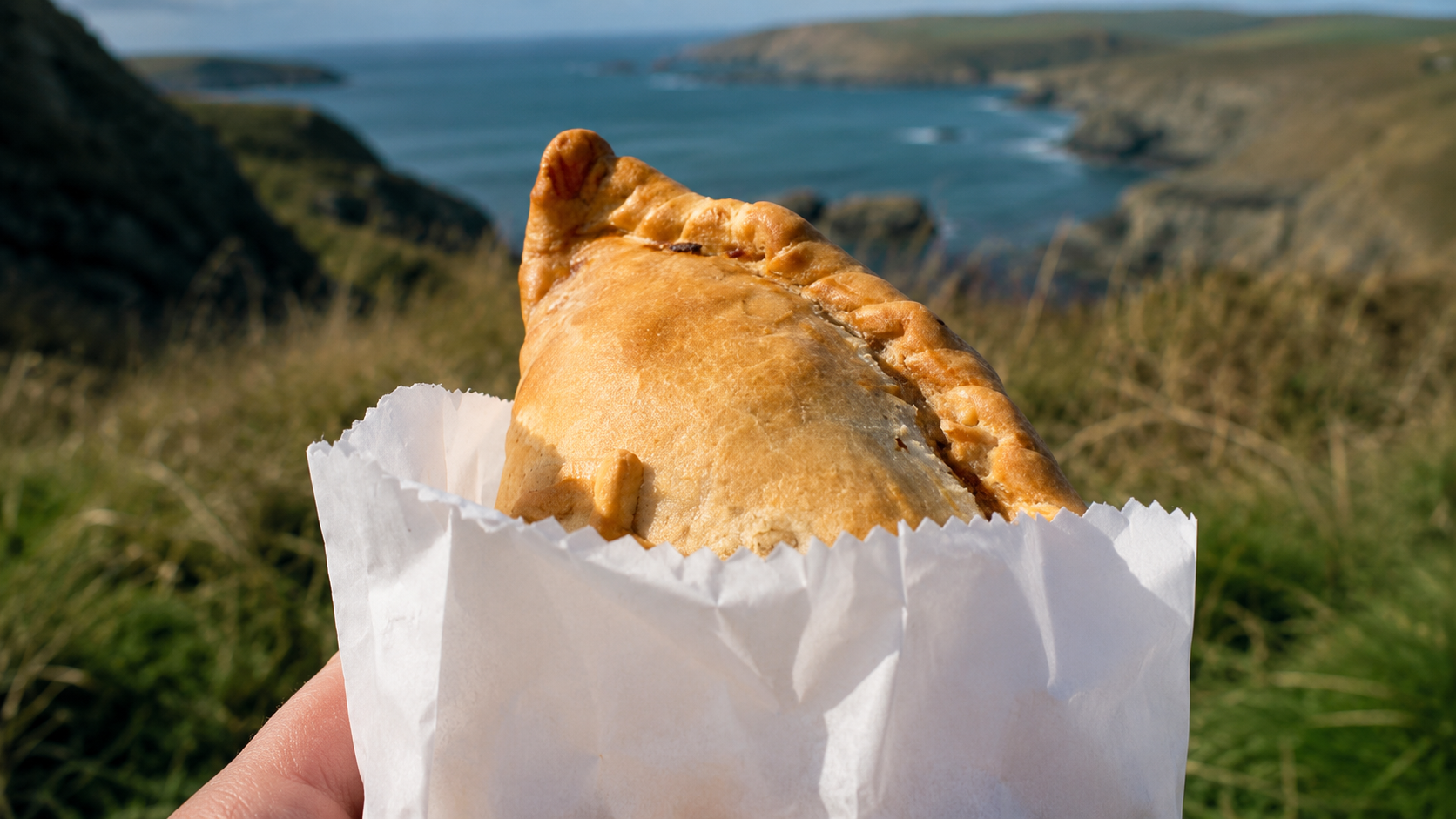
A Cornish pasty is a D-shaped, side-crimped savoury pasty traditionally filled with beef, potato, swede, onion, salt and pepper. To be sold as a genuine Cornish pasty, it must be made in Cornwall and follow the protected traditional specification.
The filling goes into the pastry raw, then cooks inside the case. That gives a proper pasty its character: not a stew wrapped in pastry, not a pie pretending to be portable, and not a generic meat parcel with Cornish branding.
What makes a genuine Cornish pasty?
A Cornish pasty is not Cornish because there is a coastal sketch on the packet or a tin mine in the branding. The name has protected status.
For a pasty to be sold as a genuine Cornish pasty, it must be made in Cornwall. It can be sold outside Cornwall, so a proper Cornish pasty does not have to be eaten in Cornwall. But the making has to happen here.
A genuine Cornish pasty also has to follow the traditional style:
- D-shaped pastry
- Crimped down one side
- Savoury pastry strong enough to hold the filling
- Raw filling cooked inside the pastry
- Traditional beef and vegetable filling
That side crimp is one of the easiest signs to look for. It is not decorative. It is part of the pasty’s identity.
Traditional Cornish pasty ingredients
The traditional Cornish pasty filling is clear:
- Beef
- Potato
- Swede — often called turnip in Cornwall
- Onion
- Seasoning, mainly salt and pepper
That is the classic version. No carrot. No peas. No cheese. No poured-in gravy. No herb mixture trying to prove a point.
You will find plenty of other pasties in Cornwall, and some are very good: cheese and onion, vegetable, lamb, spicy fillings, vegan versions, breakfast pasties and bakery specials. That is fine. Not every pasty has to be the protected traditional one.
But if you are buying a Cornish pasty specifically, the classic filling is beef, potato, swede, onion, salt and pepper. The plainness is not a weakness. It is the test.
Too much potato and it goes dull. Too little swede and it loses sweetness. Weak seasoning makes it timid. Bad pastry turns lunch into labour.
Why the side crimp matters
The crimp is one of the easiest things to check before you buy. A traditional Cornish pasty should be crimped down the side, not across the top.
That does not mean every top-crimped pasty is bad food. It does mean it is not following the traditional Cornish pasty shape. If a bakery is selling the classic version, I want to see that side crimp.
A good crimp also tells you something about the maker. It should look sealed, firm and deliberate. It does not need to be machine-perfect. In fact, a slightly handmade look can be part of the charm. But it should not look loose, split or careless.
The crimp is the join that holds the pasty together. It has work to do.
How to spot a good Cornish pasty before you buy
You can tell a fair bit before the first bite.
Look for:
- A side crimp on the traditional Cornish version
- A proper D shape
- Clear Cornwall provenance
- A recently baked look, not pale pastry or a tired hot-cabinet sheen
- A steady turnover of customers, especially if buying hot
- A filling description that keeps the traditional version traditional
A hot cabinet is useful, but it is not a guarantee. A pasty that has sat too long can go soft, dull and greasy. If you can get one that has come out recently, take that over the one that has been waiting patiently under lights.
Size is another quiet trap. A large Cornish pasty can be a full meal. A medium one is usually enough for lunch. The biggest one is not automatically the best one, and a heavy pasty is not always a generous one.
The queue is not the whole story either. In a harbour town in August, a queue can mean quality, visibility, habit, coach timing or the fact that everyone got hungry at once.
Where to buy a Cornish pasty in Cornwall
You are rarely far from a pasty in Cornwall, which is both helpful and dangerous.
The safest places to start are bakeries, butchers and farm shops where pasties are a serious part of the trade. A pub can also be a good shout if the pasty feels like part of the food offer rather than an afterthought. Larger Cornish producers can be reliable too, especially when you want consistency or something easy to find while travelling.
The question I’d ask is not “is this tiny and independent?” or “is this famous?” It is: does this place treat the pasty as the main event?
You will find Cornish pasties across the county, from Truro, Falmouth, St Ives, Newquay and Penzance to Bodmin, Redruth, Hayle, St Austell, Padstow and the villages in between. If you are here for more than a day, do not put the whole burden on one pasty. Try a couple from different kinds of places.
A bakery pasty, a butcher’s pasty and a bigger Cornish name will teach you more than one overhyped lunch ever could.
Can you buy a genuine Cornish pasty outside Cornwall?
Yes. A genuine Cornish pasty can be sold outside Cornwall, provided it has been made in Cornwall to the protected standard.
That is useful if you want to order pasties for home, send some to someone else, or avoid a “Cornish-style” version made nowhere near the county. Many producers sell chilled, frozen or bake-at-home pasties. The format changes by maker, so follow the cooking or reheating guidance that comes with them.
For reheating, the oven is usually kinder to pastry than a microwave. A microwave may be convenient, but it tends to soften what should have some structure.
If you are buying for someone who does not know Cornish pasties well, start with the traditional beef version. The novelty fillings make more sense once the classic has set the benchmark.
Hot, cold, beach, pub or car park
A hot Cornish pasty on a grey day is hard to beat. The filling holds heat fiercely, so give it a moment before charging in. That first bite should be savoury, peppery and properly warming, not a test of pain tolerance.
Cold pasties divide people, but I have no problem with them. A good pasty should still work on a walk, in the car, on a picnic or at the beach. You lose some of the aroma, but the structure should hold.
Beach eating needs one practical warning: gulls are not charming when you are holding lunch. Keep the pasty wrapped until you are ready to eat. The lesson only needs learning once.
With a pint, I’d usually lean towards a bitter, pale ale or amber ale. You want enough malt and bitterness to stand up to the pastry and pepper without flattening the filling. Tea works too, especially when the weather is being Cornish in the most literal sense.
A short history of the Cornish pasty
The pasty has been around in different forms for centuries, but Cornwall made it its own.
By the eighteenth and nineteenth centuries, it was closely tied to working families in Cornwall. Mining is the famous part of the story because a pasty made sense underground: portable, filling, self-contained and easy to carry when coming back to the surface for a meal was not practical.
You will hear the old story about miners holding the crimp with dirty hands and throwing it away afterwards. You may also hear versions involving knockers, the spirits said to live in the mines. Treat those as folklore rather than eating instructions.
The more useful point is that the pasty became important because it solved a problem. It fed people well, travelled easily, and turned ordinary ingredients into something satisfying.
That practicality is still its best quality.
Pasty etiquette, kept sensible
People love turning the pasty into a rulebook. Hold it by the crimp. Eat from one end. Never use cutlery. Crimp last. Crimp first.
I am not interested in making lunch more complicated than it needs to be.
If you are on a harbour wall with a hot pasty in a paper bag, use your hands. If you are at home and want a plate, use a plate. If the pasty is huge and you need to pause halfway through, nobody sensible will care.
The etiquette that does matter is simpler:
- Do not call every filled pastry a Cornish pasty
- Do not expect carrot in the traditional version
- Do not judge the whole food on one tired hot-cabinet example
- Eat the crimp
The crimp is part of the pasty. Throwing it away now feels like theatre.
Making a Cornish pasty at home
Making a Cornish pasty at home is a good way to understand why the simple version is not as simple as it looks.
You need strong pastry, raw filling, confident seasoning, a firm seal and patient baking. The pastry needs enough structure to hold the filling. Waxy potato holds better than floury potato. Beef skirt is traditional because it cooks well with the vegetables and brings depth without needing added gravy.
Your first crimp may look rough. That is fine. A good crimp comes from repetition. The aim is to seal the pasty properly and keep the filling inside while it bakes.
Homemade pasties also make you more appreciative of a good bakery. Anyone can put meat and vegetables in pastry. Not everyone can make the result balanced, sealed, evenly baked and satisfying.
Where Cornish pasties usually go wrong
Bad pasties rarely fail in surprising ways.
They are usually under-seasoned, overfilled with potato, wrapped in pastry that is too pale or too thick, or left too long in a hot cabinet. Sometimes the filling has no shape left. Sometimes the crimp looks the part but the pasty eats like a generic meat parcel.
The worst ones are not always awful. They are dull. That is almost more annoying, because the ingredients are modest enough that every part needs to pull its weight.
A good Cornish pasty should leave you fed, not defeated.
Cornish pasty FAQs
What is in a traditional Cornish pasty?
A traditional Cornish pasty contains beef, potato, swede, onion, salt and pepper. The ingredients go into the pastry raw and cook together as the pasty bakes.
Does a Cornish pasty have to be made in Cornwall?
Yes. To be sold as a genuine Cornish pasty, it must be made in Cornwall and follow the protected traditional specification. It can be sold outside Cornwall once made.
Should a Cornish pasty be crimped on the side?
Yes. A traditional Cornish pasty is D-shaped and crimped down one side. A top crimp is not the traditional Cornish shape.
Can a Cornish pasty have carrot in it?
No, not in the traditional protected version. Carrot may appear in other pasties, but a genuine Cornish pasty uses beef, potato, swede, onion and seasoning.
Can you eat a Cornish pasty cold?
Yes. A good pasty should still hold together and eat well cold, although the flavour and texture are different from a hot one.
My practical verdict
If you are coming to Cornwall, have a proper Cornish pasty. Not because it is a compulsory tourist ritual, and not because every pasty in the county deserves applause. Have one because it is one of the clearest examples of Cornish food doing what it does best: practical, local, unfussy and better when made with care.
Buy from somewhere that takes pasties seriously. Look for the side crimp, the traditional filling, proper baking and enough turnover that your lunch has not been waiting around all morning.
The Cornish pasty does not need dressing up. At its best, it is pastry, beef, potato, swede, onion, salt, pepper and craft. That is enough.