
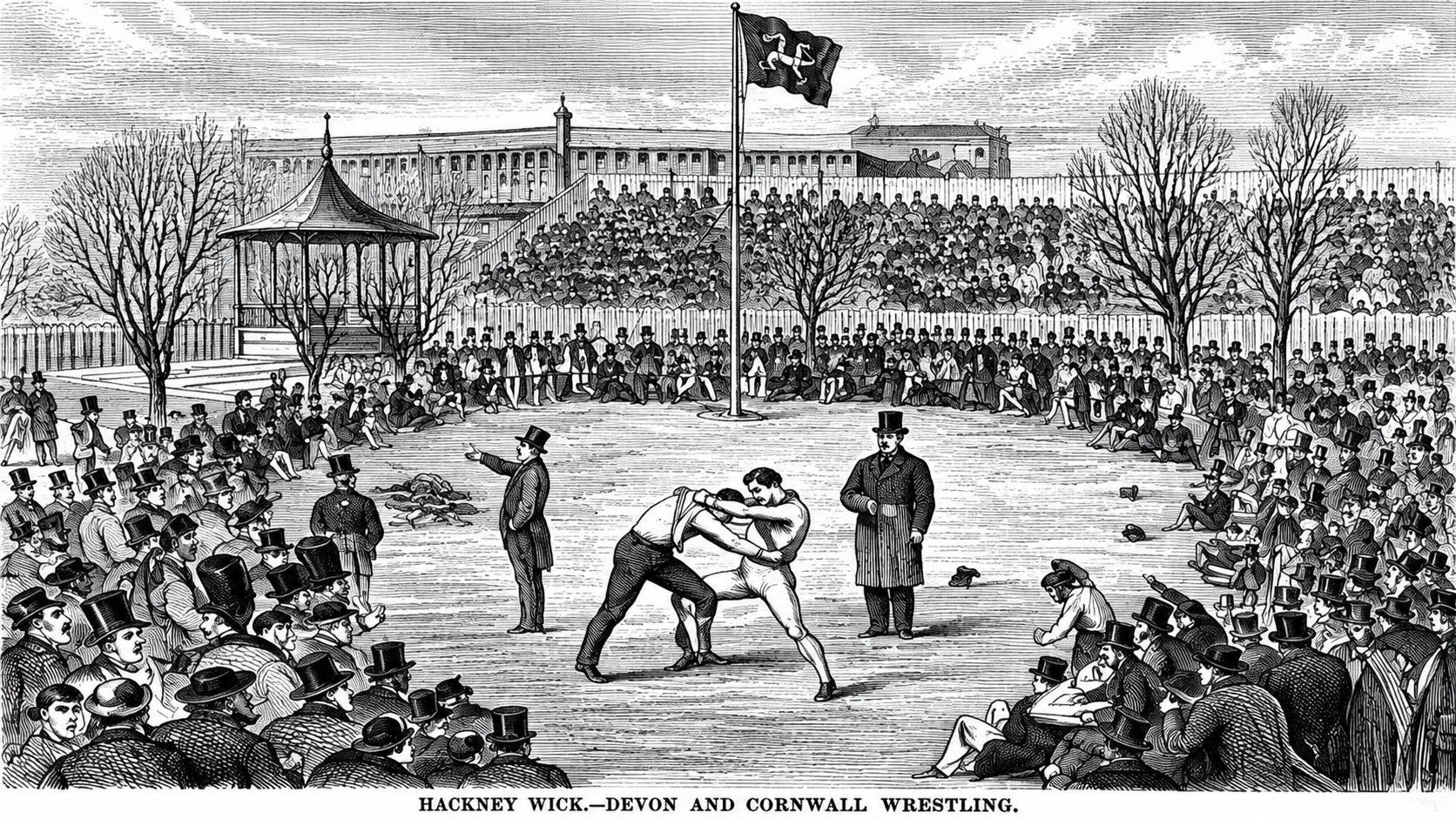
On 23 October 1826, thousands of people gathered at Tamar Green, near Devonport, to watch two men wrestle.
Not just any two men. One represented Cornwall, the other Devon, and there was £200 a side riding on the result. Historical accounts put the crowd at somewhere between 12,000 and 17,000 spectators, an extraordinary turnout for a sport that many people today have probably never seen.
In the Cornish corner stood James Polkinghorne, a former wrestling champion and publican from St Columb Major. Opposite him was Abraham Cann, Devon’s celebrated champion, a considerably smaller man with a reputation for speed and skill.
The size difference alone would have been enough to attract attention. But these men were also representing two rival wrestling traditions, and neither county was particularly keen on losing.
What followed became one of the most famous contests in Westcountry sporting history. There were fierce throws, disputed decisions, accusations over wrestling techniques and an ending that people were still arguing about years afterwards.
And the sport at the centre of it all?
Cornish wrestling, or wrasslin’ as it was traditionally known.
Today, Cornish wrestling is a relatively small traditional sport, kept alive by dedicated competitors and organisers. But during the nineteenth century, it was Cornwall’s most popular sport, attracting enormous crowds, valuable prizes and competitors whose reputations travelled far beyond the county.
Its story is one of sporting heroes, rivalry, emigration, decline and survival. And it deserves to be better known.
A Cornish giant and Devon’s smaller champion
James Polkinghorne was no ordinary opponent.
Historical accounts describe him as standing around six feet two inches tall and weighing approximately 320 pounds. At the time of his famous contest with Cann, he was running the Red Lion inn at St Columb Major and had reportedly been away from competitive wrestling for several years.
Abraham Cann was a very different proposition. Born in Devon in 1794, he belonged to a family of wrestlers and had already established himself as one of the leading competitors of his generation.
He was described as an athletic man with curly black hair, remarkable speed and an ability to defeat larger opponents. Historical accounts commonly put his weight at around 175 pounds, although some descriptions of the size difference are inconsistent.
Cann had already enjoyed success against Cornish wrestlers. In September 1826, just a month before the famous contest, he won a tournament at the Eagle Tavern in London, defeating James Warren of Redruth.
He was therefore arriving at Tamar Green with more than local pride behind him. He had a reputation to defend.
Polkinghorne, meanwhile, represented Cornish wrestling’s formidable tradition of powerful throws and jacket wrestling. The Cornish champion was considerably heavier, but Cann’s supporters believed his speed and technique could overcome that advantage.
There was also a more fundamental difference between them.
Cornish wrestlers traditionally competed without shoes and used holds on their opponents’ jackets. Devon wrestling permitted a more aggressive use of the feet, including kicks to the legs. The two styles had developed different approaches to putting an opponent on the ground.
So when Polkinghorne and Cann finally met, they were not simply competing to discover which man was stronger. They were also testing the reputations of two different wrestling traditions.
For Cornwall and Devon, that was quite enough to turn a sporting contest into a matter of county pride.
The match that nobody could agree on
The contest was arranged for the best of three back falls, with each side staking £200.
That was a substantial amount of money in 1826, especially when compared with the earnings of ordinary working people. Wrestling had become serious business, and the leading competitors could attract considerable financial backing.
The scale of the occasion was remarkable. Later historical accounts describe visitors pouring into Devonport and local accommodation coming under pressure as spectators travelled to witness the contest.
Polkinghorne entered the ring without shoes. Cann’s footwear became one of the most contentious aspects of the match, with historical accounts differing over whether he wore one shoe or two.
What is clear is that kicking played a major part in the contest, and it caused considerable resentment among Cornish supporters.
The wrestlers struggled through a succession of throws and disputed falls. Polkinghorne’s size gave him an obvious advantage in certain situations, while Cann’s mobility and kicking techniques helped him compete against the much larger man.
Neither side was prepared to concede easily.
Eventually, Polkinghorne left the ring believing he had secured victory. But the officials had not agreed that all the claimed falls were valid.
The result became a controversy in its own right.
Some historical accounts describe the match as having been declared a draw after prolonged disagreement. Others record Cann receiving the stakes because Polkinghorne had left the contest before an accepted conclusion.
What they agree on is that the encounter failed to produce a result that satisfied both sides.
That probably explains why it remained famous for so long. A straightforward victory eventually becomes a result in a record book. A Cornwall-versus-Devon contest involving thousands of spectators, a disputed finish and two different wrestling traditions gives people something to argue about for generations.
Nearly two centuries before television commentators started examining controversial refereeing decisions from every possible angle, Cornwall and Devon had already managed to produce a sporting argument that refused to go away.
But this was not an isolated curiosity. The contest belonged to a period when Cornish wrestling was enjoying enormous popularity.
When Cornwall went wrestling mad
It is easy to underestimate just how important wrestling once was to Cornwall.
During the first half of the nineteenth century, the county’s mining economy was thriving, and wrestling tournaments were major sporting and social occasions. Competitors entered contests for valuable prizes, while crowds gathered to watch the leading wrestlers compete.
Historical research by Mike Tripp identifies Cornish wrestling as Cornwall’s most popular sport during this period.
The best wrestlers could become celebrated figures, travelling between tournaments and earning considerable sums in prize money. Their victories were discussed, their reputations grew, and successful competitors could attract wealthy supporters.
One of the leading names was Tom Gundry, whose achievements took him well beyond Cornwall.
Gundry enjoyed considerable success in tournaments across Cornwall, Devon and London. His relatively short career brought numerous victories and substantial prize money, making him one of the outstanding wrestlers of the period.
That connection with London is particularly interesting.
Cornish wrestling had become popular enough for sporting entrepreneurs, many of them publicans, to organise tournaments in the capital. Promoters attracted leading wrestlers with the promise of valuable prizes, and spectators sometimes included members of the nobility.
Imagine that today: Cornwall exporting one of its traditional sports to London, with wealthy spectators paying to watch the best Cornish competitors.
For a time, that was exactly what was happening.
Wrestling was not simply something people did at a village gathering. It had become a form of professional sporting entertainment.
How does Cornish wrestling actually work?
For anyone unfamiliar with the sport, the rules are quite different from what most people picture when they hear the word wrestling.
Cornish wrestling is a stand-up contest in which competitors wear special jackets and attempt to throw their opponents onto their backs.
The wrestlers take holds on each other’s jackets rather than gripping the body directly. All throws begin from a standing position, and as soon as any part of a wrestler’s body apart from the soles of the feet touches the ground, the competitors separate and begin again.
The objective is to achieve what is called a Back.
The back is divided into four areas known as pins. If a wrestler throws an opponent so that three or four pins land simultaneously, the throw counts as a Back and wins the contest outright.
Lesser throws earn points, with one point awarded when one pin touches the ground and two points when two pins land.
Three judges, traditionally known as sticklers, decide whether throws are valid and award points or a winning Back.
It sounds straightforward, but the sport requires a combination of strength, balance, timing and technique. A wrestler must create the opportunity to lift or turn an opponent while avoiding being thrown themselves.
Modern Cornish wrestling also has a formal code of conduct.
Competitors shake hands before wrestling, and the traditional wrestler’s oath includes the Cornish words Gwary whek yu gwary tek, meaning “Good play is fair play.”
The oath commits wrestlers to compete without treachery or brutality.
That might seem an obvious principle for a sport, although history suggests that competitors and spectators have not always agreed on what constitutes fair play.
Just ask the supporters of Polkinghorne and Cann.
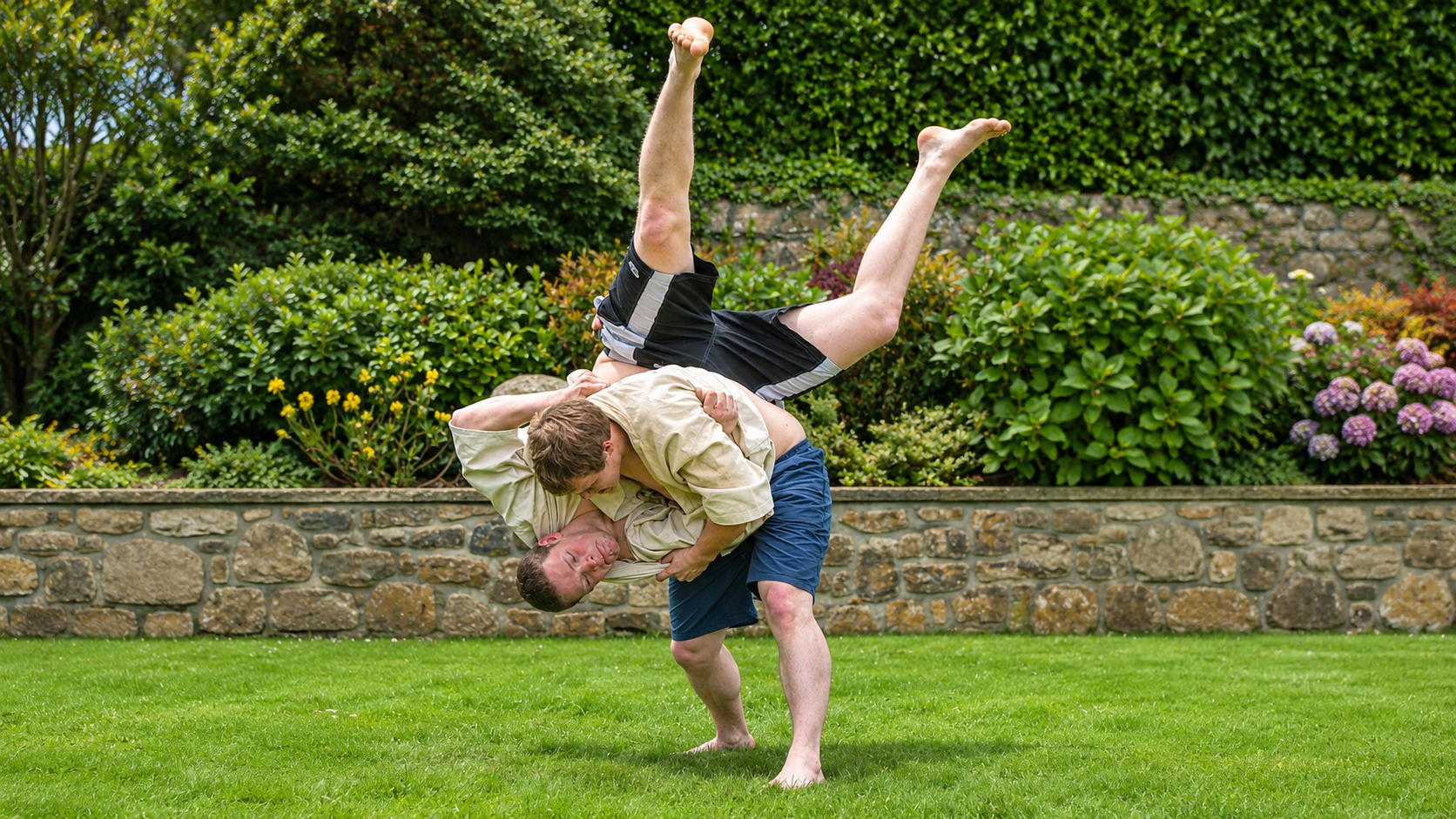
A demonstration of a traditional Cornish wrestling throw, showing the jacket holds and balance involved in the sport.
A sport with centuries of Cornish history
Cornish wrestling is frequently described as an ancient Celtic sport, sometimes with claims that it dates back thousands of years.
The trouble is that nobody can establish exactly when it began.
There are legends and traditions connecting wrestling with Cornwall’s distant past, but those stories should not be mistaken for documented history.
What can be established is that wrestling has been associated with Cornwall for centuries.
In The Survey of Cornwall, published in 1602, Richard Carew described wrestling as one of the county’s distinctive pastimes. His account included the use of jackets, demonstrating that an important feature of the modern sport was already familiar more than four hundred years ago.
By the eighteenth century, wrestling was well established within Cornish communities. It formed part of local gatherings and celebrations and provided entertainment long before modern organised sports became widespread.
Its precise origins remain uncertain, but the documented history is impressive enough without trying to give it an invented birthday.
The Cornish miners who took wrasslin’ around the world
During the nineteenth century, Cornwall underwent enormous economic and social changes.
Although mining had helped support wrestling’s popularity, the decline of the mining industry eventually forced many Cornish people to seek work elsewhere.
Skilled miners and engineers left for other parts of Britain and countries across the world. Some found employment in the mines of Australia, others travelled to the United States or South Africa.
They took their knowledge and skills with them, but they also carried their Cornish identity.
Food, customs, family traditions and sporting interests followed them overseas. Among those traditions was Cornish wrestling.
In Australia, wrestling became particularly associated with Cornish immigrant communities. Tournaments provided both sporting entertainment and a familiar connection with the homeland people had left behind.
Research into Cornish wrestling in Australia shows how the sport helped emigrants maintain a distinct sense of Cornish identity.
That is something worth thinking about.
A group of Cornish miners could travel halfway around the world, spend their working lives in unfamiliar surroundings and still gather to compete in a sport that reminded them of home.
The mines were different, the landscape was different and the climate was certainly different. But once the wrestlers put on their jackets, there was something unmistakably Cornish about what followed.
The sport’s overseas popularity did not last indefinitely. In Australia, Cornish wrestling had largely disappeared by the outbreak of the First World War, although it later experienced renewed interest as Cornish identity and heritage attracted greater attention.
Back in Cornwall, meanwhile, the sport was facing its own problems.
How Cornwall’s favourite sport nearly disappeared
The enormous popularity of nineteenth-century Cornish wrestling gradually faded.
The mining communities that had helped sustain the sport were changing. Economic decline and emigration affected traditional gatherings, while football, rugby and cricket were becoming increasingly established.
These sports developed organised competitions, governing bodies and structures that made regular participation easier.
Cornish wrestling remained closely connected to local tournaments and traditional occasions. Although it continued to attract committed competitors, it no longer enjoyed the dominant position it had held during the earlier nineteenth century.
There were also problems within wrestling itself.
Historical research has uncovered evidence of match-fixing during the nineteenth and early twentieth centuries, a practice known as faggoting.
The manipulation of contests damaged the sport’s reputation and added to the difficulties it faced.
It would be tempting to leave that part out and imagine a golden age in which every wrestler competed honourably, every official made the correct decision and everybody went home happy.
But that would hardly be an accurate history of competitive sport.
Cornish wrestling had produced famous champions, valuable prizes, rivalry, controversy and disputes over results. In that respect, it was not so different from many popular sports today.
By the early twentieth century, however, its decline was serious enough to threaten its future.
If the tradition was going to survive, it needed greater organisation.
The revival that helped save Cornish wrestling
In 1923, the Cornwall County Wrestling Association was established to help organise and promote the sport.
The association introduced a more structured approach, including organised fixtures, registration of wrestlers and judges, and efforts to make the rules more consistent.
This was an important turning point.
Traditional wrestling had developed over generations, often with differences between local customs and competitions. A recognised governing organisation provided a stronger foundation for championships and helped the sport adapt to changing expectations.
The revival also strengthened Cornwall’s sporting connections with Brittany.
In 1928, organised contests began between Cornish and Breton wrestlers, reflecting the cultural links between the two Celtic regions. These encounters continued intermittently for decades, providing opportunities for wrestlers from both traditions to compete.
The changes did not restore Cornish wrestling to its former position as the county’s most popular sport. Football and rugby were already firmly established, and the days of enormous nineteenth-century wrestling crowds were largely over.
But the organisation helped ensure the sport survived.
Cornish wrestling remained something people could practise and compete in, rather than becoming a historical curiosity remembered only through newspaper reports and photographs.
Cornish wrestling is still alive today
The most remarkable part of this story is that Cornish wrestling is still practised.
The Cornish Wrestling Association continues to maintain the rules and organise championships for senior and junior competitors.
The senior competition includes different weight categories, while junior divisions provide opportunities for younger wrestlers to learn the techniques and take part.
That is important because a living sporting tradition cannot survive through historical recognition alone.
It needs people willing to learn, compete, teach and organise.
Cornish wrestling has also featured in wider discussions about protecting traditional cultural practices.
In October 2026, the UK Government specifically mentioned Cornish wrestling in a parliamentary answer concerning the safeguarding of traditional wrestling styles.
The Government referred to the UK’s ratification of UNESCO’s Convention for the Safeguarding of the Intangible Cultural Heritage in 2024 and its work to recognise traditions, customs and sports as part of Britain’s living heritage.
That recognition is welcome, although it does not mean Cornish wrestling has automatically received a special UNESCO designation or that its future is secure.
A sport cannot survive entirely through official recognition, however valuable that may be.
A wrestling association still needs competitors, judges, organisers and somewhere to hold its tournaments.
A heritage document cannot put anybody onto their back.
Cornwall’s history, still standing
Cornish wrestling has had quite a journey.
It developed into one of Cornwall’s great traditional pastimes, became the county’s most popular sport, produced famous champions and attracted enormous crowds.
It travelled around the world with Cornish emigrants, became caught up in the changing fortunes of mining communities and nearly disappeared as modern sports took over.
Yet it survived.
Today, Cornwall has plenty of physical reminders of its past. Engine houses stand on the hillsides, harbours still carry the marks of their working history, and historic buildings help tell the stories of the communities that built them.
Cornish wrestling is different.
There is no single building or monument that can preserve it. You cannot save wrasslin’ simply by repairing a roof, restoring an old photograph or putting a plaque beside a field.
Every generation has to make the effort to keep it alive. Somebody must learn the holds, somebody must teach them, somebody must organise the tournaments, and somebody must be prepared to put on the jacket and compete.
Perhaps that is what makes Cornish wrestling such an important part of Cornwall’s heritage. It has not survived because nobody touched it. It has survived because people kept doing it.