
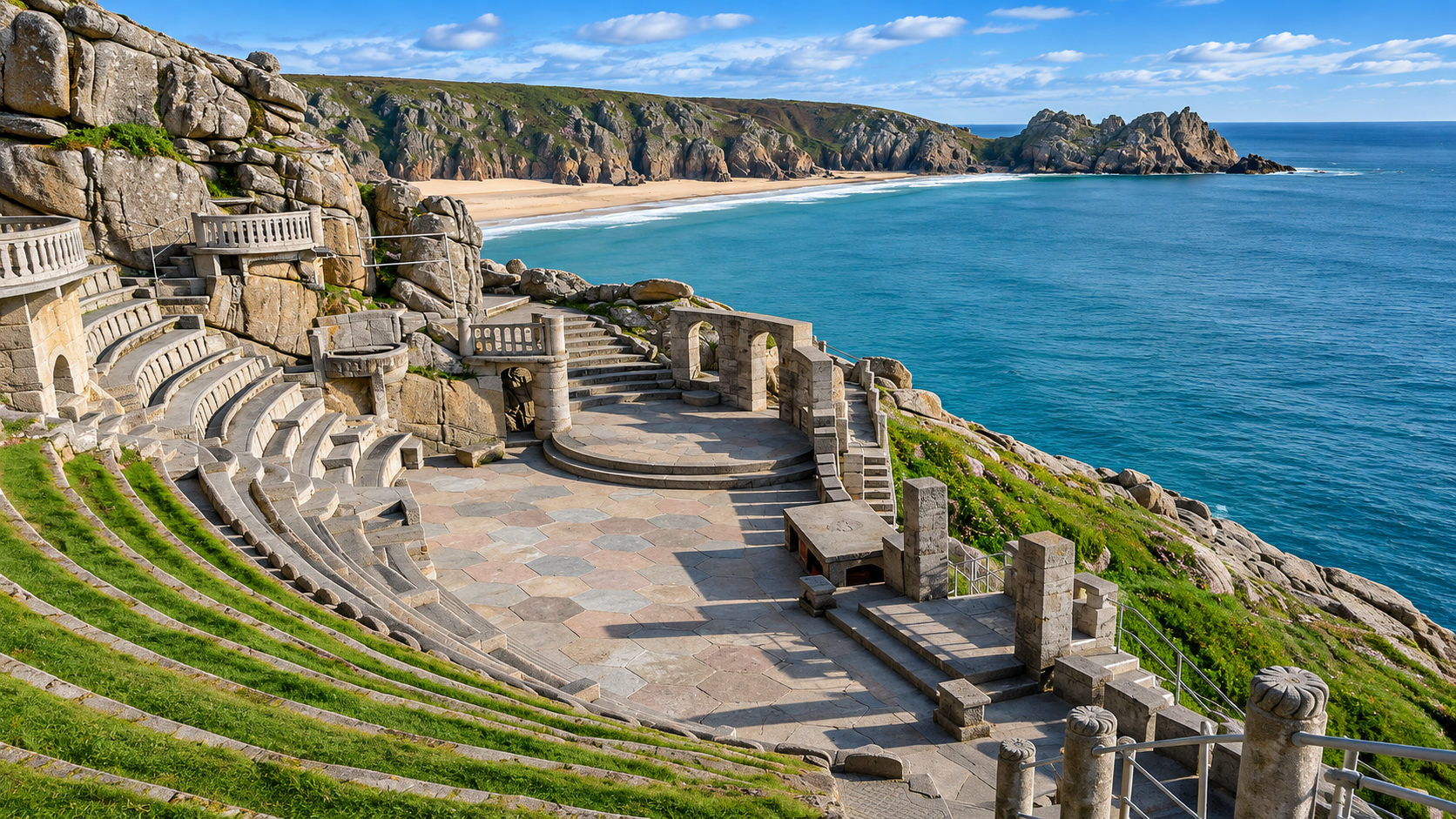
Look down over the stone terraces of the Minack Theatre towards the Atlantic and it is easy to assume they have been there for centuries. The theatre seems to belong to the cliff, as though somebody discovered the remains of an ancient amphitheatre above Porthcurno and decided to start putting plays on there.
The truth is far stranger.
Less than a century ago, there was no theatre at all. There was a steep Cornish cliff covered in gorse, heather and granite. Then Rowena Cade decided it would make a good place to perform Shakespeare.
What followed was not a grand architectural project backed by wealthy investors and heavy machinery. Cade, helped by a small number of local men, spent decades shaping the hillside largely by hand. She carried materials, moved stone, mixed concrete and decorated the theatre herself.
The Minack may now be one of Cornwall’s most recognisable landmarks, but its beginnings were remarkably close to an ambitious garden project that got completely out of hand.
A £100 headland above Porthcurno
Rowena Cade was born in Derbyshire in 1893 and grew up in a comfortable Edwardian household. Her family subsequently lived in Cheltenham, but the First World War and the death of her father brought significant changes to their lives.
In the early 1920s, Cade moved to Cornwall with her mother. She bought the Minack headland above Porthcurno for just £100 and built Minack House, which still stands above the theatre today.
Even the name suited what was to come. Minack derives from the Cornish meynek, meaning a rocky place.
Rocky it certainly was.
The land below Cade’s house tumbled towards the Atlantic in a mixture of granite, vegetation and precipitous slopes. Nobody had designed it as an entertainment venue. There were no sweeping rows of seats waiting to be restored and no forgotten stage buried beneath the undergrowth.
The theatre began because Cade became involved with local amateur dramatics.
In 1929, a local group staged an outdoor production of Shakespeare’s A Midsummer Night’s Dream in a nearby valley. It proved so successful that the production was repeated the following year.
The group then set its sights on The Tempest, a play involving a shipwreck, a remote island, magic and the sea. There are few natural settings better suited to it than a Cornish cliff with the Atlantic filling the horizon.
There was just one fairly substantial problem.
They needed somewhere to perform it.
Turning a cliff into a stage
Cade offered the use of her land, but providing the scenery was considerably easier than providing somewhere for actors and an audience to stand.
During the winter of 1931–32, she and her helpers set about transforming the cliff. Her gardener Billy Rawlings played a particularly important part, alongside other local craftsmen.
They cleared vegetation, shifted earth and tackled enormous pieces of granite. The initial stage was a roughly levelled area covered with turf, while terraces were cut into the hillside to provide somewhere for spectators to sit.
This was physical work on a steep slope where mistakes could have considerably more serious consequences than a wonky patio.
Cade later described Rawlings and another Cornishman splitting enormous boulders by hand. Some pieces disappeared towards the sea, accompanied by what she tactfully called “some good dialect expressions of regret”.
That may be one of the finest polite descriptions of Cornish swearing ever preserved.
The men moved other pieces into position inch by inch using metal bars, working on slippery ground above a sheer drop. Cade helped fill the spaces behind them with earth and smaller stones.
It was dangerous, exhausting work, and all for what was initially intended to be a temporary performance.
On 16 August 1932, the first production of The Tempest opened at the Minack.
That date is worth remembering. The theatre looks ancient enough to encourage all sorts of imagined histories, yet its first audience arrived in the twentieth century. What appears from a distance to be some mysterious old amphitheatre was actually the result of a determined woman and a handful of helpers reshaping a Cornish cliff.
And 1932 was only the beginning.
Rowena Cade did not simply commission the Minack
It would be easy to tell the story as though Cade had the idea and other people built it for her.
That would miss what makes the Minack extraordinary.
She worked on it herself, and kept working on it for the rest of her life.
The theatre developed gradually, with Cade continuing to shape and improve it for decades. She worked with hand tools, moved building materials around the cliff and used concrete to create much of what visitors now take for stone.
Sand was carried up from the beach below in sacks and mixed into the concrete. Cade herself helped carry it, a remarkable undertaking considering the steep climb from the shore.
There was occasionally even dynamite.
The surroundings might have suggested Greek ruins, but the building site was considerably more practical: bars for moving granite, buckets, concrete, hand tools and whatever was necessary to persuade a Cornish cliff to become somewhere people could watch a play.
The work also shows why describing Cade merely as the theatre’s founder does not quite cover it.
She was its builder and artist too.
The theatre that pretends to be older than it is
Part of the Minack’s magic comes from an illusion.
Its curved terraces, carved-looking surfaces, pillars, steps and weathered appearance seem inseparable from the granite around them. Yet many of the decorative surfaces were deliberately created from concrete.
Cade carved intricate designs into the wet material using an old screwdriver. Rather than simply providing functional seating, she gave the theatre its own distinctive character.
She also inscribed the names and dates of productions into seats and other parts of the theatre, gradually turning the building itself into a record of what had happened there.
That makes the Minack different from a theatre that merely contains history.
Its history is written across it.
The names of previous productions sit among the terraces while the sea, cliffs and weather remain part of every new performance. A conventional theatre works hard to control its environment. The Minack invites the environment onto the bill.
Sometimes that means a glorious sunset. Sometimes it means wind, rain and the Atlantic reminding everybody that outdoor theatre beside the sea was always a fairly bold proposition.
War interrupted the performances, but not the ambition
The Minack’s early success established the beginnings of a theatrical tradition, with productions continuing through the 1930s.
The Second World War brought that to a halt.
Performances ceased during the war, and the theatre did not reopen until 1951. By then, considerable rebuilding was needed before audiences could return.
The reopening production was Tristan of Cornwall, another story with a strong connection to the landscape and history of the far west.
The theatre continued developing as a venue for amateur and professional productions, while Cade remained closely involved with its construction and operation.
She was not simply creating somewhere people could admire the view. She was building a working theatre, one that needed to accommodate performers, audiences and the practical demands of productions.
And because each year brought different needs, there was always another improvement to make.
A life’s work left in the cliff
By the 1970s, the Minack had become far more substantial than the rough terraces and turf stage created for that first production.
In 1976, Cade transferred the theatre to a charitable trust, helping secure its future beyond her own lifetime.
But she did not simply retire and leave others to look after it.
She continued working on the theatre well into her eighties, developing and decorating the place that had occupied so much of her life.
Rowena Cade died on 26 March 1983, aged 89.
By then, she had devoted roughly half a century to the Minack.
That timescale changes the story. The theatre was not one heroic burst of construction followed by an opening ceremony and a finished building. Cade kept altering, carving and developing it as the years passed. The place grew with her.
A granite plaque commemorates her at the theatre, but the larger memorial is difficult to miss.
It is underneath the audience’s feet.
Every terrace that seems ancient, every strangely decorated piece of concrete and every production name worked into the theatre belongs to the same extraordinary undertaking.
A woman bought a rocky Cornish headland, became involved in amateur dramatics and decided that the cliff beneath her house could become a theatre.
Then, rather than waiting for somebody else to make it happen, she started building.
The Minack is still doing what Cade built it to do
The Minack today is a modern working theatre rather than a preserved historical curiosity. Professional and amateur companies perform there, and the venue has developed facilities that Cade could never have provided during those first years of construction.
Its performances are only part of its continuing purpose. Visitors can also explore the theatre and discover more about its remarkable history.
But the essential idea remains wonderfully unchanged.
People still descend the terraces, take their seats above the sea and watch performers occupy the space Cade and her helpers first shaped from the hillside for The Tempest in 1932.
That continuity may be the most impressive part of the story.
Cornwall has plenty of dramatic ruins whose original purpose disappeared centuries ago. The Minack manages almost the reverse trick. It looks like a ruin from the distant past, yet it is a comparatively young place still carrying out the job for which it was created.
And whenever the Atlantic behind the actors begins looking suspiciously more dramatic than anything happening on stage, it is worth remembering who put the theatre there in the first place.
Rowena Cade did not find the Minack.
She made it.