
For generations, the story of the Cornish language seemed to have a neat ending. Dolly Pentreath of Mousehole died in 1777 and, according to the version repeated ever since, Cornish died with her.
It’s a wonderfully tidy story. It’s also increasingly difficult to defend.
Kernewek suffered a devastating decline, and by the late eighteenth century very few people were still speaking it. But historical evidence shows that the language continued beyond Dolly Pentreath, survived in various forms through the nineteenth century and eventually became the subject of an extraordinary revival.
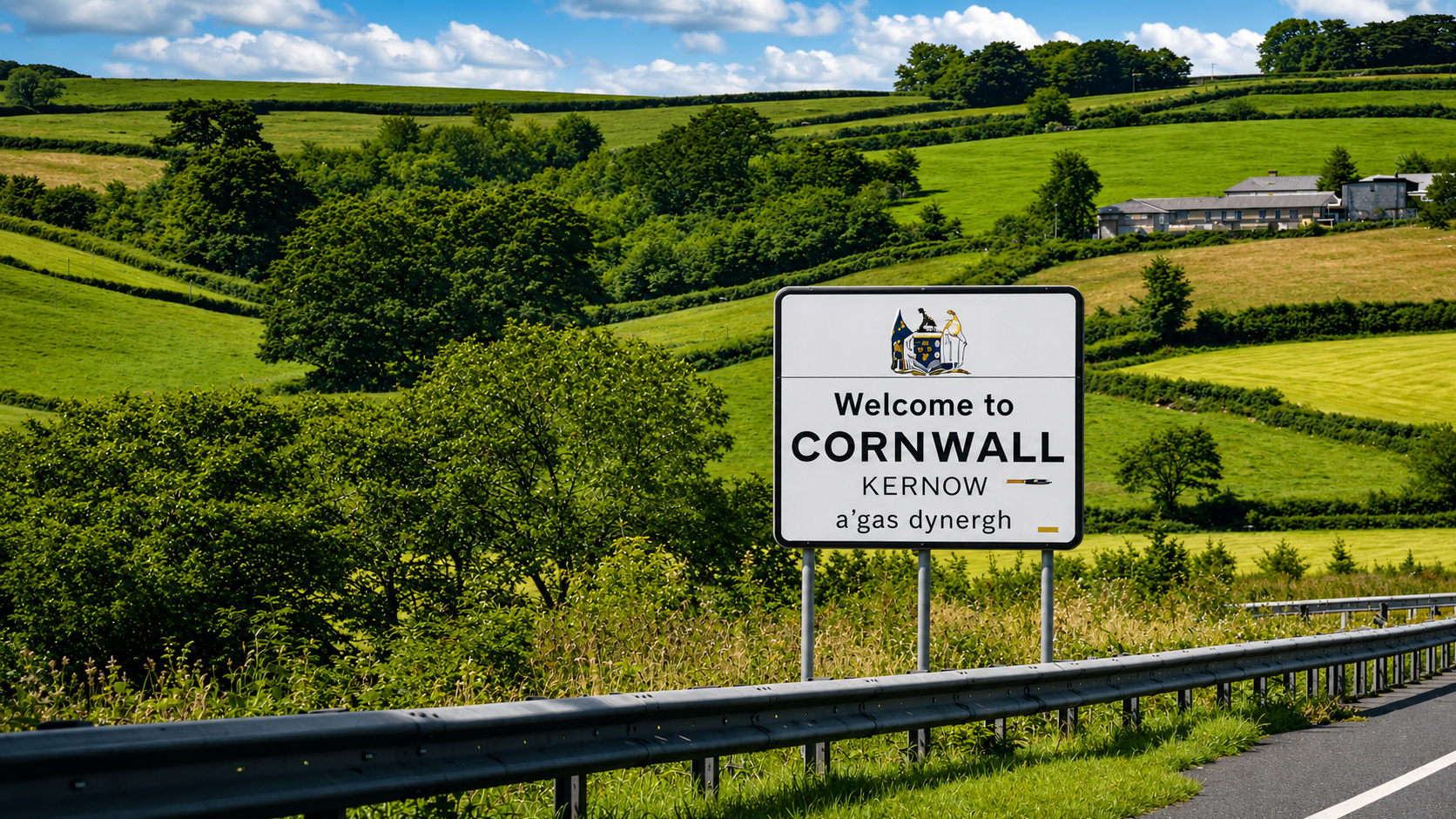
Today, Cornish appears on signs, is taught in schools and can be heard in public life. It has also gained stronger official protection, with new commitments introduced in December 2025 to support its future.
The more interesting story isn’t how Cornish died. It’s how a language came frighteningly close to disappearing and somehow refused to stay buried.
Cornwall once spoke Cornish
Long before English became the everyday language of Cornwall, people here spoke the Celtic language we now call Cornish, or Kernewek.
It wasn’t some ceremonial curiosity reserved for songs, mottos or special occasions. It was a community language, spoken between families and neighbours, and used in an impressive body of medieval literature.
Among the surviving works are the Ordinalia, a series of religious mystery plays from medieval Cornwall. These are substantial dramatic texts, showing that Cornish was a developed written language capable of carrying complex stories, dialogue and religious ideas.
Its decline didn’t happen because everybody suddenly decided English was better. It happened gradually as the balance of power, administration, religion and commerce shifted towards English.
The Reformation was particularly important. Unlike Welsh, Cornish did not receive a translation of the Book of Common Prayer, and the increasing use of English in religious life helped weaken the position of the language. Growing commercial and administrative contact with the wider English-speaking world added further pressure. Knowing English became increasingly useful, and eventually essential.
Over generations, bilingualism could turn into language replacement. Parents who knew Cornish also needed English. Their children increasingly needed English. Eventually, the language offering the greatest practical advantage became the one most reliably passed on.
That’s how a language can retreat without anybody holding a meeting to abolish it.
Then came Dolly
Dorothy ‘Dolly’ Pentreath lived in Mousehole, where she worked selling fish. By the eighteenth century, Cornish had retreated so far that people who could still speak it fluently were becoming objects of considerable curiosity.
One of the men fascinated by them was the antiquarian Daines Barrington.
In 1768, Barrington travelled through west Cornwall trying to discover whether the language was still spoken. He initially investigated the area around Sennen before being directed towards Mousehole, where he encountered Dolly.
What makes his account particularly interesting isn’t simply that Dolly spoke Cornish. It’s what happened around her.
Barrington reported that other elderly women nearby understood what Dolly was saying, although they did not necessarily speak it with her fluency.
That is a fascinating detail, because it challenges the familiar image of one elderly woman sitting in complete linguistic isolation while the rest of Cornwall had forgotten every word.
There were other people who understood Cornish, even if their ability to speak it varied.
When Dolly died in December 1777, her reputation grew into something considerably bigger. She became famous as the last speaker of Cornish, and her supposed position at the end of the language’s history was reinforced by a memorial erected at Paul in 1860.
Associated with Prince Louis Lucien Bonaparte, the memorial describes her as someone said to have been the last person to converse in the ancient Cornish language.
It is a powerful image. One elderly woman dies, and an ancient language dies with her.
But there is a rather obvious problem.
The evidence doesn’t support treating Dolly’s death as the precise moment Cornish disappeared.
Dolly remains enormously important. Linguistic research has identified her as one of the last recorded fluent native speakers brought up with Cornish from childhood.
That is an extraordinary place in history without needing to make her the final person on earth who could speak it.
The people history almost forgot
The difficulty with finding the last speaker of any language is that ordinary conversations rarely leave written records.
Imagine trying to identify the exact last person in Cornwall to use an old dialect expression. Unless someone happened to record every conversation in every home, workplace and fishing boat, how could we possibly know?
That problem becomes even greater when the people whose lives we’re investigating were ordinary working people whose words rarely appeared in books or official documents.
For much of the nineteenth century, the usual story was that Cornish had vanished as a living language and survived only in historical texts and fragments of local speech.
But research by Dr Kensa Broadhurst at the University of Exeter has challenged that picture.
Her 2025 book, The Cornish Language in the Nineteenth Century, examines evidence from the period between Dolly’s death and the recognised revival of the early twentieth century.
The research argues that Cornish remained in use during the nineteenth century, including among working people and individuals actively trying to preserve it.
Two of those individuals are particularly interesting.
Frederick William Pearce Jago was a Cornish doctor whose interest in the language led to the publication of The Ancient Language and the Dialect of Cornwall in 1882.
His work gathered historical material, linguistic observations and vocabulary at a time when Cornish was widely regarded as a thing of the past. It also included information about Dolly Pentreath, whose status as the supposed last native speaker was already firmly established.
The Reverend Wladislaw Lach-Szyrma, associated with Newlyn, also investigated the language and encouraged efforts to preserve it. During the 1870s, he promoted an essay competition concerned with Cornish, and surviving entries are now held in the Morrab Library archives in Penzance.
Those surviving documents are valuable because they provide something more substantial than a vague claim that people remained interested in Cornish. They show individuals actively investigating, recording and promoting the language decades before the modern revival gathered momentum.
Of course, recording a language isn’t the same as speaking it fluently. Some of those interested in Cornish were preserving or studying it rather than using it as the language of their childhood.
Nevertheless, the nineteenth century was not simply an empty space between Dolly Pentreath and Henry Jenner.
People were still investigating Cornish, recording what survived and trying to keep it alive.
1904 and the beginning of the comeback
More than a century after Dolly’s death came one of the decisive moments in the modern history of Kernewek.
In 1904, Henry Jenner published A Handbook of the Cornish Language, providing a major catalyst for the organised revival.
The challenge facing revivalists was unusual. They weren’t merely encouraging people to use a language still widely spoken in their homes. They were working with surviving literature, historical records, earlier scholarship and fragments of remembered language to make Cornish practical again for modern life.
That raised some difficult questions. Which historical form of Cornish should form the basis of modern teaching? How should words be spelt? How should pronunciation be reconstructed? What should happen when modern life required vocabulary that medieval writers had never needed?
Those questions eventually produced different spelling systems and considerable disagreement among people who were, rather ironically, all trying to save the same language.
Robert Morton Nance became another significant figure in the revival, developing a regularised spelling system known as Unified Cornish and helping build the foundations for further learning and writing.
The disagreements weren’t always helpful, particularly for newcomers trying to learn the language, but they also revealed something important: people cared enough about Cornish to argue about how it should live.
A language nobody wanted would not have generated much debate.
From survival project to living language
The twentieth-century revival gradually moved Cornish beyond scholars, collectors and enthusiasts.
People learned it. Classes developed. New literature appeared. Some families began using Cornish with their children, and cultural organisations helped bring the language into public life.
A major milestone arrived in 2002, when Cornish received recognition under Part II of the European Charter for Regional or Minority Languages.
Then, in 2014, the UK Government formally recognised Cornish people under the Framework Convention for the Protection of National Minorities, acknowledging Cornwall’s distinct cultural and historical identity.
The change since then is visible.
Kernewek appears on bilingual signs. It is used in Cornwall Council’s work and communications. Children encounter it through schools, adults can attend classes, and there are Cornish-language publications, broadcasts, music and digital learning resources.
In June 2026, Cornwall Council reported that more than 6,000 children across 30 schools were engaging with the language through the Go Cornish programme.
That is a significant development for a language once considered to have disappeared.
None of it means Cornwall has suddenly become bilingual. Fluent speakers remain a small minority, and English overwhelmingly dominates everyday life. A language can be alive without being secure.
But compare that situation with the supposedly definitive ending in Mousehole in 1777, and the scale of the revival becomes clear.
A stronger future for Kernewek
In December 2025, the Cornish language received another important boost.
On 5 December, the UK notified the Council of Europe that it would apply Part III of the European Charter for Regional or Minority Languages to Cornish, extending the commitments previously made under Part II.
That sounds like the sort of phrase designed specifically to make a reader’s eyes wander towards the kettle, but the practical meaning is worth understanding.
Under the new arrangements, the UK undertook 36 measures covering areas such as education, public authorities, media, cultural activity and economic and social life.
One example involves opportunities to teach Cornish or teach through Cornish. Another concerns the possibility of using the language when submitting documents or applications to public authorities.
These are commitments to support and promote the language, not evidence that all those opportunities are already available everywhere.
In June 2026, Cornwall Council set out its ambition for every child leaving primary school in Cornwall to have an awareness of and connection with Kernewek.
Schools were encouraged to use resources developed through the Go Cornish programme, with different levels of recognition available for those introducing the language more extensively.
More than two centuries after Cornwall supposedly lost its final speaker, people are discussing how the next generation should encounter the language.
That’s quite a reversal.
So did Cornish actually die?
This is where language history becomes awkward, because everything depends on what we mean by ‘died’.
Cornish unquestionably ceased to function as the ordinary community language it had once been. The chain of transmission from one generation to another was severely weakened, and its traditional speech community dwindled dramatically.
That wasn’t a minor decline. It was a profound loss.
Yet describing Dolly Pentreath’s death as the precise moment Cornish became extinct obscures evidence of continued language knowledge and use afterwards.
It also creates an artificial gap between traditional Cornish and the modern revival, as though generations of people preserving words, texts and knowledge contributed nothing in between.
Broadhurst’s research presents a more complicated picture, arguing that Cornish should be regarded as critically endangered rather than extinct during the nineteenth century.
That interpretation does not mean historians have discovered an uninterrupted, flourishing community of fluent native speakers right through to 1904. The surviving evidence has limits, and the degree to which different individuals could actually converse in Cornish varied.
But it does mean the simple story of a language dying with one woman is inadequate.
Cornish didn’t disappear from human knowledge and use. It survived in a severely diminished condition until deliberate efforts helped bring it back into wider circulation.
A language survives because people decide it matters
Stone monuments survive because they’re stone. Put one somewhere sensible and, barring weather, vandals and somebody deciding it needs ‘improving’, it can remain there for centuries.
A language has no such luxury.
It only survives when human beings keep doing something with it. Somebody has to speak it, teach it, write it, record it, argue over it, translate new words into it and persuade another generation that learning it is worth their time.
Cornish reached a point where the traditional chain of everyday speakers was almost broken beyond repair. Yet people kept hold of enough to give future generations something to work with.
The nineteenth-century writers and language enthusiasts had something to preserve. Henry Jenner and the early revivalists had something to build on. Later generations of teachers, speakers, writers, parents and community groups continued the work.
Today, a child can encounter Kernewek at a Cornish primary school while an adult living hundreds or thousands of miles away can study the language online.
There are still enormous challenges if Cornish is to become more widely spoken. Official recognition alone cannot create conversations around kitchen tables. Signs in two languages are visible evidence of identity, but they aren’t the same thing as thousands of people confidently using both.
The real test of the revival will be whether growing numbers of people choose to speak Cornish in their ordinary lives, not only during lessons, ceremonies or organised events.
But perhaps it’s time to retire the gravestone version of the story.
Dolly Pentreath deserves to be remembered as one of the last recorded people raised speaking traditional Cornish fluently, not burdened with the impossible responsibility of having an entire language expire with her.
Kernewek came perilously close to disappearing.
It never quite did.