
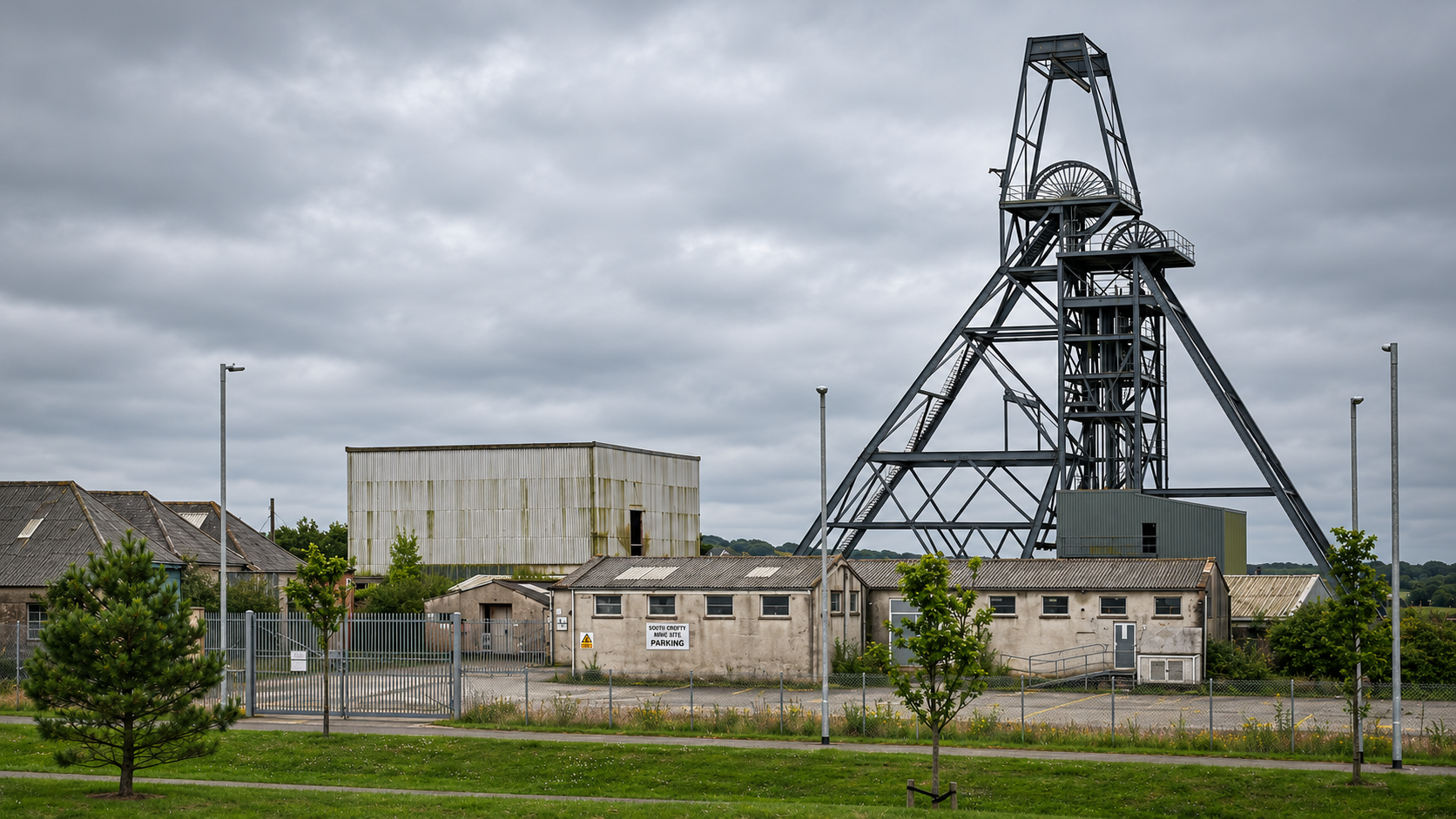
On 6 March 1998, South Crofty closed for the final time as a working tin mine. After centuries of mining beneath the ground around Camborne and Redruth, Cornwall’s last operating tin mine had fallen silent.
For the miners and their families, it meant far more than another industrial business shutting down. Generations had earned their living underground, mining skills had been passed through families, and entire communities had grown around the work. The closure marked the end of commercial tin mining in Cornwall, an industry that had shaped the county and sent Cornish expertise around the world.
But South Crofty had one rather important difference from many of Cornwall’s abandoned mines. The tin hadn’t run out. Valuable deposits remained deep underground. The problem was that extracting them had become too expensive compared with what the mine could earn from selling the metal. And that left a question hanging over South Crofty long after the last miners came to the surface. Could it ever work again?
Nearly three decades later, that question is no longer just an interesting discussion about Cornwall’s industrial past. Pumps are removing water from the old workings, shafts are being refurbished and new equipment is arriving as another attempt to bring South Crofty back into production gathers pace. For a mine that was supposed to have finished its working life in 1998, that’s quite a remarkable turn of events.
More than 400 years of mining beneath Pool
South Crofty stands at Pool, between Camborne and Redruth, in what was once one of the busiest mining districts in Cornwall. Long before the modern mine existed, people were extracting minerals from the ground here. The earliest known references to mining at Penhellick Vean, part of the area that eventually became South Crofty, date from the 1590s. That’s more than four centuries of documented mining history connected with the site.
Of course, the operation in those early days looked very different from the enormous underground workings that developed later. Miners followed mineral deposits using the tools and techniques available to them, initially working relatively shallow areas where valuable ore could be reached. As mining technology improved, workings extended deeper underground. Shafts were sunk, drainage systems developed and increasingly powerful machinery made it possible to reach deposits that earlier generations couldn’t have worked economically.
South Crofty didn’t grow as one single mine, either. Over the centuries, neighbouring operations opened, expanded, struggled and sometimes merged. Different owners acquired adjoining workings, gradually creating a much larger industrial concern. One of the most significant additions came in 1936, when South Crofty’s operators acquired Dolcoath, one of the most famous mines in Cornish history. Dolcoath had been one of Cornwall’s great mining operations, and its acquisition added another important piece to the collection of historic workings associated with South Crofty.
Although the mine eventually became famous for tin, copper played an important role in its earlier history. During the eighteenth and nineteenth centuries, Cornwall was a major copper-producing region, and the mines around Camborne and Redruth contributed to an industry supplying metal to markets far beyond the county. But mineral markets changed, and deeper tin deposits became increasingly important. By the twentieth century, South Crofty had become one of the country’s most significant surviving tin operations.
And the scale of what developed underground was extraordinary. Its workings extended for kilometres beneath the surrounding area, with some reaching more than 900 metres below the surface. Think about that the next time you’re travelling through Pool. Beneath the roads, buildings and industrial estates lies an enormous network of shafts and tunnels developed by generations of Cornish miners. The winding gear and buildings above ground were only the visible part of something much bigger.
South Crofty was more than a mine. It was people’s livelihoods.
It’s difficult to understand the importance of South Crofty without understanding what mining meant to the communities around Camborne, Pool and Redruth. Mining wasn’t simply one employer among many. For generations, it influenced where people lived, what work was available and the skills passed down through families.
A mine needed underground workers, certainly, but it also depended on engineers, electricians, mechanics, carpenters, blacksmiths, surface workers and people maintaining complex machinery. Local workshops supplied equipment. Businesses provided materials and services. The wages earned by miners helped support shops, pubs and the wider community.
And mining created a particular kind of working culture. The job demanded skill, experience and trust in the people working alongside you. Deep underground, problems with machinery, ventilation, water or unstable ground could have serious consequences. It was hard work, and it could be dangerous.
The old engine houses and chimneys scattered across Cornwall might look magnificent today, particularly when they’re standing against the coastline, but nobody built them to improve the scenery. They were working industrial structures, designed to keep mines operating and people employed.
Cornwall also became internationally recognised for its mining expertise. Cornish miners and engineers developed skills that were sought after around the world. As opportunities declined at home during different periods, many travelled to mining regions in Australia, South Africa, North America and elsewhere. They carried their knowledge abroad, helping establish the international reputation of Cornish mining.
But those achievements came at a cost. Families were separated, communities lost experienced workers and people who wanted to remain in Cornwall sometimes had to leave to find employment.
By the late twentieth century, many Cornish mines had already closed. South Crofty was different because it was still operating. While other sites were becoming historic landmarks or reminders of a disappearing industry, men at South Crofty were still going underground to earn their living. That made what happened in 1998 particularly painful. This wasn’t an industry that had disappeared centuries earlier. It was living memory.
The tin price crash that helped bring everything down
To understand why South Crofty closed, we need to look beyond Cornwall. Mining has always depended on a fairly unforgiving calculation. You have to be able to sell the minerals you extract for more than it costs to get them out of the ground.
And when you’re operating deep underground, those costs can be enormous. South Crofty needed machinery, electricity, pumping systems, maintenance, skilled workers and facilities for processing ore. International competition made things increasingly difficult, particularly when overseas producers could operate under different geological and economic conditions.
Then came October 1985. The International Tin Agreement, which had been intended to help stabilise the world tin market, collapsed. The resulting tin price crash placed enormous pressure on producers around the world. For Cornwall’s mines, many of which were already dealing with high operating costs, it was disastrous.
Mines closed as businesses struggled to cover their expenses. Jobs disappeared, and communities that had relied on mining faced an increasingly uncertain future. South Crofty survived the immediate crisis, but keeping it open required difficult decisions, changes to working arrangements and efforts to reduce costs. The mine continued operating through the late 1980s and into the 1990s, even as the wider Cornish tin industry contracted. Eventually, however, the economics became impossible to sustain.
On 6 March 1998, South Crofty closed. It was Cornwall’s last working tin mine, and its closure brought centuries of commercial tin mining in the county to an end. For those who had spent their working lives underground, it meant losing jobs, income and an occupation that had been part of their communities for generations.
But there was another frustrating aspect to the closure. South Crofty hadn’t stopped because miners had extracted every last piece of tin. There were still valuable mineral deposits underground. They simply couldn’t be mined profitably under the conditions facing the business at the time.
And that distinction would become enormously important. Because a mine with no remaining mineral deposits has a fairly obvious future. A mine containing valuable tin, but closed because it can’t make money, presents a rather different possibility.
Why you can’t simply reopen an old mine
It’s tempting to think reopening South Crofty should be fairly straightforward. The tin is still there. The mine operated for centuries. There are shafts, tunnels and plenty of geological records showing where the mineral deposits are located. So why not send the miners back down?
Unfortunately, a mine that’s been closed for decades is nothing like a factory where you can clean the windows, switch the lights on and start production again. For a start, there’s an enormous amount of water to deal with.
Underground mines need pumping systems to keep groundwater from flooding the workings. When mining stops and the pumps are switched off, water gradually enters the shafts and tunnels. At South Crofty, large sections of the underground workings became flooded after closure. And because old mine workings can connect across substantial distances, removing that water is a complicated engineering operation. It’s not simply a matter of dropping a pump into a hole and waiting for the water level to fall.
The water also has to go somewhere. Water moving through historic mineral workings can contain dissolved metals and other substances that need to be removed before it can be safely discharged into the environment. That makes water treatment a fundamental part of any responsible reopening project. In 2023, Cornish Metals commissioned a dedicated mine water treatment plant at South Crofty, allowing work to begin on removing water from the flooded workings.
But pumping out the mine is only the beginning. Shafts need inspection and refurbishment. Underground areas must be made safe. Ventilation, electrical systems and communications need to meet modern requirements. Winding equipment is needed to move people, materials and eventually ore through the shafts. And extracting tin-bearing rock is only part of the operation. There also needs to be a processing plant capable of separating valuable minerals from the surrounding material.
Then there’s the money. All this work requires substantial investment before the business can earn revenue from regular production. Reopening South Crofty is closer to building a modern industrial operation inside an old mine than simply restarting the machinery left behind in 1998. And that’s why the attempts to revive it have taken so long.
Why tin is still worth digging for
When we think about tin in Cornwall, it’s easy to picture old mines, historic engine houses and the days when Cornish mining was known around the world. But tin isn’t simply a metal belonging to the past. It’s still used in products that most of us depend on every day.
One of its most important modern applications is solder, which creates electrical connections between components in electronic equipment. Mobile phones, computers, vehicles and countless other products rely on those connections. Tin also has uses in packaging, chemicals and other manufacturing processes.
So while the Cornish tin industry declined, the world didn’t suddenly stop needing tin. Modern technology continues to depend on minerals and metals that have been extracted from the ground for centuries. And the countries manufacturing those products need reliable supplies.
That matters because global production and refining are concentrated in particular regions, leaving supply chains exposed to political changes, disruption and fluctuations in mineral production. Tin is included on the UK’s critical minerals list, reflecting its economic importance and concerns about supply security.
A successful South Crofty operation could contribute to domestic mineral production and help diversify supply. But it’s important not to exaggerate what one mine could achieve. South Crofty wouldn’t make Britain self-sufficient in tin, and it wouldn’t remove the need for international trade. The current project is also designed to produce tin concentrate, which would need further refining before becoming usable metal.
Still, there’s something remarkable about the possibility. A mine whose history stretches back to the sixteenth century could eventually produce a mineral used in twenty-first-century electronics. The technology has changed almost beyond recognition. The tin is still valuable. Whether Cornwall can extract it economically is the difficult part.
South Crofty’s latest revival is more than another proposal
South Crofty has attracted repeated attempts at revival since its closure. Different owners and investors have examined whether the remaining tin deposits could support another commercially successful mining operation. The attraction has always been clear. There are known mineral resources, extensive geological records and a long history of mining beneath the site. But the difficulty has been turning that potential into something financially and technically workable.
Cornish Metals, which acquired the project through its predecessor Strongbow Exploration in 2016, has been pursuing a substantial programme of work to bring South Crofty back into production. And the developments reported in October 2026 show how far that effort has progressed.
Cornish Metals announced that mine dewatering had reached more than 400 metres below the surface. That’s a significant milestone for workings that had been flooded for decades. The company also reported progress refurbishing the New Cook’s Kitchen shaft, one of the essential routes into the mine.
At the surface, a new service winder had been delivered and mounted on its foundation, while the building for the production winder had been completed and the equipment was on site awaiting installation. A refurbished workshop and stores facility at Bartles Foundry had officially opened in September 2026, providing permanent space for maintenance, engineering and storage.
Work on the proposed mineral processing plant was also progressing, with major excavation substantially complete and further construction work underway. Underground, development had begun on the infrastructure required for modern mining operations, alongside training for new workers.
These aren’t simply drawings of what somebody would like to build. They’re physical changes taking place at a former mine. But there’s an important distinction between a revival project making substantial progress and a mine successfully producing tin for sale.
South Crofty still needs major engineering work, completed infrastructure, sufficient financing and a commercially successful return to production. In its 2026 interim results, Cornish Metals described progress assembling the funding required to develop South Crofty, while acknowledging that important conditions still needed to be satisfied before all of the financing became available.
The company has been targeting first production of tin concentrate in mid-2028. That’s the company’s ambition, not a guaranteed opening date. The timetable will continue to depend on engineering, construction, financing and the successful completion of the facilities required for production.
But compared with the years when South Crofty was an abandoned mine with the possibility of another future, the scale of work now taking place is substantial. The old mine is being prepared for another working life. Whether that effort succeeds is a question that still needs answering.
The challenge that hasn’t changed since 1998
There’s something worth remembering amid all the excitement surrounding South Crofty’s revival. The mine didn’t close because Cornwall had forgotten how to mine tin. It closed because the business could no longer operate profitably. And that basic challenge hasn’t disappeared.
Tin prices can rise and fall. Energy and labour costs change. Underground engineering is expensive, and unexpected geological or technical problems can affect production. Even a mine containing valuable mineral deposits can struggle financially if the cost of extracting them becomes too high.
Modern technology, improved geological knowledge and different market conditions may give South Crofty opportunities that weren’t available in 1998. But no amount of history can guarantee commercial success. That’s why the mine’s future has to be judged by more than the amount of work happening on site. A successful operation will need to produce tin reliably, manage its costs and generate enough income to remain viable. And those are questions that can only be answered fully once a mine is operating.
There’s an understandable desire to see South Crofty succeed, particularly given what its closure meant for Cornwall. But wanting something to work and proving it can work are two different things. The project deserves recognition for genuine progress. It also deserves to be judged honestly on what it eventually delivers.
What a working South Crofty could mean for Cornwall
If South Crofty returns to production, the significance would extend beyond the tin coming out of the ground. The Camborne and Redruth area has a long tradition of engineering, manufacturing and industrial employment.
A modern underground mine could create opportunities for miners, geologists, electricians, mechanics, processing specialists, engineers and maintenance teams. It could also support local businesses supplying equipment, materials and specialist services. And those are precisely the kinds of skilled working opportunities that matter to a county whose economy is so often discussed in terms of tourism, hospitality and seasonal employment.
Cornwall has a remarkable industrial history. But preserving old engine houses and celebrating the achievements of earlier generations isn’t quite the same as providing skilled industrial jobs today. A successful South Crofty could help demonstrate that Cornwall’s mining knowledge still has a place in a modern economy.
That doesn’t mean recreating the mining industry of the nineteenth century. One modern operation couldn’t replace the enormous network of mines, workshops and associated businesses that once supported thousands of families across Cornwall. Nor should we assume that every local person would automatically benefit. The real measure would be the employment created, the skills developed, the opportunities available to local workers and whether the operation remained economically sustainable.
And there are environmental responsibilities too. Cornwall still lives with the consequences of historic mining, including contaminated water, waste materials and damaged industrial sites. Any modern operation needs to manage those risks properly. Water treatment, waste handling, energy use and the effects on nearby communities all matter. There’s no sense in celebrating the return of an industry if the costs are simply passed on to the people living around it.
The prospect of renewed Cornish tin mining is exciting because of what it could contribute to Cornwall’s future. But that future needs to be built on sound engineering, responsible environmental management and a business capable of surviving without relying indefinitely on promises.
The mine that never quite became history
Drive around Cornwall and you’ll see the remains of an industry that once transformed the county. Engine houses stand above the coastline. Old shafts and mine buildings survive across the landscape. Museums and heritage sites preserve the stories of the people who worked underground. They’re important reminders of Cornwall’s achievements and the generations whose labour helped build its industrial reputation.
South Crofty occupies a rather unusual place among them. It was the last working tin mine when commercial production ended in 1998. For years, its flooded shafts and abandoned workings seemed to represent the final chapter of an industry that had once been central to Cornish life.
Yet the mineral deposits remained. And as technology, investment and demand for tin changed, so did the possibility of returning to work underground. Today, industrial activity is returning to a site that was supposed to have finished its working life nearly three decades ago. Pumps are removing water, shafts are being restored and preparations are being made for modern mining equipment.
There’s still a long way to go before anyone can declare South Crofty’s revival a commercial success. But the mine’s story has already taken an extraordinary turn.
For the families whose livelihoods depended on Cornish mining, South Crofty was never simply a historic landmark. It was a workplace. It helped support a community. And when it closed, Cornwall lost something that couldn’t be replaced by preserving the buildings alone.
Whether South Crofty eventually returns to sustained tin production remains to be seen. But there’s one reason its story has continued long after that final day in March 1998. The miners went home. The pumps stopped. The workings flooded. But deep beneath Cornwall, the tin was still there.