
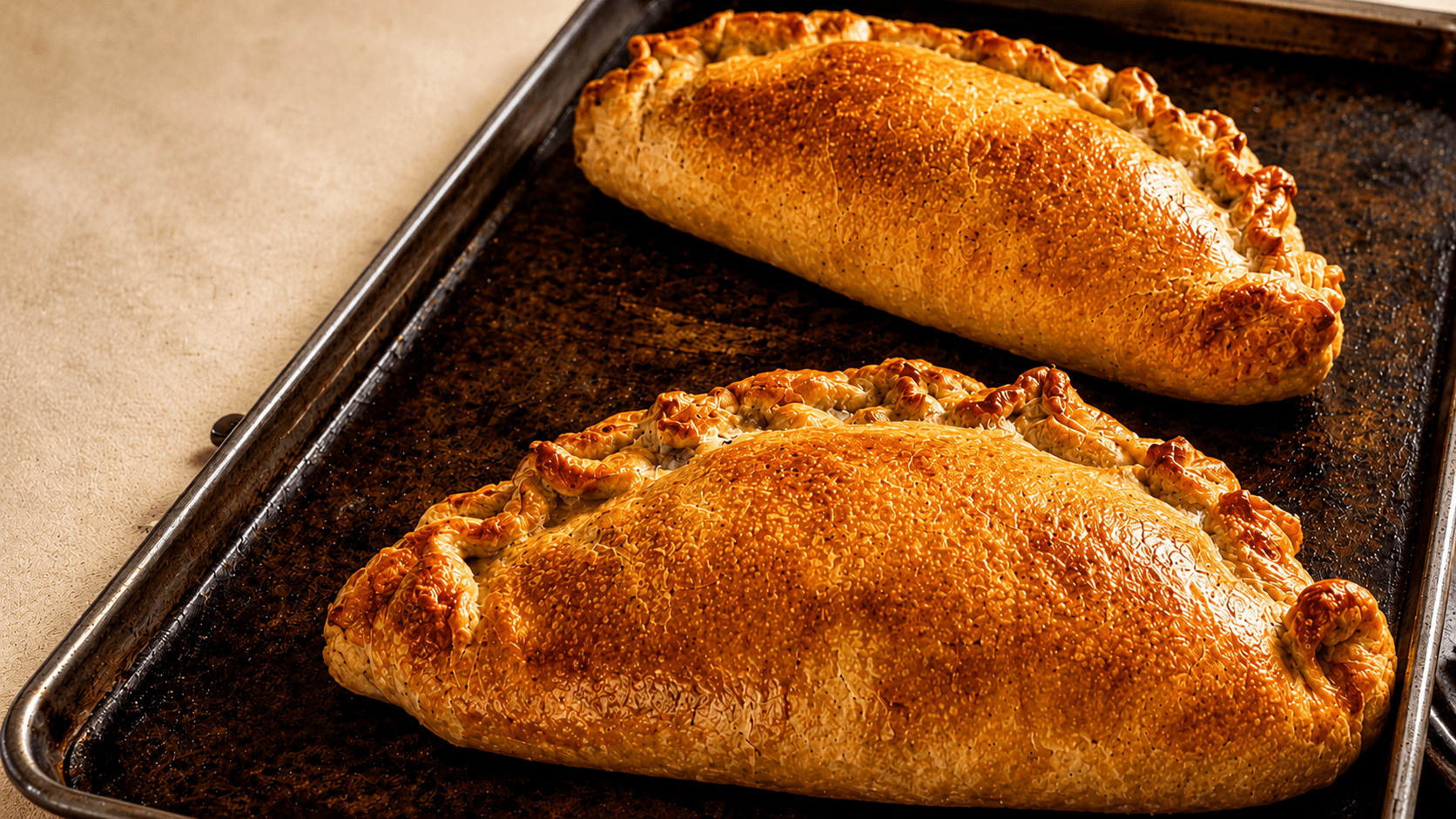
You’d think that in Cornwall, of all places, we’d have settled what makes a proper Cornish pasty by now. But mention carrots, crimping or whether a pasty made across the Tamar can really be Cornish, and you’ll soon discover there’s plenty left to argue about.
The surprising thing is that some of those arguments have actually been settled by law. A genuine Cornish pasty has a protected name, an official specification and rules covering everything from its ingredients to the position of the crimp. There are even minimum percentages for the meat and vegetables.
But the law only tells us what qualifies for the protected name. It doesn’t tell us how every Cornish family made their pasties in the past, and it certainly doesn’t guarantee that the one you’ve just bought will taste any good. And that’s what makes the subject rather more interesting than a simple recipe.
Behind that familiar pastry parcel is a story of working families, Cornish miners, traditions carried across the world and a food that eventually became important enough to receive legal protection.
What makes a Cornish pasty legally Cornish?
In July 2011, the Cornish pasty gained European Protected Geographical Indication status, usually shortened to PGI. Following Brexit, it remained protected under the UK’s geographical indication scheme.
The principle is fairly straightforward. You can’t make a pasty anywhere you fancy, put ‘Cornish’ on the packaging and sell it as the genuine article. To qualify for the protected name, a Cornish pasty must be produced in Cornwall and meet the registered product specification.
That specification sets out the ingredients, how they’re prepared, the type of pastry permitted and the appearance of the finished product.
The traditional filling must contain:
- Beef: Roughly diced or minced, making up at least 12.5% of the whole pasty.
- Potato: Sliced or diced.
- Swede: The vegetable traditionally called turnip in Cornwall.
- Onion: Along with the potato and swede, contributing to a minimum vegetable content of 25% of the whole pasty.
- Seasoning: Primarily salt and pepper.
The main filling ingredients must go into the pasty uncooked. They then cook together inside the pastry, allowing the meat, vegetables and seasoning to develop their flavour during baking.
The specification permits small quantities of certain additional ingredients to improve flavour, moisture or production, provided they don’t change the traditional character of the filling. It doesn’t allow other meats or vegetables, and the filling must be free from artificial additives.
There’s also more flexibility with the pastry than you might expect. Shortcrust, rough puff and puff pastry are all permitted. It must be savoury and strong enough to contain the filling without falling apart during cooking and handling. The baker can also glaze it with egg, milk or both.
And then there’s the shape. A protected Cornish pasty must have its characteristic D shape, with the pastry edges crimped along one side. It sounds like a lot of rules for something most of us would happily eat while walking down the street. But the purpose is to protect a food that’s become closely associated with Cornwall.
The important distinction is that the specification defines what can be sold under the protected name today. It doesn’t describe every pasty Cornish people have ever made. And that becomes particularly clear when you look at the ingredients.
Turnip, swede and the great carrot argument
Ask somebody in Cornwall what goes into a traditional pasty and there’s a good chance they’ll say beef, potato, onion and turnip. Look at the official specification and you’ll find swede instead.
So which one is right? Both, provided we’re talking about the same vegetable.
In Cornwall, swede has traditionally been called turnip. It’s the familiar yellow-fleshed root vegetable, rather than the smaller white-and-purple turnip commonly sold under that name elsewhere. It’s a minor difference in language, but quite an important one when you’re making the filling.
Someone following a Cornish recipe without knowing that distinction could end up using a completely different vegetable. And then there are carrots.
Few ingredients have the potential to start such a ridiculous argument over a pasty. There’s nothing stopping somebody making a beef-and-vegetable pasty with carrots in it. It might taste perfectly good. Some people might even prefer it.
But carrots aren’t part of the protected Cornish pasty specification. That’s not a judgement on whether they’re delicious. It’s simply a question of what the protected product is supposed to contain.
The same applies to other fillings. You can make pasties with chicken, lamb, cheese, vegetables or practically anything else that works inside pastry. They’re still pasties. They just aren’t protected Cornish pasties.
And there’s a historical twist to all this, because Cornish families themselves haven’t always used the exact combination of ingredients required today.
Why the crimp has to be on the side
If there’s one thing people immediately recognise about a Cornish pasty, apart from the filling, it’s the crimp. That folded edge running along one side is almost as distinctive as the shape of the pasty itself.
And yes, the official rules require it. The pastry is assembled into a D shape, and the edges are crimped along one side rather than simply pinched together across the top.
But the regulations don’t specify an exact number of crimps. Nor do they demand that every one must be made by hand. Mechanical crimping is perfectly acceptable. So there’s no need to stand outside a bakery counting finger marks before deciding whether your lunch is legitimate.
The specification even recognises that traditional crimping can produce slightly different finished shapes. The folded edge might sit flatter or rise at an angle. What matters is the distinctive side crimp.
But here’s where the history becomes interesting. Not every pasty made in Cornwall over the centuries has been crimped in exactly the same way. Different families and bakers have used different methods, including top-crimped variations.
The modern protected specification establishes a recognised standard. It doesn’t prove that every Cornish household throughout history followed that standard. That’s an important difference between preserving a tradition and pretending it has never changed.
The pasty was working people’s food long before it became famous
Today, you’ll find Cornish pasties displayed in bakery windows, sold at motorway services and advertised to visitors as one of Cornwall’s essential food experiences. But the pasty was part of everyday life here long before anybody thought about marketing it to holidaymakers.
Pasties themselves have a much older history. Meat and other ingredients enclosed in pastry were known in medieval Britain, including among wealthy households. Cornwall’s particular relationship with the pasty developed over centuries, especially through the needs of working families.
By the eighteenth and nineteenth centuries, pasties had become established as practical meals for people working in agriculture, mining and other demanding occupations. They were filling, portable and could be made using ingredients available to the household.
And the historical records tell us something interesting about what people were eating. An agricultural survey of Cornwall prepared by George Boucher Worgan, associated with research from 1808 and published in 1811, refers to a labouring man usually having a bit of beef for his pasty.
It’s a small detail, but it tells us a great deal. Beef was already associated with Cornish pasties more than two centuries ago. But the reference to a bit of beef also reminds us that working families weren’t necessarily filling their pasties with generous quantities of expensive meat.
Household money mattered. Vegetables helped make a substantial meal, and the filling could depend on what was available. Historical accounts from the nineteenth century also describe pasties made with ingredients such as pork, turnip and potato.
Those pasties wouldn’t necessarily meet today’s protected specification, which requires beef, but they were part of Cornwall’s actual food history. That’s why it’s misleading to imagine one identical recipe being followed by every Cornish family for hundreds of years.
Traditional cooking was often shaped by necessity, family habits and whatever ingredients could be obtained. The pasty wasn’t invented for tourists, designed by a marketing company or created to win awards. It was food people needed.
How the Cornish mining industry made the pasty famous
Cornwall’s mining industry played an enormous part in establishing the pasty’s place in local identity. During the nineteenth century, thousands of men worked in Cornwall’s mines, often spending long hours underground.
Returning to the surface for lunch wasn’t always practical, particularly when working deep below ground. A pasty provided a useful solution. It was substantial, could be carried to work and enclosed its filling inside pastry. There was no need for a plate or cutlery, and it could be eaten during a break without complicated preparation.
Historical records from the 1860s also show that children employed in Cornish mines took pasties with them as part of their meals. The break for something to eat was commonly known as crib or croust, words closely associated with working life in Cornwall.
But there’s another side to the story that deserves just as much attention. We often talk about the miners eating pasties underground, but somebody had to prepare those meals before the working day began.
Behind the pasties were families managing household budgets, preparing ingredients and making food that needed to sustain someone through physically demanding work. The knowledge was often passed through generations, with recipes and techniques learned at home rather than from written instructions.
A family might use more vegetables when meat was scarce or prepare its pastry differently from a neighbouring household. The result wasn’t necessarily uniform, but it was practical.
And that’s probably the most important thing to understand about the pasty’s early place in Cornish life. It became part of our identity because it was useful to the people living and working here, particularly in the mining communities that shaped Cornwall.
Which brings us to one of the most famous stories about it.
Did Cornish miners really throw away the crust?
You’ve probably heard the story. Cornish miners supposedly held their pasties by the thick crimped edge so they could eat the filling without touching it with their dirty hands. Because mining could involve exposure to dangerous substances, including arsenic, the crimp supposedly acted as a handle that was thrown away afterwards.
It sounds reasonable enough. If you’ve been working underground with potentially harmful dust on your hands, holding the edge of a pasty rather than touching the filling seems sensible.
But there’s a problem. The idea that Cornish miners routinely threw away their pasty crusts is disputed.
Even the Cornish Pasty Association acknowledges that there are competing explanations. One account suggests miners used the crimp as a handle and discarded it. Another suggests they carried their pasties wrapped in paper or cloth, allowing them to eat the whole meal without directly handling it.
And when food was valuable and household money could be tight, throwing away a substantial piece of pastry every day wasn’t necessarily an attractive option.
That doesn’t mean the discarded-crust story is entirely false. Some miners may well have used the crimp as a handle. It would be surprising if nobody ever did.
But there’s a difference between saying something may have happened and claiming it was the established practice of every Cornish miner. The connection between pasties and mining is well documented. The claim that miners routinely threw away the crust is much less certain.
And there’s no need to turn a plausible story into a historical fact when the genuine history is already interesting enough.
Can you make a Cornish pasty outside Cornwall?
Imagine a baker in Devon producing a pasty with beef, potato, swede and onion. The ingredients are prepared correctly, the pastry is excellent and the crimp sits neatly along the side.
It looks like a Cornish pasty. It might taste like a particularly good one. But because it was made outside Cornwall, it doesn’t qualify for the protected Cornish pasty name.
That’s because the geographical origin is an essential part of the designation. The rules protect both the product’s traditional characteristics and its connection with Cornwall.
But the arrangement works the other way too. A genuine Cornish pasty made in Cornwall can be transported and sold elsewhere. It doesn’t suddenly lose its identity when the delivery van crosses the Tamar.
A pasty made here to the protected specification can be sold in London, Manchester or elsewhere and still be a genuine Cornish pasty. The location of the customer isn’t what matters. It’s where the pasty was produced and whether it meets the requirements.
That protection is valuable to Cornwall’s food producers because it prevents the Cornish name being used for products that don’t have the required connection to the county.
But it doesn’t mean bakers outside Cornwall are incapable of making excellent pasties. A good recipe doesn’t suddenly stop working at the county boundary. The legal distinction is about authenticity and geographical origin, not a guarantee that every baker in Cornwall is better than every baker elsewhere.
And that brings us to something rather more important when it comes to choosing where to spend your money.
A genuine Cornish pasty isn’t necessarily a good one
This is the distinction that matters when you’re standing outside a bakery deciding what to buy. A pasty can meet every requirement of the protected specification and still be disappointing.
It might contain the correct percentage of beef. The potato, swede and onion might all be present. The pastry could be properly crimped and the whole thing made in Cornwall. But none of that guarantees an enjoyable lunch.
The pastry might be thick and heavy. The filling could be poorly balanced, the seasoning disappointing or the ingredients unevenly cooked. Equally, another bakery working to exactly the same specification might produce something excellent.
And that shouldn’t be surprising. The protected rules allow differences in pastry, preparation and baking techniques. Individual recipes and the skill of the baker still matter.
A good Cornish pasty needs more than the correct ingredients. The pastry should be properly cooked, hold together and complement the filling rather than overwhelm it. The beef and vegetables should cook together to create a satisfying savoury flavour, with seasoning that brings everything together.
There should be a sensible balance between pastry and filling, and enough substance to make the pasty feel like a proper meal. And the price matters too. A pasty might be beautifully made, but if you’re paying considerably more for it than you would elsewhere, it’s reasonable to ask whether the experience justifies the difference.
Protected status establishes authenticity. It doesn’t automatically establish quality or value for money. That’s why two genuine Cornish pasties can offer very different experiences.
It’s also why a bakery shouldn’t receive automatic praise simply because it’s small and independent, or automatic criticism because it’s part of a larger business. A famous name doesn’t guarantee a good pasty. Neither does a long history or an attractive shopfront. What matters is what the business actually sells.
The Cornish name deserves protection, but the individual pasty still has to earn its reputation.
How the Cornish pasty travelled around the world
The mining connection also explains how the pasty became familiar far beyond Cornwall. As Cornwall’s mining industry changed and workers travelled overseas in search of employment, Cornish miners took their skills, customs and food traditions with them.
Communities of Cornish miners became established in mining regions across the world. And wherever families settled, familiar foods helped maintain a connection with home.
One particularly interesting example is Michigan’s Upper Peninsula in the United States. Cornish miners travelled to the region to work in its mines, and pasty-making became established within the local food culture. Over time, the tradition spread beyond the original Cornish communities.
Today, pasties remain closely associated with Michigan’s Upper Peninsula, where they’re sold by bakeries and enjoyed as a familiar regional food.
Think about how remarkable that is. A meal associated with working families in Cornwall travelled across the Atlantic and became part of another region’s identity. Not because somebody launched an international food brand, but because people moved abroad, found work, raised families and carried their traditions with them.
Naturally, recipes changed as communities adapted to different ingredients and local tastes. Those overseas versions don’t necessarily meet the requirements of today’s protected Cornish pasty specification, but their connection to Cornish migration is part of the wider history.
The pasty became much more than something people ate underground. It became a small but recognisable piece of Cornwall that travelled wherever Cornish people went.
So what really makes a proper Cornish pasty?
If we’re talking about the protected product, the answer is straightforward. It must be made in Cornwall, contain the specified ingredients in the required proportions, use permitted pastry and have its characteristic side crimp.
Those rules matter because they protect a genuine regional food and prevent the Cornish name becoming a meaningless label attached to any pastry parcel containing meat and vegetables.
But there’s much more behind the pasty than the modern specification. There’s the history of working families making the most of what they had, miners carrying food underground, recipes passed between generations and Cornish people taking their traditions to communities thousands of miles from home.
There’s also the fact that those traditions weren’t always as uniform as we sometimes imagine. Families used different ingredients. Bakers developed their own methods. Some familiar stories have become difficult to separate from folklore.
None of that diminishes the Cornish pasty. If anything, it makes its history more interesting. The protected specification preserves an established version of a food with deep roots in Cornwall.
What it can’t preserve is the skill of every baker or guarantee that every pasty bearing the protected name will be worth buying.
And that’s worth remembering when you’re standing at the counter, looking at a row of freshly baked pasties and deciding which one deserves your money.
Because the right ingredients, the Cornish origin and the side crimp tell you whether it’s a genuine Cornish pasty. Whether it’s a good Cornish pasty is something the baker still has to prove.