12 Cornwall Coastal Villages With Character and Easy Wandering
If you want Cornwall coastal villages with some atmosphere, a decent walk built into them, and a day that does not start unravelling the moment you look for parking, these are the places I would start with. St Ives is beautiful, but it also encourages the wrong kind of planning for a lot of people: too much pressure, too many people trying to have the same idea at the same time, and too much effort spent managing the day rather than enjoying it.
What I mean by “low-fuss” is not empty, secret, or magically easy. This is still Cornwall. Roads are still narrow, summer still tests your patience, and the nicest places nearly always involve at least a bit of compromise. What I am after here is a better balance: coastal villages with real character, enough shape and texture to reward a wander, and logistics that do not dominate the whole outing.
I have kept this list coastal on purpose, and I have spread it right round Cornwall rather than piling into the same few harbour villages. Some are stronger for lunch and a stroll, some for scenery and a longer look round, some for a slow hour by the water when you do not want the day to become a production. The point is not that they are all equally easy. It is that they all give you a better enjoyment-to-hassle ratio than Cornwall’s most overworked names.
If you want the quick version, Porthleven is the easiest all-rounder, Mousehole is the prettiest village here that still rewards an actual wander, and Boscastle is the best if you want scenery to do some of the lifting. St Mawes is one of the safest south-coast recommendations. Helford and Coverack suit slower days. Portwrinkle and Polkerris are smaller picks, but both work well if you pitch them properly.
What makes a good Cornwall coastal village for wandering
A lot of Cornwall villages look promising in photos and then flatten out when you arrive. You see the harbour, take the picture, maybe walk one lane, and that is more or less it. For this list, “character” means the place still feels distinct once you are actually in it. It has a working sense of itself, or a layout that keeps rewarding you, or a setting that changes the mood as you move through it.
“Good wandering” matters more than most round-ups admit. A village does not need to be large, but it does need more than one good angle. Ideally you can arrive, get your bearings quickly, loop the centre, take a turn you had not planned on, stop for something, and still feel as though there is a bit more to see. The best places on this list give you that without making you work too hard for it.
And “low-fuss logistics” means easier by Cornwall standards, not easy in the abstract. Usually that comes down to five things: whether parking is broadly manageable, whether the village centre is readable on foot, whether the gradient is realistic for the sort of visitor you are, whether the place pays off quickly enough, and whether the crowds tip it into irritation. A village does not need to ace all five. It just needs to feel worth the effort.
Best Cornwall coastal villages by type of day
If I wanted the safest all-round harbour day, I would choose Porthleven.
If I wanted the most photogenic wander, I would choose Mousehole.
If I wanted a north coast village that still earns its reputation, I would choose Port Isaac.
If I wanted scenery and a more spacious-feeling outing, I would choose Boscastle.
If I wanted a south-coast lunch-and-stroll day, I would choose St Mawes.
If I wanted a slower, quieter mood, I would look first at Helford, Coverack, or Portwrinkle.
If I wanted a village that works well as a short stop rather than a full destination day, I would choose Polkerris.
Port Isaac
Port Isaac is one of the few very well-known Cornwall villages that still earns the recommendation. It is steep, it can still be awkward if you arrive at the wrong time on a bright summer day, and I would not call it relaxed in the same way as some of the others here. But once you are in it, the place has real depth. The lanes tighten and open again, the harbour sits properly at the centre of things, and there is enough shape to it that you do not feel as though you have seen the whole place in ten minutes.
The first thing to understand is that the slope matters. If you dislike hills or you are trying to plan something easy for older relatives, I would be more cautious here than the postcard version suggests. The smarter version of Port Isaac is to park where it makes practical sense, accept the walk, and take the village slowly rather than trying to force efficiency into it. The reward comes quite quickly once you are down in the centre, but the climb back is part of the deal. That is also why the logistics are still manageable rather than effortless: the parking is usually better handled than in some comparable places, but the village itself will always ask something of you physically.
What works so well is the density of the place. You have the harbour, the tight stone lanes, little corners that open onto water or rooftops, and enough visual variety to make a proper circuit satisfying. I would allow at least 90 minutes, more if you want lunch or a long sit by the harbour. If you arrive early or outside the school-holiday crush, it is one of the strongest villages on the list. If you turn up late in August hoping for easy spontaneity, it can feel more effortful than the article promise really allows.
Boscastle
Boscastle feels different from most coastal villages because the setting changes the whole rhythm of the visit. You do not just arrive at a harbour and orbit it. You arrive into a steep-sided valley, the village stretches with that landscape, and the harbour feels like the culmination of the place rather than the only reason to stop. It gives the day more breadth and more movement.
This is one of the easiest villages here to recommend if you want scenery and a proper wander together. The walk down through the village, the water running through it, the harbour at the far end, and the pull of the coastal edge all make it feel larger and more layered than it is. You are not depending on a single pretty view to carry the whole experience. That is also why it does well on the low-fuss test: the layout is simple to understand, the village has a clear direction to it, and the effort you put in is paid back steadily rather than all at once.
In practical terms, Boscastle works best when you give it time. I would not use it as a quick photo stop. Two hours is a comfortable minimum, and a half-day makes more sense if you want to combine the village with the harbour and a short stretch of coast path. It also holds up well in mixed weather because the valley setting still gives the place shape when the sea is grey. Compared with some better-known north coast options, it feels calmer and better organised on the ground. The trade-off is that there is still some walking involved, and the atmosphere is more scenic and spatial than compact and cosy.
Crackington Haven
Crackington Haven is a good reminder that not every successful coastal stop needs to be a dense harbour village. The draw here is the setting first: the beach, the cliffs, the shape of the valley, and the sense of exposure once you get to the shore. The settlement itself is relatively compact, so this is not one to choose for lots of little lanes and village detail. It is one to choose when you want the coastal scenery to do most of the work.
The useful thing about Crackington Haven is that the payoff is immediate. You arrive, the landscape explains itself, and you do not need to decode the place. The road drops you into a small valley floor where the beach and cliffs take over almost at once, so the visit starts fast and stays visually clear. That makes it a strong pick for a shorter stop, a lunch break with a walk, or a scenic pause in a wider day rather than a destination that needs to carry everything on its own. If you come expecting a deep village wander, you will find it a bit thin. If you come wanting cliffs, sea, a quick reset, and somewhere that feels less overworked than the big names, it does the job very well.
I would usually allow an hour or two here unless I was specifically building in a longer coastal walk. It suits people who like looking out rather than nosing around shops and side lanes. On a bright or breezy day it feels clean and open. On a flat, dull day it can feel more functional. This is one of the places where the weather matters more than the village itself, and that is exactly why the logistics stay low-fuss: the place gives you its best qualities quickly, without much rummaging around or too much commitment if the conditions are only middling.
Portwrinkle
Portwrinkle is not trying to impress you, which is exactly why it works. It is one of the quieter, smaller places on this list, and I would not sell it as some major coastal day out. What it offers is a simple, settled sort of visit: sea, beach, a small village feel, and very little sense of performance. It is the sort of place that calms the day down.
The key here is scale. You are not getting a long sequence of lanes or a harbour packed with visual incident. You are getting a compact coastal stop where the beach edge and village setting do enough if you are in the right mood for them. The pleasure is in walking a short distance, looking out, maybe stopping for something, and letting the place stay modest. I would choose Portwrinkle when I wanted a gentle morning by the water, a short lunch stop, or a quieter south-east Cornwall outing that does not involve too much walking or too much planning. It is also a sensible choice if you are staying nearby and do not need somewhere that shouts for attention.
In practical terms, this is one of the easier places on the list because it resolves quickly. That is a strength if your expectations are right. I would allow an hour or two, longer only if the weather is good and you are deliberately taking it slow. The mistake would be to build too much expectation around it. It is not here because it overwhelms you. It is here because it is easy to enjoy, and the logistics mostly stay in the background once you arrive.
Mousehole
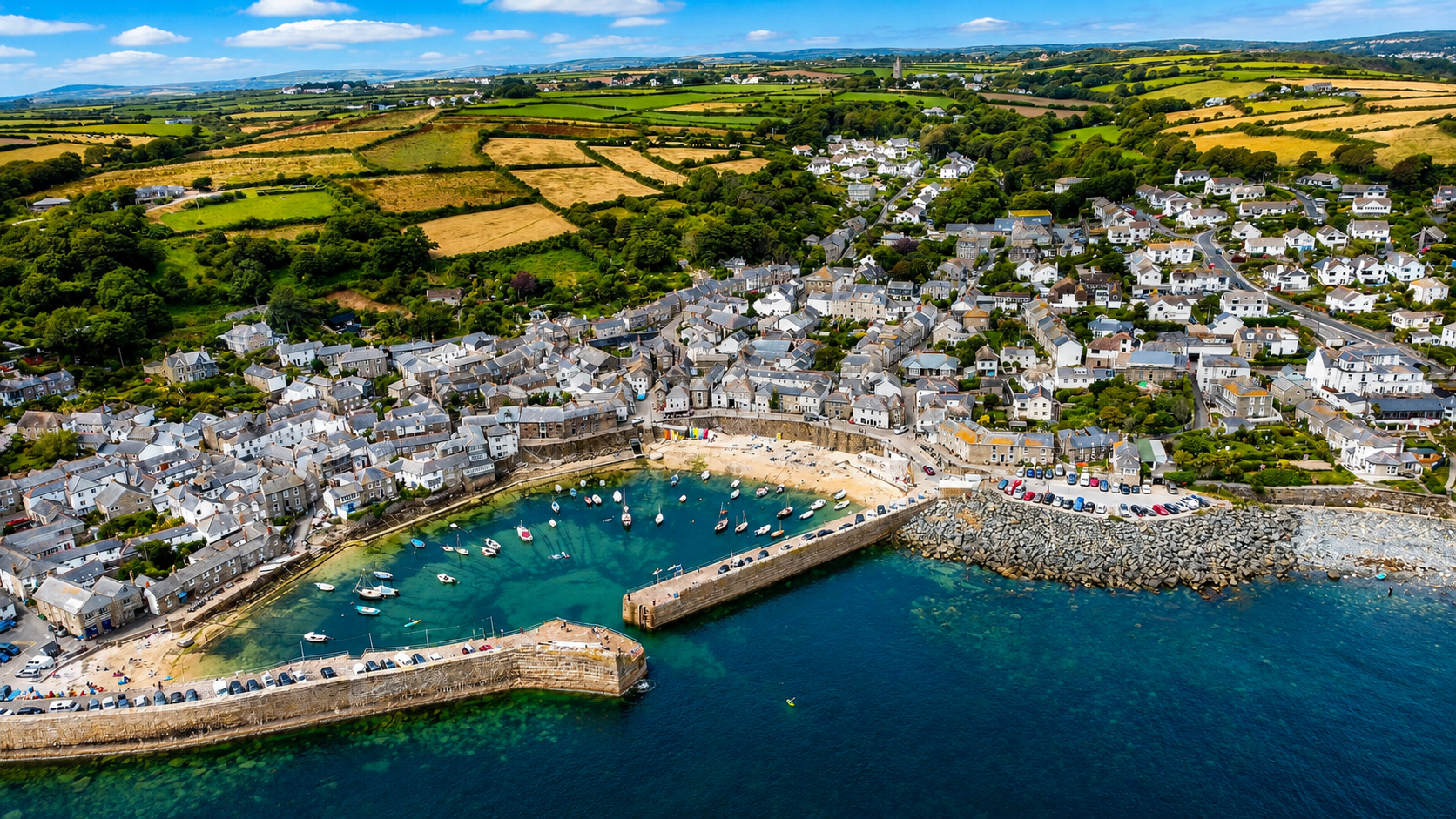
Mousehole is one of the prettiest villages in Cornwall, but that is not enough on its own to make this list. What keeps it here is that it remains satisfying once you get past the first impression. The harbour is the obvious draw, but the lanes, turns, little rises and different viewpoints mean the place still rewards movement. It is not just a scene. It is a village you can actually wander.
The first few minutes tell you a lot. You leave the more practical edges behind, move into the tighter old core, and the place immediately starts feeling more enclosed and self-contained. That works in its favour. The harbour is compact enough to feel intimate, and the surrounding lanes give you plenty of excuses to keep circling back and seeing it from slightly different angles. It is one of the rare places where looking around without much of a plan is genuinely the right way to do it.
I like Mousehole best outside the peak crush or at the edges of the day. In high summer, the village can still feel busy, but it generally copes better than the real pressure-cooker destinations because the setting is so coherent and the centre is worth lingering in. I would allow at least 90 minutes, and two hours is easy if you stop for something. This is not the best choice if you want loads of physical space or the easiest possible parking setup. It is one of the best choices if you want atmosphere and a proper coastal-village feel that does not collapse after one photograph.
Newlyn
Newlyn earns its place here by not trying to be the same sort of village as the others. It is a working harbour first, and that gives it a character a lot of prettier places cannot fake. If you want tidy, quaint, and purely picturesque, choose Mousehole. If you want a coastal place with a real pulse, a stronger sense of ordinary life, and a harbour that still feels used rather than curated, Newlyn is a much more interesting choice.
The smart way to approach Newlyn is not to treat it as a substitute postcard village. It is better than that. The appeal is in the harbour life, the movement, the sense that the place has purpose beyond receiving visitors for the afternoon. Boats, working edges, and the general rhythm of the place give you something to look at even when the weather is not performing. That makes it one of the strongest picks on the list for readers who are a bit bored of prettiness without substance.
I would rarely send somebody to Newlyn as a full soft-focus village day on its own unless they already know they like working ports. It works best either as a shorter stop or as part of a longer west Cornwall outing, especially paired with Mousehole. On the ground, that pairing makes a lot of sense because the contrast sharpens both places. Newlyn feels tougher-edged, more practical, less arranged for you. Mousehole then gives you the tighter harbour prettiness if you still want it. If I only had an hour, I would still happily use it, because the point of the place comes across quickly and the logistics are refreshingly straightforward once you stop expecting a storybook village.
Porthleven
Porthleven is the easiest broad recommendation in this whole piece. It has character, plenty of harbour atmosphere, enough space that the day does not feel cramped, and a food-and-drink reality that makes lunch-and-wander visits genuinely practical rather than wishful. When people want one place that feels distinctively Cornish without being awkward from start to finish, this is usually where I would send them.
The layout helps enormously. The harbour gives the place a clear centre of gravity, but there is room around it, and that makes a real difference when other people are there too. You can loop it, stop, sit down, double back, look out to sea, and not feel as though every decision is being made shoulder to shoulder with everyone else. Some villages stay charming only when they are quiet. Porthleven usually remains usable even when it is busy. That is the heart of its low-fuss appeal: the village absorbs people without instantly feeling cramped or brittle.
This is one of the best picks on the list if you want to build a meal into the day, because that part of the visit feels natural here rather than bolted on. I would comfortably allow two to three hours, more if you want to linger. It also works across a wider range of conditions than a lot of villages. In decent weather it is lively and easy. When the sea is rough, the harbour edge and wider coastal feel can make it more dramatic rather than less worth doing. The only caution is that its popularity is no secret anymore, so I would still choose my timing with a bit of care in peak periods.
Coverack
Coverack is one of the quietest recommendations here, and that is its whole strength. On the Lizard side of Cornwall, it offers a softer, less worked-over version of the coastal village day: a small harbour, a broad sense of sea and sky, and a pace that does not push you. It is not trying to win on drama or density. It wins on ease and mood.
What I like about Coverack is that it settles very quickly. You arrive, the shape of the place is easy to understand, and the village does not make you earn the atmosphere. The harbour and shoreline give you the focus, and the rest of the stop becomes about how long you want to stay rather than how much there is to decode. From the centre, the village feels open rather than tucked in, with the water always close enough to keep the place coherent. This is why I would choose it for a slow couple of hours, a gentle stop on a wider Lizard day, or a coastal outing with someone who does not want steps, fuss, or lots of onward decisions.
Compared with Helford, Coverack is more open and sea-facing. Compared with Porthleven, it is quieter and less built around eating out as part of the plan. Compared with some of the better-known fishing villages, it is simply less effortful. That is where the low-fuss case really sits: the layout is obvious, the village pays off almost immediately, and you do not need to strategise much once you are there. I would allow around 90 minutes to two hours for most visits. It is best on calm, bright days, when the simplicity of the place feels like a virtue rather than a lack.
St Mawes
St Mawes is polished, but in a way that mostly works for it rather than against it. It feels sheltered, orderly, and easy to use. The waterfront has room, the setting across the water is attractive, and the village suits the kind of day a lot of people actually want: a slow meal, a harbour stroll, a look at the boats, and no unnecessary hassle.
What it is not is rough-edged or particularly surprising. I would not send someone here for the most atmospheric tangle of lanes on the list. I would send them here because the day usually goes well. That matters. There is a difference between somewhere being a bit gentler in character and somewhere being bland. St Mawes avoids blandness because the setting is strong enough and the village has enough shape to hold your attention, even if it is more composed than dramatic.
This is one of the safest picks on the list for mixed groups, older relatives, or anyone who wants a harbour village without steep, awkward wandering built into it. It is also strong for lunch-and-stroll outings because that format suits the place naturally. I would allow two hours easily, and more if you are building in lunch or stretching the day with nearby water views or a ferry-linked plan. If I wanted ruggedness, I would choose elsewhere. If I wanted a village that behaves itself as a day out, I would choose St Mawes with confidence. Its low-fuss strength is not excitement. It is reliability.
Helford
Helford belongs here because it offers a different coastal mood from almost everything else on the list. It is less about a classic harbour scene and more about creek, estuary, boats, trees, and stillness. That makes it a very good pick if you want somewhere that feels properly Cornish but does not feel like every other coastal village recommendation.
This is one of the places where mood matters as much as facilities or scale. You are not really here for a long sequence of things to do. You are here because the setting itself is enough: the quieter water, the softer light, the feeling that the landscape is folding around the village rather than opening straight onto the sea. The village sits close to the water with a compact, tucked-away feel, and the experience is more about moving slowly between the creekside edges than roaming widely. It works best when you lean into that and let the stop be slower.
I would usually treat Helford as a gentle stop of one to two hours unless I was combining it with a wider day on the Helford side. It is a place to arrive without rush, look out, move around slowly, and let the setting do the work. Compared with Coverack, it is more enclosed and wooded. Compared with St Mawes, it is less polished and less built around lunch as the obvious centrepiece. On a bright still day, it is excellent. On a heavy grey day, it can feel flatter than the other villages on this list, so I would choose it with the weather in mind. Its low-fuss strength is that it asks very little of you once you arrive, but it does depend more than most on you being in the right mood for quiet.
Cawsand and Kingsand
Cawsand and Kingsand are best understood as one joined-up place rather than two separate decisions. Together they make one of the most enjoyable gentle wanders on this side of Cornwall: little beaches, colourful houses, a sheltered bay, and enough turns and transitions that the whole place feels easy to inhabit rather than thin.
What makes them work so well is that the scale is human from the start. You do not arrive into somewhere grand or overwhelming. You arrive into somewhere that invites you to slow down almost immediately. The two villages blend into each other naturally, which gives the walk more shape than either would have alone. You can move along the front, drift into the streets behind, and keep finding small changes of angle without needing to cover much ground. That makes this one of the better choices on the list if you want a modest but properly satisfying stroll without much friction once you are there.
I would allow around two hours, or longer if the weather is good and you want to stop for food or simply stay put by the water. Depending on where you are coming from, this can also be one of the places where arriving by water is the smarter version of the day, though I would always check current arrangements before relying on that. By car, the key is to avoid assuming it will be completely effortless just because the villages feel relaxed when you arrive. The reward here is not scale or drama. It is how pleasant the place is to spend time in, and how quickly the wandering starts making sense once you are on foot.
Polkerris
Polkerris is small, but it is one of the clearest examples on this list of a village knowing exactly what kind of stop it is good at. There is a beach, a sheltered little setting, a harbour feel, and just enough around it that lunch and a stroll can feel complete rather than token. I would not oversell it as a major wandering village. I would recommend it because it does a smaller job very well.
This is the sort of place I would use when the day needs to stay simple. Maybe you are with people who do not want hills or a lot of decisions. Maybe you want somewhere by the water that feels contained and settled rather than busy. Maybe you want to stop, eat, look out, and have a short walk after without turning it into a longer coastal mission. The village centre resolves quickly around the beach and waterfront, which is exactly why it works. Polkerris is very good for that sort of outing.
On the ground, the appeal comes quickly. You understand the place within minutes, which is useful. Unlike some small villages, it does not feel as though there is a mismatch between expectation and scale if you pitch it right. I would usually allow one to two hours here, and I would think of it as a strong add-on stop or a low-pressure half-day rather than a destination that needs to fill a whole afternoon on its own. If you want complexity, choose somewhere else. If you want ease, it is a very smart pick, and one of the clearest low-fuss choices in the whole article.
How to choose the right Cornwall coastal village
If I wanted the safest all-round recommendation, I would choose Porthleven.
If I wanted the strongest classic harbour feel, I would choose Port Isaac or Mousehole. Port Isaac is more dramatic and effortful. Mousehole is more intimate and forgiving once you are on foot.
If I wanted scenery and a village that feels larger than its footprint, I would choose Boscastle.
If I wanted the gentlest lunch-and-stroll day, I would choose St Mawes.
If I wanted a quieter, slower mood, I would choose Helford or Coverack, depending on whether I wanted creekside calm or a more open sea-facing stop.
If I wanted somewhere smaller and easygoing rather than famous, I would choose Portwrinkle or Polkerris.
If I wanted a place with a stronger sense of real working harbour life, I would choose Newlyn.
And if I were staying on the south-east side and wanted one of the most enjoyable low-key wanders on the list, I would choose Cawsand and Kingsand.
The useful question is not really which village is best in the abstract. It is what sort of day you actually want to have. People make bad Cornwall decisions when they choose by headline prettiness and forget to ask whether they want a half-day potter, a meal with a view, a bigger scenic walk, or a genuinely easy stop.
When to visit these Cornwall coastal villages
For this sort of village-hopping, I would take May, June, or September over August almost every time. You usually get better light, more room, and less sense that the day is being dictated by parking pressure before it has properly started.
In school holidays, I would be most deliberate about Port Isaac and Mousehole. Both are worth visiting, but both are better when the timing is intentional. Earlier is usually smarter. They are not the villages I would leave until late afternoon and hope for the best.
Porthleven and St Mawes cope better with visitors because the layout gives the day more breathing room. Boscastle also holds up well because the setting spreads the experience beyond one tight focal point. Portwrinkle, Polkerris, and Coverack can be good on busier weeks precisely because they are not trying to function as giant attractions.
Weather matters too, but not evenly. On greyer, more changeable days, I would favour Boscastle, Porthleven, or Newlyn, where the place still has enough structure or harbour life to carry the visit. On bright, still days, Coverack, Helford, and Cawsand-Kingsand are much stronger. Crackington Haven is especially dependent on the landscape showing well, because the setting is the main reason to be there.
The other thing I would say is not to overfill the day. Two villages in one day can work if one is clearly the main stop and the other is shorter and nearby in feel or geography. More than that usually turns into a collecting exercise. Cornwall villages are better when you let one of them have a bit of your time.
Which Cornwall coastal villages are most worth your time
The smartest Cornwall coastal village choices are not always the most famous. They are the ones where the atmosphere survives contact with reality. That is the standard I would use.
If I were sending most people to three places from this list, I would start with Porthleven, Mousehole, and Boscastle. Porthleven is the easiest all-rounder and the best lunch-and-wander option. Mousehole gives you the strongest visual charm while still rewarding a proper wander. Boscastle brings scenery, shape, and a more spacious-feeling outing.
But the right choice depends on your day. St Mawes is one of the safest south-coast picks if you want an easy harbour stop. Helford is the calmest creekside mood. Port Isaac is the dramatic north-coast classic that is still worth the effort if you time it properly. Cawsand and Kingsand are quietly excellent. Portwrinkle and Polkerris are smaller, but smaller is exactly the point.
The mistake is to chase the biggest name and hope the day sorts itself out. The better approach is to choose the village that fits the pace, season, and level of effort you actually want. Cornwall usually rewards that kind of honesty.
FAQ
Which village here is easiest for a relaxed half-day?
Porthleven is the easiest broad recommendation, with St Mawes close behind. Both have enough built into them that you can arrive, settle in, eat if you want to, and not feel rushed.
Which has the best harbour atmosphere?
Port Isaac and Mousehole are the strongest for classic harbour character. Port Isaac feels more dramatic and steeper-edged. Mousehole feels tighter, prettier, and easier to drift around.
Which villages suit a quieter, slower day?
Helford, Coverack, Portwrinkle, and Polkerris are the calmest picks here. They are better for slowing down than for trying to pack a lot into the day.
Which are best outside peak summer?
Boscastle, Porthleven, St Mawes, and Mousehole all work especially well outside the busiest weeks. Helford is also very good when you catch it on a bright quiet day.
Which are awkward if you dislike hills?
Port Isaac is the one I would be most careful with. Boscastle also involves some gradient. Porthleven, St Mawes, and Polkerris are easier choices if you want a less effortful visit.
Can you do these without a car?
Some are more realistic than others, but in practice a car still gives you the most freedom for this sort of Cornwall village day. Cawsand and Kingsand can sometimes make better sense by water depending on where you are starting from, and a few others are more reachable than people assume, but I would always check current transport or ferry options before committing.
Which are best for lunch and a wander?
Porthleven and St Mawes are the strongest for that combination. Polkerris also works well if you want something smaller and simpler.
Which villages are best if I am starting late in the day?
Porthleven, St Mawes, and Polkerris are safer late-start options because the payoff comes quickly and the day does not depend so heavily on threading a tight arrival window.