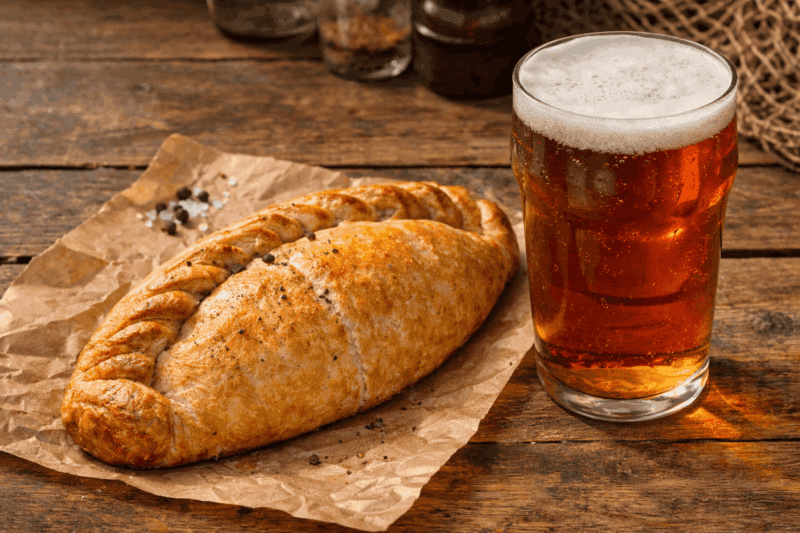
How to Find a Proper Cornish Pasty and a Good Local Pint
You can eat and drink very well in Cornwall. You can also buy a poor version of Cornwall and mistake convenience for the real thing. That is where most visitors go wrong.
A proper Cornish pasty is not just any folded pastry with a crimp, and that is the first thing to understand if you want the real thing in Cornwall. The protected Cornish version is made in Cornwall, shaped like a D, crimped along the side, and filled with beef, potato, swede and onion, with the filling put in raw before baking. The official specification also makes clear that Cornish pasties are sold in different sizes and through different sorts of places, including bakers and butchers.
That matters because Cornwall sells plenty of things called pasties that are not the traditional one. Cheese and onion, curry fillings, chicken tikka, breakfast versions — fine, if that is what you fancy. I am not against them. I just would not confuse them with the real benchmark. If I want to know whether a place can make a proper Cornish pasty, I look at the traditional one first.
The same applies to drink. If you are in Cornwall, I think the point is to drink Cornwall as well: local beer, local lager, or local cider that the pub actually keeps properly. St Austell remains the county’s anchor brewery, Skinner’s is still proudly independent and Cornish, and there are other names worth watching for, including Driftwood Spars, Harbour, Verdant and Firebrand.
If I were telling a friend how to do this properly, I would keep it simple. Freshness matters more than fame with pasties. Care matters more than branding with pints. And a proper pasty should be eaten from the paper bag, in your hands, while it is still hot enough to matter.
What a Proper Cornish Pasty Actually Is
A proper Cornish pasty is the traditional beef one. Beef, potato, swede and onion. That is the standard. The official Cornish pasty specification is quite clear on the shape, the crimp, the ingredients and the raw filling going into the pastry before baking. It also makes clear that the finished pasty should have a balanced savoury taste created by the meat and vegetables cooking together inside the pastry.
That is why I do not get too impressed by novelty. A good non-traditional pasty can still be a decent lunch, but it is not the thing itself. If a bakery cannot get the traditional one right, I am not very interested in what it can do with a curried one.
How I judge a Cornish pasty before I even take a bite
The first thing I look for is whether the traditional pasty feels like the backbone of the place or just one option in a crowded cabinet. If the proper Cornish pasty looks like the main event, that is a good sign. If it feels buried under gimmicks, I get doubtful.
Freshness matters far more than reputation. Heat alone proves very little. A mediocre pasty can still be warm. What you want is turnover, a shop that clearly moves pasties through lunch properly, and staff who know what has just come out rather than leaving you to guess.
Timing matters too. Midday is usually a better bet than late afternoon. By later in the day, the best batch may have gone, or the remaining ones may simply have sat too long. That does not mean every late pasty is poor. It means I would not make my one proper Cornish pasty stop at the tired end of the day if I could help it.
Size matters as well, because not all pasties are made equal. The official specification itself recognises different sizes and weights. Bigger does not mean better. Some large pasties are mostly ballast: too much potato, too much pastry, not enough balance. I would always rather have a medium-sized pasty that eats properly all the way through than a giant one that looks impressive and turns dull halfway in.
Chains, independents and why I do not judge too quickly
Visitors often want a clean answer here: chains bad, independents good. I do not think it works like that.
Warrens is an old-established Cornish name with roots in St Just, and Rowe’s also trades heavily on Cornish pasties baked in Cornwall. Those are not outsider brands borrowing a bit of Cornish identity for summer trade. They are part of ordinary bakery life down here.
At the same time, smaller independents can still make the better pasty, and local butchers are worth paying attention to for a reason visitors often miss: if the meat is already central to the business, the filling can be stronger from the outset. A butcher’s pasty is not automatically better, but I would never overlook one just because it is not sold from a bakery counter.
And yes, Nile’s is one of my own favourites. They say they bake on site, use Cornish skirt beef in their steak pasties, and source their potatoes from Fowey growers. More importantly, their pasties taste like the traditional one is the point, not background stock.
My rule is simple. I do not buy from a chain because it is familiar, and I do not buy from an independent because it has a nicer story. I judge what is in front of me on the day. A fresh, well-run branch can beat a poor independent. But the best pasties often still come from places where the pasty itself feels like the business.
What a good Cornish pasty is like when you eat it
A good one should feel balanced from the first bite. The pastry should hold together without turning into armour. The filling should be properly seasoned. You should get beef, swede, onion and potato working together, not a dull pile of potato with occasional sightings of meat.
Too much potato is one of the common failures. So is pastry that is too thick and dry. The official specification talks about a balanced savoury taste created by the raw ingredients cooking together. That balance is exactly what poor pasties miss.
And for me there is a right way to eat one. Out of the paper bag. In your hands. Hot enough that you notice it. A Cornish pasty is portable food. That is part of its whole logic. On a bench, in the car after a windy walk, standing outside the bakery because you could not wait, sitting on a harbour wall if the gulls leave you alone. Put it on a plate with a knife and fork if you like, but I do not think that is the version most people come down here looking for.
The one I would avoid if you want the real experience
I do not think there is much point in sneering at convenience food. People buy it for convenience and that is what it is for.
But I would say this plainly: a packeted Ginsters from a petrol station forecourt is not the Cornish pasty experience I would point a visitor towards. That is convenience food first. If what you want is the proper version, go to a bakery, or sometimes a butcher, and buy one fresh and hot. The difference is not subtle.
What Local Beer, Lager or Cider to Drink With a Cornish Pasty
I still think “pints” is the right shorthand, but in Cornwall that should include cider as well as beer. The main thing is that it should feel local and it should be kept properly.
St Austell is still the obvious starting point. Tribute is its best-known pale ale, Proper Job is the firmer, hoppier choice, and Korev is the clean Helles-style lager that makes real sense on a warmer day. Those are the sort of Cornish beers I am happy to order on purpose, not just because they happen to be there.
Skinner’s deserves proper mention too. It is independent, traditional and proudly Cornish. Betty Stogs is the one most people know first, but Cornish Knocker and Lushingtons are worth looking for as well. If a pub has Skinner’s on and treats it properly, I pay attention.
Beyond those two, Cornwall’s brewery range is broader than many visitors realise. Driftwood Spars is still brewing in St Agnes. Verdant has become the county’s standout modern hop-led name. Harbour is explicit about brewing in Cornwall with Cornish spring water. Firebrand gives you another local option if you want a Cornish lager or a brighter pale beer rather than defaulting to something generic.
Why Cornish Cider Is Worth Ordering
Cornwall is not just a beer county. If it is warm, if I want something sharper, or if the pub’s cider offer is better kept than its ale, cider makes perfect sense.
Healeys is the obvious name because Rattler is everywhere, and it works because it is crisp, fresh and does exactly what people expect it to do. Cornish Orchards sits in a slightly different lane: cleaner, neater, more polished. I would put it this way: Rattler is the louder holiday-order cider, while Cornish Orchards is often the tidier pub-fridge one.
The point is not that cider beats beer, or beer beats cider. The point is to order the local thing the place actually handles well.
How I Judge a Pub for a Good Local Pint or Cider
The pub matters as much as the pump clip.
A good pub for local beer or cider usually feels settled. The bar looks in order. The local option is there because the place believes in it, not because visitors expect something Cornish on the bar. The staff do not look baffled by what they are serving. The room feels like a pub first, not just a scenic holding area for holiday trade.
That is why I would never let the view make the whole decision. Harbour pubs can be very good. They can also get away with a lot because the scenery is doing half the work. I would rather have a properly kept pint of Tribute, Proper Job, Betty Stogs or Cornish Knocker in a plain room that knows what it is doing than a disappointing pint beside the water. The same goes for cider.
How I would do it on the day
I would split the food decision from the drink decision.
First, I would get the best traditional Cornish pasty I could find, not the nearest one. That might be a good branch of an established Cornish chain. It might be an independent bakery. It might be the local butcher if the pasties look right and the meat is clearly part of the strength of the place. If I were near Nile’s, I would be strongly tempted to go there because it is one of the ones I trust most.
Then I would choose the drink properly rather than treating it as an afterthought. If the harbourfront pub looks rammed and careless, I would walk a bit further. If it is hot and the cider is better than the ale, I would happily go cider. If the pub keeps St Austell or Skinner’s well, that is already a good sign. If I see a Cornish brewery or cider maker I like in a pub that clearly knows what it is doing, even better.
That, in the end, is the smarter Cornwall version of the day. Do not let convenience make the decision and then pretend you chose well.
Final verdict
If you want the proper version of this, start with the proper pasty. The traditional Cornish pasty is still the standard: beef, potato, swede and onion, made in Cornwall, side-crimped, eaten hot from the bag. Non-traditional fillings may be enjoyable, but they are not the benchmark.
Then drink local, and choose with a bit of care. Cornwall has enough good beer, lager and cider of its own that there is no reason to default to something generic unless that is what you genuinely want. I would take a well-made bakery or butcher’s pasty over a packeted forecourt version every time. I would take a well-kept local pint or cider over a generic fallback every time. And I would take a smaller, better-balanced pasty over a giant disappointing one every time.
FAQ
What makes a Cornish pasty a real Cornish pasty?
It must be made in Cornwall and follow the protected specification: D-shaped, crimped along the side, and filled with beef, potato, swede and onion, assembled raw before baking.
Is carrot traditional in a Cornish pasty?
No. The protected Cornish pasty is built around beef, potato, swede and onion.
Are chain bakeries automatically worse than independents?
No. A fresh, well-run Cornish chain branch can beat a poor independent quite easily. Freshness, balance and turnover matter more than the label over the door.
Are local butchers worth checking for pasties?
Yes. Often they are. A good butcher can have a real edge because meat quality is already central to the business.
Which Cornish beers are the best-known starting points?
Tribute, Proper Job and Korev from St Austell are the obvious first names. Betty Stogs, Cornish Knocker and Lushingtons from Skinner’s are also worth looking for.
Is cider as valid a local choice as beer in Cornwall?
Absolutely. Healeys Rattler and Cornish Orchards are both useful names to know, though they offer different styles.
Is a packeted Ginsters from a petrol station forecourt the same as a bakery pasty?
No. It is convenience food, not the version most people are looking for when they want a proper Cornish pasty stop.
Does a bigger pasty mean a better one?
Not at all. Some of the worst ones are just big. Balance, seasoning and decent pastry matter far more than sheer size.