
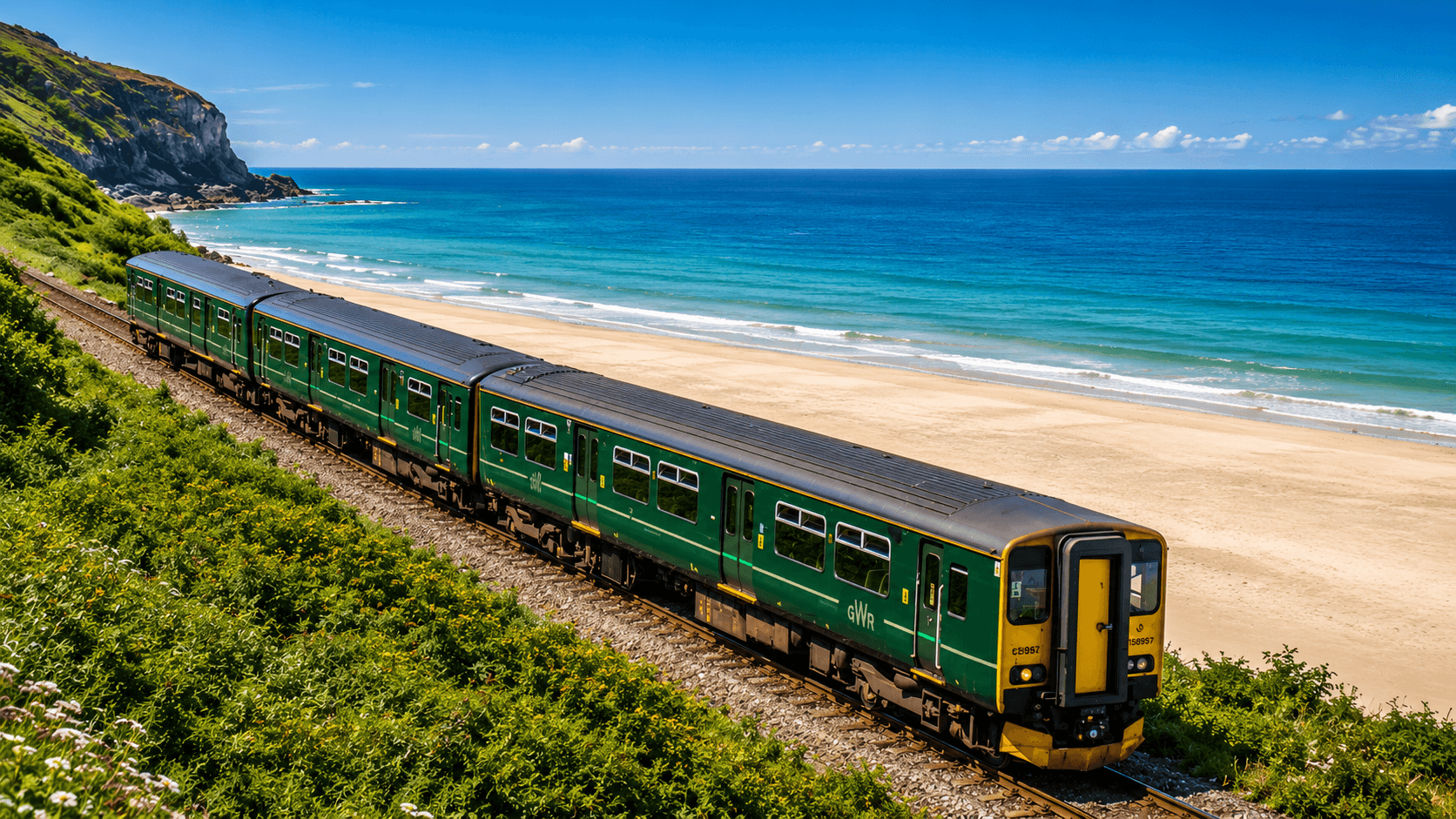
The St Ives Bay Line is one of the easiest ways to enjoy Cornwall by train, with coastal views, beach stops and a far calmer arrival than driving into St Ives.
Cornwall by Train: Best Routes, Places to Stay and Car-Free Travel Tips
Cornwall by train is practical if you build the trip around the railway, not around a wish list of every cove and village on the map.
The trains will not take you everywhere. They will not drop you beside every beach, cliff path, fishing village or country pub. What they do well is link Cornwall’s main towns and run scenic branch lines to some of the county’s most useful places: St Ives, Falmouth, Looe, Newquay and the Tamar Valley.
That is where Cornwall by train starts to make sense.
If you want to visit Cornwall without a car, the answer is not “yes, easily” or “no, don’t bother”. The honest answer is: yes, if you choose the right base and use the right routes.
For me, the best Cornwall train trip is not about ticking off the whole county. It is about using the railway for the places it serves properly, then letting those places breathe.
The train is not the best way to see every inch of Cornwall. It is one of the best ways to enjoy the places that sit naturally on the rails.
Quick answer: can you visit Cornwall by train?
Yes, you can visit Cornwall by train, and you can have a very good car-free trip if you focus on rail-friendly places.
The easiest places to visit by train in Cornwall include:
- St Ives via St Erth
- Carbis Bay on the St Ives Bay Line
- Falmouth from Truro
- Looe from Liskeard
- Newquay from Par
- Calstock on the Tamar Valley Line
- Truro on the main line
- Penzance on the main line
The weaker plan is trying to reach remote coves, rural pubs and scattered attractions by rail alone. Some of those trips need a bus, taxi, longer walk or a car for part of the stay.
How trains in Cornwall work
Cornwall’s rail network is easiest to understand in two parts.
The main line runs through Cornwall from Plymouth towards Penzance. It serves places such as Liskeard, Bodmin Parkway, St Austell, Truro, Redruth, Camborne, St Erth and Penzance. This is the backbone of train travel in Cornwall.
The branch lines are where most of the best train journeys in Cornwall happen:
- St Ives Bay Line — St Erth to St Ives
- Maritime Line — Truro to Falmouth Docks
- Looe Valley Line — Liskeard to Looe
- Atlantic Coast Line — Par to Newquay
- Tamar Valley Line — Plymouth to Gunnislake
Treat the main line as the spine and the branch lines as your day-out routes. That keeps the planning clean.
Getting to Cornwall by train
Most rail journeys into Cornwall come through Devon, cross the Tamar, then continue west through the county.
Great Western Railway runs services from London Paddington into Cornwall. Penzance is served by direct routes from places such as London Paddington, Reading, Cardiff Central, Bristol Temple Meads, Taunton, Exeter St Davids and Plymouth.
For many visitors, the train already feels like part of the holiday. The further west you go, the more the journey starts to loosen its grip on the city. By the time you are past Plymouth and into Cornwall, you are no longer in “getting there” mode in quite the same way.
The Night Riviera Sleeper runs between London Paddington and Penzance. It is the atmospheric option rather than a luxury one: a practical overnight train with cabins available as an add-on to a rail ticket. Cabins include useful basics such as sockets, USB points, a sink and storage.
For long-distance daytime journeys, book ahead when your dates are firm. Advance fares can be cheaper, but they usually tie you to a specific train. If your plans depend on weather, family timing or a relaxed final day, do not trap yourself with the wrong ticket.
Best train journeys in Cornwall
The best train journeys in Cornwall are useful as well as scenic. Some are about views. Some are about avoiding parking. Some are about reaching a proper town where you can eat, drink and wander without needing the car.
Here is how I would choose between them.
St Ives Bay Line: best for classic coastal views
The St Ives Bay Line runs from St Erth to St Ives and takes around ten minutes. It is short, but it earns its reputation quickly.
The train sweeps along the bay, passing Hayle Towans and Carbis Bay before arriving above St Ives. On the way from St Erth, sit on the right-hand side for the sea views. Coming back, sit on the left.
This is the easiest way to do St Ives without starting the day in a parking fight. St Erth is the practical access point, especially with the Park & Ride. From St Ives station, you are close to Porthminster, the harbour, beaches, shops and galleries.
Carbis Bay has its own station, so you can use the line for a beach stop as well as a St Ives day.
Use this line for:
- St Ives without the parking stress
- Carbis Bay beach days
- A short scenic train ride
- Galleries, harbour wandering and beaches
- A strong first Cornwall-by-train experience
Be careful with:
- Busy summer trains
- Beach dog restrictions once you arrive
- Carrying too much kit for a compact branch-line ride
My take: if someone wants one train ride that proves Cornwall by rail is worth bothering with, I send them here.
Maritime Line: best all-round Cornwall train day out
The Maritime Line runs from Truro to Falmouth Docks, with the full journey taking around twenty-five minutes. This is the strongest all-round branch line for a proper day out.
Truro gives you a compact Cornish city: cathedral, shops, cafés, pubs, galleries and good rail connections. Falmouth gives you harbour, beaches, maritime history, independent shops and plenty of places to eat and drink.
A clean day looks like this:
- Start in Truro
- Take the train to Falmouth
- Walk the town and harbour
- Choose beach, museum, shops or Pendennis Castle
- Eat properly
- Take the train back
Falmouth also holds up well when the weather turns. Some Cornish beach towns lose half their appeal in hard rain; Falmouth still has enough substance to make the day work.
Use Falmouth Town for the town centre. Use Falmouth Docks for Pendennis Castle and that end of town. Penryn is worth a stop if you want somewhere older, quieter and less visitor-polished between Truro and Falmouth.
Use this line for:
- Falmouth by train
- Food, pubs and harbour wandering
- Wet-weather flexibility
- Truro-based stays
- A relaxed day with enough choice
Be careful with:
- Peak-period crowds
- Less frequent Sunday patterns
- Trying to cram too much into a day that works best with space
For Pasties & Pints, this is one of the best rail days in Cornwall. You can have a proper lunch, a harbour walk and a pint without the car hanging over the afternoon.
Looe Valley Line: best for estuary and harbour
The Looe Valley Line runs from Liskeard to Looe. It is a softer journey than St Ives, less polished, and better if you like the estuary side of Cornwall.
The train drops from Liskeard towards the coast through wooded valley and river scenery. The final stretch between Sandplace and Looe is the one to look out for. At low tide, the exposed river can be good for wading birds. At high tide, the view feels fuller and more dramatic.
Looe is easy by train because the station lands you close to the town. You can walk to the harbour, beach, shops, pubs and restaurants without needing a second transport plan.
Liskeard is more than a place to change trains. It is an old Cornish market town with mining-era history and useful main-line connections. I would not dress it up as the headline of the trip, but it has value if you give it time.
Use this line for:
- Looe by train
- Estuary views
- Harbour wandering
- Birdwatching at the right tide
- A quieter alternative to St Ives
Be careful with:
- Seasonal service patterns
- Winter disruption
- Tide affecting the feel of the journey
My take: choose Looe if you want Cornwall with a bit of working-harbour texture, not a glossy postcard day.
Atlantic Coast Line: best for Newquay by train
The Atlantic Coast Line runs from Par to Newquay. The journey takes around fifty minutes and passes through the Luxulyan Valley and across Goss Moor before reaching the coast.
Newquay station is well placed for the town. Great Western Beach is close, and other beaches are within reach depending on how much walking you want. In peak season, arriving by train removes one of Newquay’s dullest rituals: circling for parking when everyone else had the same beach idea.
Newquay itself is lively. That is either the selling point or the warning label. It suits surf, beaches, groups, casual food and a bigger seaside-town mood. It is not where I would send someone looking for hush and empty lanes in August.
Luxulyan gives the line a different use. From there you can walk into the Luxulyan Valley, with its industrial heritage and the Treffry Viaduct. That is a better fit for walkers than beach-day travellers.
Use this line for:
- Newquay by train
- Beaches and surf-town energy
- Luxulyan Valley walks
- Avoiding Newquay parking pressure
- A simple Par-to-Newquay day
Be careful with:
- Smaller intermediate stops being less frequent than the main Newquay-Par pattern
- Newquay being very busy in summer
- Assuming every beach will be right by the station
The Newquay service is more useful than some older Cornwall guides make it sound. That makes this line worth taking seriously for a car-free beach trip.
Tamar Valley Line: best for river views and Calstock
The Tamar Valley Line runs from Plymouth to Gunnislake, crossing into Cornwall at Calstock.
This is not a classic Cornish beach route. Good. It gives you something else: river, viaduct, wooded slopes, pubs and slower village time.
The headline moment is Calstock Viaduct, where the train crosses high above the Tamar. Calstock itself is the stop I would build around. You have riverside views, pubs, walks and access to Cotehele on foot from the station.
Do not treat the Cotehele walk as a decorative add-on. Wear sensible shoes and leave time. This line rewards a slower day.
Use this line for:
- Calstock
- Cotehele
- River walks
- Pub days
- A quieter Cornwall-Devon border feel
Be careful with:
- Return times
- Rural walking conditions
- Expecting a beach-holiday mood
My take: do this after St Ives and Falmouth, or instead of them if you already know you prefer rivers to crowds.
Best places to visit in Cornwall by train
If you are planning Cornwall without a car, start with places where the station is genuinely useful.
The easiest places to visit by train in Cornwall include:
- St Ives — via St Erth on the St Ives Bay Line
- Carbis Bay — on the St Ives Bay Line
- Falmouth — via Truro on the Maritime Line
- Looe — via Liskeard on the Looe Valley Line
- Newquay — via Par on the Atlantic Coast Line
- Calstock — on the Tamar Valley Line from Plymouth
- Truro — on the main line and Maritime Line
- Penzance — on the main line and useful for the far west
That list is more useful than a romantic one. It gives you places where the railway genuinely helps, rather than places that technically appear in a car-free itinerary but leave you wrestling with the last few miles.
Best places to stay in Cornwall without a car
Your base matters more than your ambition. A beautiful place miles from a station may be wonderful, but it is not a good rail base.
Truro
Best all-round base.
Truro has the main line, the Maritime Line to Falmouth, and decent reach east and west. Stay here if flexibility matters more than waking up beside the sea.
Penzance
Best for west Cornwall.
Penzance suits St Erth, St Ives connections and the far west. It also works well for sleeper arrivals and gives you a proper town rather than a resort bubble.
Falmouth
Best for atmosphere.
Falmouth is the base to choose if you want the stay itself to feel like a holiday: harbour, pubs, beaches, food and rail access back to Truro.
St Ives
Best if St Ives is the trip.
St Ives is beautiful and better accessed by train than car in busy periods. It is less convenient for wider rail exploring because you connect back through St Erth.
Newquay
Best for beach-heavy trips.
Newquay is livelier and less central, but useful if your plans are built around beaches, surf and the town itself.
Liskeard
Best for east Cornwall practicality.
Liskeard is useful for the Looe Valley Line and main-line travel. Not glamorous, but practical.
If you want my cleanest recommendation: stay in Truro for flexibility, Falmouth for atmosphere, Penzance for the far west.
A simple Cornwall by train itinerary
For a first rail-based Cornwall break, I would keep it simple and base yourself in Truro.
Day one: arrive and explore Truro.
Day two: take the Maritime Line to Falmouth.
Day three: travel to St Erth, then take the St Ives Bay Line to St Ives.
Day four: choose the Looe Valley Line for Looe or the Atlantic Coast Line for Newquay.
Day five: have a slow morning, then take the main-line train home or continue west to Penzance.
That gives you city, harbour, beach, estuary or surf-town energy, and enough contrast to feel like you have actually moved through Cornwall.
If you prefer a coastal base, use Falmouth or Penzance instead and accept the trade-off. You gain atmosphere, but lose some central convenience.
Tickets for travelling around Cornwall by train
For a straightforward branch-line return, an Off-Peak Day Return will often be the simplest ticket.
For longer journeys into Cornwall, Advance tickets can save money if your train times are fixed. They are less useful when you want freedom to change plans.
For heavier travel, look at rover or ranger tickets:
- Cornwall Ranger — off-peak rail travel within Cornwall and to or from Plymouth, including the Tamar Valley branch
- Ride Cornwall — rail plus many local bus services
- Freedom of Devon & Cornwall Rover — useful for wider multi-day rail travel
- PlusBus — useful when the train journey needs a bus add-on
Railcards can make a real difference. National railcards cover many travellers, and Cornwall residents may be able to use local options. Groups travelling together may have GroupSave options on eligible GWR journeys.
Children under five usually travel free, and children aged five to fifteen usually travel at half fare.
The mistake is not paying too much by a pound or two. The mistake is buying a ticket that does not match the way you actually want the day to move.
Dogs, bikes and access on Cornish trains
Dogs are allowed on trains, usually up to two per person, free of charge and on a lead. The train may be fine with your dog; the beach, pub or attraction may not be. Cornwall has seasonal dog restrictions on some beaches, so match the rail trip to the dog plan, not the other way round.
Bikes are possible but need care. Branch-line trains have limited space, and GWR’s policy is generally a maximum of two bicycles per train, with staff discretion on the day. Some main-line services need advance bike reservations.
Assisted travel is available through the relevant train operator. For most Cornish routes that will be GWR, though some main-line journeys may involve CrossCountry. If you need help with boarding, ramps, luggage or mobility access, arrange it early. Larger mobility scooters may need extra approval.
Do not assume every Cornish station is equally easy. Some are staffed and straightforward. Others are rural, small and limited. Station access is part of the plan.
Food and drink by train
The train makes Cornwall’s food-and-drink days better because nobody has to spend the afternoon guarding the car keys.
Falmouth is the easiest win: plenty of food, pubs, harbour walks and rail access.
Truro is good for cafés, browsing and a practical start or finish.
Looe gives you harbour-town eating and pubs close to the station.
Calstock is the slow river-and-pint option.
Newquay is lively, casual and beach-led.
Pick one main food stop and let the day breathe. A good rail day has space in it.
When to travel around Cornwall by train
Summer gives you beaches, long days and busy trains.
Spring and autumn are often better for walking, pubs, galleries and less crowded towns.
Winter can work for town-based trips and hardier walks, but branch-line services, engineering work and weather need more attention.
Train timetables usually change in May and December. Public holidays, Christmas closures and planned works can also reshape a journey. Use current live times before setting out.
When the train is the wrong tool
Some Cornwall trips need a car for part of the stay.
If your plans are built around remote coves, cliff-edge villages, rural pubs at night and spontaneous lane-hopping, rail will frustrate you. If your accommodation is miles from a station with poor onward transport, you are not doing Cornwall by train. You are arriving by train, then improvising.
The better answer is often mixed: train for towns and branch lines, bus or taxi where it helps, car hire for the awkward places.
That is not failure. That is sensible Cornwall planning.
Cornwall by train FAQs
Can you visit Cornwall without a car?
Yes, if you choose rail-friendly bases and destinations. Truro, Falmouth, Penzance, St Ives, Looe and Newquay all work well by train. Remote coves and rural attractions may need buses, taxis, walking routes or a car for part of the trip.
What is the best place to stay in Cornwall without a car?
Truro is the best all-round rail base. Falmouth is better for harbour atmosphere, and Penzance is better for west Cornwall and St Ives connections.
What is the most scenic train journey in Cornwall?
The St Ives Bay Line is the classic short scenic ride. The Looe Valley Line and Tamar Valley Line are quieter alternatives with estuary and river scenery.
Can you get to St Ives by train?
Yes. Travel to St Erth, then take the St Ives Bay Line into St Ives. It is one of the easiest ways to avoid St Ives parking pressure.
Can you get to Falmouth by train?
Yes. Take the Maritime Line from Truro to Falmouth. Falmouth Town is usually the most useful stop for the town centre.
Can you get to Looe by train?
Yes. Change at Liskeard for the Looe Valley Line to Looe. The station is close enough for the harbour, beach, shops and pubs.
Can you get to Newquay by train?
Yes. Take the Atlantic Coast Line from Par to Newquay. The station is close to the town and several beaches.
Are dogs allowed on trains in Cornwall?
Yes. Dogs are generally allowed free of charge, up to two per person, on a lead. Destination rules are separate, especially on beaches.
Can you take a bike on trains in Cornwall?
Yes, but space is limited. Branch-line trains have limited bike capacity, and some main-line trains require advance bike reservations.
What ticket is best for exploring Cornwall by train?
For one return journey, an Off-Peak Day Return may be enough. For heavier same-day travel, look at Cornwall Ranger or Ride Cornwall. For multi-day rail travel, a rover ticket may suit better.