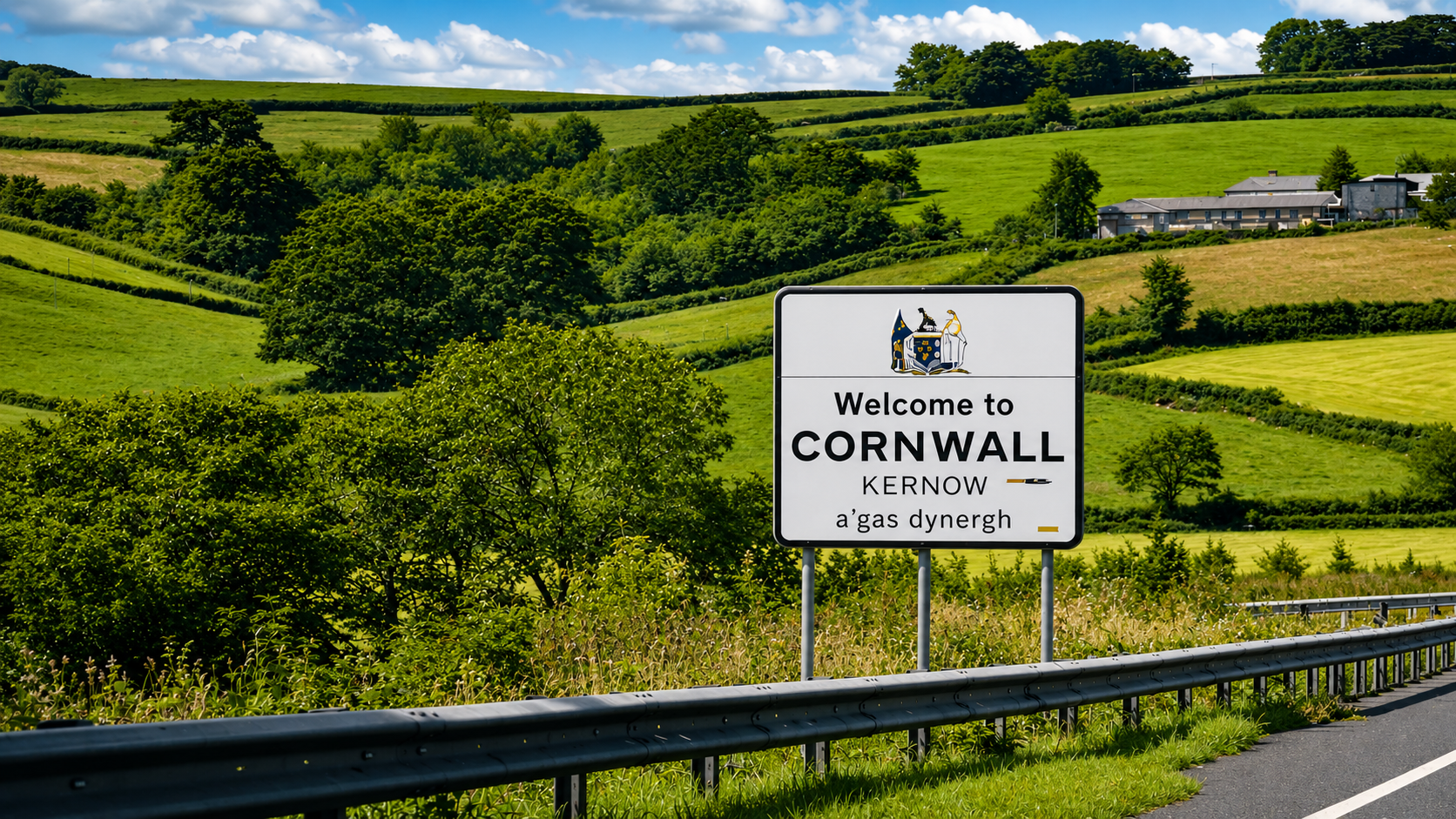
The Welcome to Cornwall sign shows Cornwall as Kernow — a reminder that visitors are entering somewhere with its own language, identity, and history.
Cornish Words, Beaches and Place Names Visitors Should Know
Fowey is said Foy, not Foul-ey.
That one correction says a lot about Cornwall.
Plenty of visitors see Cornish place names before they ever hear them spoken. Some come from Cornish. Some have older roots. Some have local pronunciations that do not follow the spelling in the way people expect.
And that matters, because Cornwall is not just a place you visit.
It is Kernow.
Kernow is the Cornish name for Cornwall. Kernewek is the Cornish language. You will see both on signs, stickers, flags, local businesses, cultural events, community spaces, and campaigns protecting Cornish identity.
You do not need to speak Cornish fluently to show respect. You do not need to get every name right the first time.
But noticing the language is a good start.
Learning a few words, listening to how local names are said, and correcting yourself without making a joke of it are small ways to treat Cornwall as a living culture rather than just a holiday backdrop.
Cornish is not a museum piece. It is still being learned, spoken, taught, revived, and used by people who care about Cornwall’s future as well as its past.
Useful Cornish words and phrases
Here are a few simple ones to start with.
Kernow
Cornwall. More than a translation, it carries place, people, identity, and belonging.
Kernewek
The Cornish language. A rough guide is ker-NEW-ek.
Dydh da
Hello, or good day. Roughly dith da.
Meur ras
Thank you. Roughly moor rass.
Mar pleg
Please. Roughly mar pleg.
Gorthugher da
Good evening. Roughly gor-thug-her da.
These are small phrases, but they help change the way you arrive. You are not just consuming a place. You are entering somewhere with its own language, history, and living identity.
Cornish words hidden in place names
Cornish is not only found in phrasebooks. It is written into the map.
Many Cornish place names describe the landscape itself: coves, farms, headlands, valleys, pools, rivers, settlements, and older ways of living with land and sea.
Once you know a few patterns, the map starts to make more sense.
Porth often points to a cove, harbour, port, or coastal landing place.
You see it in names such as Porthleven, Porthcurno, Porthmeor, Porthminster, Porthtowan, Perranporth, Mawgan Porth, Maenporth, and Porthgwarra.
Tre often means farmstead, settlement, or homestead.
You see it all over Cornwall in names such as Trewoon, Tresillian, and Trevaunance.
Pen often means head, end, top, or headland.
Pol often means pool, pond, creek, or inlet.
You see it in names such as Polzeath and Polperro.
Nans often means valley.
There is an old saying: “By Tre, Pol and Pen, you shall know the Cornishmen.”
The point is simple: Cornish identity is not only in flags and festivals. It is in the names of fields, coves, lanes, villages, valleys, harbours, beaches, and headlands.
Cornish places visitors often misread
This is where language respect becomes practical.
Some Cornish place names are not said the way they look on a road sign, map, or sat nav.
Pronunciation can vary by accent, generation, and local use, so treat these as rough guides rather than strict rules. The point is not perfection. The point is listening.
Fowey
Commonly said Foy, rhyming with “boy.”
Not Foul-ey.
Mousehole
Commonly said Mow-zul.
Not Mouse-hole.
Looe
Said Loo.
Not Loo-ee.
Launceston
Often heard locally as Lann-sun, Lan-sun, or Lawn-stun.
Not usually the full visitor guess of Lawn-sess-ton.
Roche
Said Roach.
Not Rosh, and not Ro-shay.
Liskeard
A rough guide is Lis-card or Liz-card.
Not Liss-keerd.
Doublebois
Said Double-boys.
Not Doobl-bwah.
Marazion
Often said Muh-RAY-zee-un, or shortened closer to Muh-RAY-zhun.
Not Mah-RAH-zee-on.
That last one is a useful reminder: Cornwall’s place-name heritage is not only on the coast.
Beaches and coves to say with care
Cornish names are also on the beaches, coves, cliffs, harbours, surf spots, and coast paths visitors come here for.
Some are easy once you know them. Others catch people out.
Praa Sands
Often said like Pray Sands.
Not Prah Sands.
Perranporth
Break it into parts: Perran-porth.
That final porth is a useful clue.
Mawgan Porth
Often heard close to Morgan Porth.
Again, porth is doing important work.
Porthcurno
A rough guide is Porth-cur-no or Porth-kerr-no, depending on accent.
Listen locally, especially in west Cornwall.
Porthmeor
Often said close to Porth-meer.
One of the St Ives beach names visitors often see before they hear.
Maenporth
Commonly said Main-porth.
Not May-en-porth.
Trevaunance Cove
A rough guide is Treh-vawn-ans Cove.
A good example of why it helps to slow down and break Cornish names into parts.
Kynance Cove
Usually Kye-nance Cove.
One of Cornwall’s most famous coves.
Porthleven
Usually Porth-lev-en.
Not Port-hleven.
Godrevy
A rough guide is God-rev-ee.
Useful for visitors heading towards the lighthouse and beaches near Gwithian.
These are not just pretty names for pretty places.
They are part of how Cornwall’s coast is remembered, mapped, spoken, and shared.
Why this matters
The point is not to shame anyone for getting a name wrong.
Cornwall has old names, Cornish names, Anglicised spellings, local pronunciations, family pronunciations, and names shaped by generations of use. Visitors will not get them all right immediately.
But it is worth trying.
Place names are not decoration.
They carry memory. They describe the coastline, valleys, farms, churches, rivers, harbours, headlands, coves, beaches, and settlements that shaped life here.
When a visitor learns that Porth often points to a harbour or cove, the map starts to change.
When they realise Pen can point to a headland or high place, they begin to read the landscape differently.
When they learn that Fowey is Foy, they are not just correcting a sound.
They are listening more carefully.
That is the heart of it.
Slow down.
Notice the names.
Listen before assuming.
Ask if you are unsure.
Correct yourself without making a fuss.
Treat the language as part of Cornwall, not as a novelty attached to it.
Cornish matters because identity matters. A language does not have to be spoken by everyone to be worth protecting. Even small phrases like Dydh da and meur ras can help people arrive with more care.
So start small.
Say Kernow.
Say meur ras.
Say Fowey like Foy.
Say Mousehole like Mow-zul.
And treat the names with care.
Meur ras, Kernow.
Thank you, Cornwall.