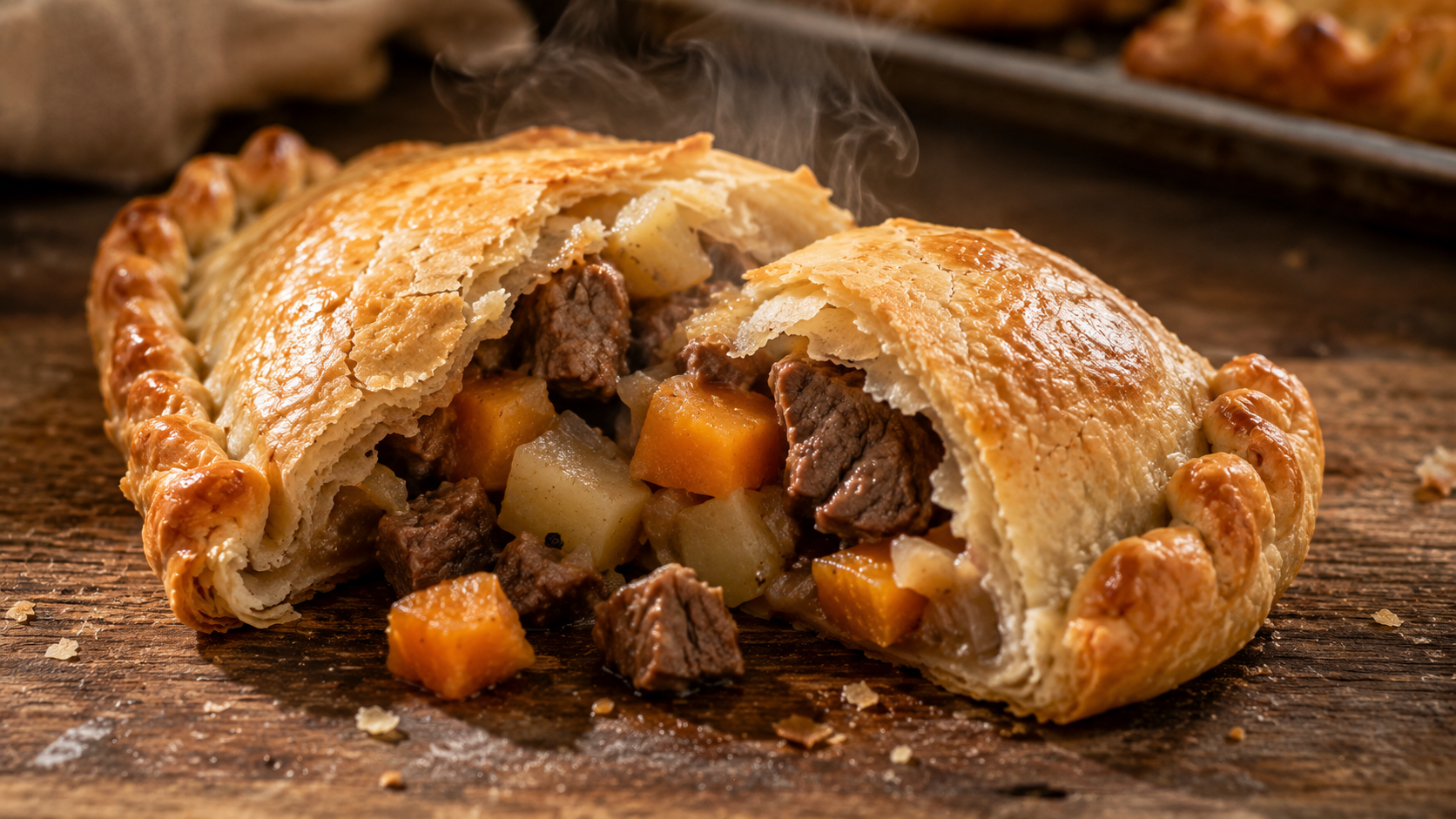
A proper Cornish pasty should have golden pastry, a side crimp, proper beef, honest veg, and a rich savoury filling.
What Makes A Proper Cornish Pasty?
A proper Cornish pasty is not just something hot to eat on a bench by the sea.
It is one of Cornwall’s clearest symbols: simple, filling, practical, and tied to working life, family habits, local bakeries, and the Cornish way of doing things properly.
You can buy pasties all over the place now. Some are decent. Some are not bad at all. But that does not mean every pasty is a proper Cornish pasty.
And yes, people in Cornwall do have opinions on this.
A Proper Cornish Pasty Starts With The Filling
A proper Cornish pasty starts with the basics: beef, potato, swede, onion, and seasoning.
Nothing fussy. Nothing trying too hard.
The traditional filling works because it is simple, honest, and built around ingredients that cook together properly inside the pastry.
The filling should not feel like mush. You want to see and taste what is inside: beef, potato, swede, onion, salt, pepper, and that proper savoury smell when you break it open.
No need for weird twists when the original works.
The Beef Matters
A proper Cornish pasty should use beef.
Not mince. Not mystery meat. Not some soft grey filling that could have come from anywhere.
You want proper pieces of beef, cut small enough to cook through inside the pasty but still big enough to give you bite.
That is part of the point. The beef should feel like beef. It should bring flavour, texture, and richness to the filling, not disappear into a mush.
Traditionally, skirt beef is often associated with Cornish pasties because it has good flavour and suits slow cooking inside the pastry.
It does not need to be fancy, but it does need to be right.
A pasty is simple food, not cheap food done badly.
The balance matters too. You do not want a pasty that is all potato with a few lonely bits of beef hiding somewhere near the crimp. The veg has its place, but the meat should be there properly, seasoned well, and cooked in with everything else so the flavour runs through the whole filling.
The Filling Should Cook Inside The Pasty
That raw filling matters.
When the beef cooks inside the pasty with the potato, swede, onion, pepper, and salt, it creates the gravy and savoury smell that makes a proper pasty feel like a proper pasty.
Cook the filling separately first and you lose some of that magic.
So when you break one open, you should see real beef, proper veg, steam, seasoning, and that smell that tells you someone has made it properly.
The Shape And Side Crimp Matter
A proper Cornish pasty has that familiar D shape, with the crimp running along the side.
The side crimp is not just decoration. It is part of the identity. You see it and you know what it is meant to be.
A top-crimped pasty might still taste good. Different bakers and families will always have their own ways of doing things.
But if we are talking about a proper traditional Cornish pasty, the side crimp is what most people look for.
The Pastry Has A Job To Do
The pastry should be strong enough to hold the filling, not fall apart in your hands after two bites.
A pasty was never meant to be dainty. It is food you can carry, eat hot or cold, and trust to fill you up properly.
Good pastry should have enough bite to hold itself together, but not be so thick and heavy that it feels like chewing through a boot.
It should hold the pasty together without taking over the whole thing.
Size Matters Too
A proper pasty should feel like a proper feed.
It does not have to be enormous for the sake of it, and bigger does not always mean better. But it should have some weight to it.
A pasty that feels light, flat, or half-empty before you even bite into it is usually not a good sign.
The best pasties feel generous without being ridiculous. Enough filling to satisfy you. Enough pastry to hold it all together. Enough balance that you do not end up with one end full of potato, the other end full of air, and two bits of beef fighting for space in the middle.
A proper pasty should feel like it was made to feed someone, not just photographed.
A Proper Cornish Pasty Should Taste Proper
A proper Cornish pasty should taste savoury, peppery, rich, and satisfying without being greasy.
The beef should bring depth. The onion should sweeten as it cooks. The swede and potato should soften without turning to paste. The seasoning should lift everything without taking over.
You should not need sauce to rescue it.
That is not saying no one can have sauce if they want it. Do what you like. But a proper pasty should stand on its own.
If the filling is bland, dry, under-seasoned, or swimming in grease, something has gone wrong.
The best ones have that smell as soon as you open the bag: hot pastry, pepper, beef, onion, and gravy all coming through together.
You take a bite and it tastes like everything has cooked as one, not like separate bits thrown together at the end.
That is the difference.
A proper pasty should not just fill you up. It should make you understand why people still care about them.
Other Pasties Can Be Good Too
That does not mean no one can enjoy different pasties.
Cheese and onion, steak and ale, chicken, vegetable, whatever people fancy — there is room for those.
But they are not the same thing as a proper traditional Cornish pasty.
The traditional one has earned its place.
Where You Buy Your Cornish Pasty Matters
The other important bit is where it is made.
The name “Cornish Pasty” is protected, and that matters. Cornish food should not just be something people copy, package up, and profit from while Cornwall itself gets nothing back.
That is why buying from a proper Cornish bakery matters.
You are not just buying lunch. You are supporting local bakers, local jobs, local suppliers, high streets, villages, families, and a tradition that belongs here.
That does not mean every pasty has to come with a history lesson. Sometimes you just want a hot pasty and a decent view.
Fair enough.
But where you spend your money still matters.
Quick Signs Of A Proper Cornish Pasty
A proper Cornish pasty should have:
A D shape.
A side crimp.
Proper pieces of beef.
Potato, swede, onion, and seasoning.
A filling cooked raw inside the pastry.
Pastry strong enough to hold together.
A decent bit of weight to it.
A savoury, peppery smell when you break it open.
A rich, satisfying taste without needing sauce to rescue it.
A connection to a proper Cornish bakery.
What Visitors Should Look For
If you are visiting Cornwall, look for a bakery that actually feels connected to Cornwall.
Look for a side crimp. Look for a simple traditional filling. Look for proper pieces of beef. Look for a pasty with a bit of weight to it. Look for pastry that holds together. Look for a pasty that smells like someone knows what they are doing.
And where possible, buy from an independent Cornish bakery rather than grabbing the easiest mass-produced option just because it is nearby.
A proper pasty does not need gimmicks. It does not need to be reinvented for Instagram. It does not need to be stuffed with half the fridge.
It needs to be made properly, filled properly, crimped properly, baked properly, and respected for what it is.
Because in Cornwall, a pasty is not just a snack.
It is part of the place.