What Living in Cornwall in Winter Is Really Like
If you want to know whether living in Cornwall really suits you, winter will tell you faster than summer ever will.
Summer can make almost anywhere here feel easy. The county is fuller, more open, more forgiving, and more obviously enjoyable. Winter is different. It strips things back. Roads clear, beaches empty, pubs calm down, and the place feels more like itself. But the limits show up much more clearly as well. Weather starts running the week, towns can feel thin, and everyday life depends far more on your own habits than on what the county is putting in front of you.
That is why living in Cornwall in winter matters so much if you already live here, or are thinking about moving here. It is not just the off-season. It is the season that shows whether Cornwall fits your real life.
Why living in Cornwall in winter can feel easier day to day
One of the best parts of winter in Cornwall is that the constant friction of summer drops away.
The roads are the obvious example. Journeys that can be a drag in peak season start feeling normal again. For plenty of people, that changes the whole shape of the working week. The commute becomes shorter, less irritating, and more predictable. You are not burning time sitting behind holiday traffic, and across a week that can add up to hours back.
Parking improves in the same way. Places that are awkward, expensive, or simply not worth the bother in summer become much easier to use. Some car parks move onto winter rates, and some become free, depending on where you are. Either way, the general point holds: everyday movement gets easier.
The same goes for pubs and cafés. You can walk into places that would need planning in summer, get a table without turning it into an operation, and get served faster. That sounds minor, but it changes the feel of ordinary life. You stop planning around pressure and start using places more naturally.
In that sense, winter can be one of the best times to live here. The county is less clogged up and more usable.
Where living in Cornwall in winter becomes more limited
The trade-off is that Cornwall becomes much more limited once the season drops away.
Shops shorten hours. Some cafés and smaller businesses close for stretches. Even places that stay active wind down earlier, especially midweek. By late afternoon, some towns already feel as though the day is finishing.
That is the part people often underplay. Winter is not just quieter. It is narrower. You cannot assume the same level of choice, spontaneity, or fallback that you get in summer.
That matters most when the weather is poor, because Cornwall does not have deep indoor backup. There are indoor options, of course, but not enough to make the county feel richly indoor in winter. A few cinemas, gyms, swimming pools, soft play if you have children of the right age, bits of local community life, but not a huge bench of places that can carry every wet weekend for you.
If you are used to a place where bad weather simply pushes life inside, that can be one of the bigger adjustments.
Weather does not just affect the day. It leaves a backlog
This is one of the most Cornish parts of winter life and one of the things newcomers often miss.
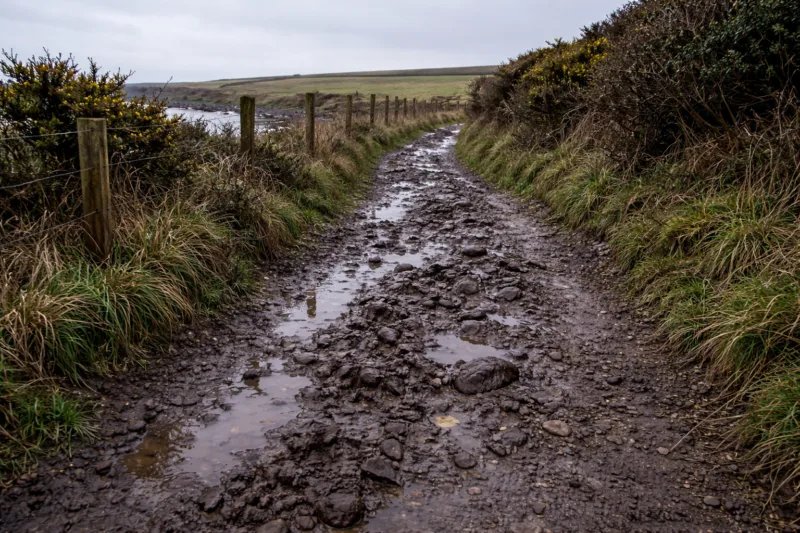
A good-weather day does not always restore your options in the way you expect. You can get a bright, dry Saturday after two weeks of rain and think that settles it: coast path walk, fresh air, problem solved, only to find the path has turned into a mud track. What looked like the perfect plan becomes slippery, messy, and more effort than it sounded.
That is because winter weather here has a backlog. Even when the rain stops, the effects remain. Paths stay boggy. Fields stay waterlogged. Verges get churned up. The day may be lovely, but the conditions still carry the memory of the last fortnight.
That is worth understanding because it changes how you live. In winter, you do not just think about today’s forecast. You think about what the weather has been doing lately and what that means in practice.
The rewards are real when the conditions line up
For all that, winter can give you some of the best moments Cornwall has.
A wide empty beach for a stroll is a completely different experience from summer. You can go somewhere beautiful and almost have the place to yourself. The coast feels bigger, rougher, and less stage-managed. Large crashing waves, strong wind, a beach with room around it: that version of Cornwall is not softer, but for plenty of people it is more memorable.
And because there is less pressure around everything, the ordinary pleasures land better. A pub lunch feels easier. A coffee stop feels calmer. A quick trip somewhere coastal feels worth doing because half the hassle has gone.
Winter can also make different activities feel like the right use of the day. On a sunny summer afternoon, there is often a sense that you ought to be at the beach. In autumn or winter, a woodland walk feels exactly right. A bike ride on an overcast day can be far more enjoyable than grinding through one in August heat, stopping constantly for water. Even house jobs fit the season better. Painting a bedroom in winter feels sensible. Doing that on one of the best days of July can feel like wasting it.
That seasonal rotation is one of the better parts of living here. Life does not stop. It shifts.
Activities are the real dividing line in living in Cornwall in winter
Whether winter in Cornwall works for you depends heavily on what you actually do with your time.
This is still, in practical terms, a county built much more around outdoor life than indoor life. If the weather is decent, there is plenty: walking, running, dog walks, coastal paths, surfing, sea swimming for those who are serious about it, cycling, gardening, fishing, and all the ordinary outdoorsy routines that make Cornwall feel like Cornwall.
If the weather turns bad for a run of weekends, the picture changes quickly.
Even active hobbies are not always stable. Football is a good example. It sounds like a good winter anchor until heavy rain starts cancelling games week after week. The routine you expected to rely on disappears, and there is not always much to replace it.
Not every activity suffers equally. Surfing is the obvious exception. Rain matters far less than conditions, and outside summer the waves can be better anyway. The same goes, in different ways, for people who genuinely build their week around running, swimming, gym sessions, pool lengths, cycling when conditions allow, or simply getting out regardless.
The important distinction is between hobbies you have in theory and habits you actually keep. Winter Cornwall works much better if you already know how you spend your time when the easy options disappear.
Winter often pulls you into a different kind of life
One of the positives people miss is that winter can make you do different things, and that is often good for you.
Gardening changes. You are not endlessly cutting the grass. You start rotating plants, tidying, planning ahead, doing the slower jobs that make more sense in the off-season. House jobs come back into view. The garden, the spare room, the things you ignore in summer all become worth doing again.
Local life can become more visible too. Clubs, community events, village panto, car boot sales, swimming sessions, the gym, small social routines that barely register in summer can take on more weight once the season changes. In some places, that is when you stop living around Cornwall and start living in it.
For some people, that is one of the strongest arguments for staying year-round. Winter strips out the surface activity and leaves you with a more grounded version of daily life.
Towns can feel flat in winter, and that matters
This is the less romantic side of it, but it is real.
A lot of Cornish town centres are not especially strong anyway, and winter exposes that. On a dark wet afternoon, some places can feel tired, half-empty, and a bit bleak. Fewer lit shopfronts, less footfall, earlier closing, less energy: you feel the gaps more sharply once the season goes out of the place.
That is important because some people rely more on town life than they realise. If your sense of a good week depends on lively high streets, plenty of indoor options, and the feeling that there is always somewhere to go to break the day up, winter here can feel lacking very quickly.
Not every town feels like that to the same degree, but enough do that it needs saying plainly.
What kind of Cornish settlement works best in winter
This is one of the most practical questions for anyone thinking of living here, and winter is when the answer becomes obvious.
The places that work best year-round are usually settlements with enough ordinary life to keep functioning when the season drops away. That does not necessarily mean the biggest or busiest places, but it does mean somewhere with a proper core: a decent food shop, basic services, at least a few reliable places to eat or get coffee, some movement in the streets, and enough year-round population that the place still feels alive in February.
For most newcomers, a functional small town or a larger village with a real year-round centre is usually a safer choice than a very seasonal beauty-spot location. That sort of settlement gives you resilience. If the weather is poor or plans fall through, you have somewhere to walk to, somewhere to sit, something open, and some sense of life still happening around you.
The places to be more careful with are the ones that look lovely in summer but are thin underneath. Scenic harbour villages, very seasonal coastal spots, or beautiful but sparse rural locations can work brilliantly if that is exactly what you want and you are set up for it. But in winter they can also feel isolating very quickly. If you have to drive for basic errands, rely on one or two places being open, or have very little around you once the weather turns, the beauty can start to feel expensive.
For most people, especially if they are new to Cornwall, the best settlement is not the prettiest one. It is the one that still functions properly in January.
Who should think twice before moving
Cornwall is not a bad place to live in winter, but it does ask more of certain kinds of people than others.
I would think twice if you rely heavily on indoor culture, strong town-centre life, or lots of variety appearing around you without much effort. I would also think twice if you are the kind of person who struggles when plans are disrupted, because winter here has a habit of knocking plans sideways. Weather changes things. Grounds flood. Paths turn to mud. Smaller places close early. The fallback is not always strong.
The same applies if your idea of a good place to live depends on convenience being built in. Cornwall in winter can be easy in some ways, especially on the roads, but it is not a high-convenience place overall. You often need to be a little more proactive, a little more adaptable, and a little less dependent on the place entertaining you.
I would also be cautious if you are choosing somewhere mainly for its summer beauty without testing how it feels in the off-season. That is where people can misread Cornwall badly.
What winter reveals about long-term living in Cornwall
Winter is useful because it reveals the underlying deal.
It shows you whether you genuinely enjoy quieter beaches and calmer pubs, or only liked Cornwall when it was sunny and full of life. It shows you whether reduced traffic feels like freedom or whether reduced options feel like loss. It shows you whether you can build a satisfying week from routines, hobbies, work, home, and a smaller set of local choices.
It also reveals whether you like the place itself or just the idea of it.
That is probably the most important point. Plenty of people love Cornwall as a setting. Winter tells you whether you can actually live with it as a system: weather-led, scattered, beautiful, sometimes frustrating, and much less eager to accommodate you once the season ends.
If I were deciding whether Cornwall suited me long-term, that is the test I would take seriously. If you still like it in January, you have learned something real.
Practical tests a newcomer should use before deciding the place suits them
If I were seriously considering a move, I would not judge living in Cornwall in winter from a good week in late spring. I would test it in winter, and I would test it in ordinary ways.
Stay somewhere for a stretch in late autumn or winter and live normally. Do not treat it like a break. Do the food shop. Drive the sort of route you would actually commute. Try getting through a wet weekend without turning it into a sightseeing exercise. See what is open on a Tuesday afternoon, not just a sunny Saturday.
Check how the nearest town feels when the weather is bad. Check whether the place you are considering still functions when it is dark by late afternoon. Check whether you can imagine an average February week there, not just a clear December day on the coast.
Pay attention to what you naturally do with your time. Do you still feel settled when the outdoor options shrink? Do you have enough habits to carry you through? Would you join things locally, use the gym or pool, get involved in clubs, make use of community life, or would you feel trapped and restless?
And be honest about driving. A location can feel charming until every basic task involves the car in bad weather.
Those are the practical tests that matter. Winter is less flattering, but it is far more useful.
My view on living here through winter
Winter is when Cornwall feels most like itself, and whether that is a positive depends on how you live.
You gain space, easier parking, shorter commutes, calmer beaches, less pressure, and a more usable version of the county in a lot of everyday ways. You also gain a more natural rhythm to the year, where different activities take over and life feels less forced into one obvious best version.
But you also see the limits clearly. Towns can feel bleak. Weather narrows your options fast. Indoor backup is thin. Some hobbies become unreliable. The place expects more self-direction than many people realise.
If you are someone who is comfortable outdoors, adaptable in bad weather, and capable of building your own routine, winter in Cornwall can be one of the best arguments for living here.
If you need constant variety, strong indoor fallback, and a place that keeps generating activity for you, it is the season most likely to expose the mismatch.
That is why winter matters. It is not the worst of Cornwall. It is the truth of it.
FAQ
Is winter the best time to judge whether Cornwall suits you?
Yes. Winter shows how the county works when the easy seasonal advantages drop away. It is the clearest test of whether Cornwall fits your real life rather than just the appealing version of it.
What kind of place is best to live in through a Cornish winter?
Usually somewhere with a proper year-round core: basic shops, a few reliable places to eat or get coffee, some services, and enough local life that it still functions well in January.
Should I avoid very scenic villages if I am moving to Cornwall?
Not automatically, but they need more caution than people think. Some feel lovely in summer and much harder work in winter if they become too quiet or too dependent on driving.
What makes winter in Cornwall easier?
Reliable hobbies, outdoor habits, flexibility, and some willingness to join local life. It also helps to live somewhere that still works practically when the weather is poor.
What usually catches newcomers out?
How much weather affects ordinary life, how limited the indoor fallback can be, and how different places feel once the seasonal activity disappears.
Are there real advantages to winter in Cornwall?
Yes. Roads are easier, parking is simpler, beaches are emptier, and pubs and cafés are often much more usable without queues, bookings, or crowds.
What should I test before deciding to move?
Test a normal winter week, not a pretty short break. Shop locally, drive the routes you would actually use, see what is open in bad weather, and work out whether you still feel settled when the obvious outdoor options shrink.